No. 21050
Schloss Seggau
Austria
CastleRestoredFor rent12th century
No. 45350
Castle · Austria
No. 45350 · 46.757 N, 15.408 E
For events
Schloss Ottersbach is marked as a château or castle venue lead. Capacity, indoor/outdoor spaces, catering rules, and accommodation options are published only after public verification.
Event types: Private events, Cultural gatherings, Filming and photography
Quick summary
Schloss Ottersbach is a castle in Austria with origins associated with the 16th century.
See all castles in AustriaSchloss Ottersbach in Mantrach, Großklein, Austria is an early seventeenth-century noble residence built by the local landowner Hans Murn under the authority of the Habsburg archduchy. Erected in 1616, the house belongs to the early modern period and became a named lordly seat when Archduke Ferdinand allowed Murn to elevate his newly constructed dwelling, give it the name Ottersbach, and assume the corresponding noble predicate. That act tied the site into the region’s system of landed lordships and confirmed its role as a centre of local administration and social rank.
Murn had earlier acquired the neighbouring fortress of Mantrach in 1593, then already in decline, and he recorded building a riverside dwelling on the Sulm below Gleinstätten, raising the holding to a specified lord’s due. He adopted a pictorial coat of arms that combined a vertical stripe with a wavy bar and an otter holding a fish. Management of the estate passed into the hands of his kinsman Elias Hemeter, whose irregular rent deliveries left the property heavily indebted by 1620.
Ownership changed repeatedly during the seventeenth century. Murn’s son Hans Jakob appears as owner in 1629, and Hans Wilhelm, his brother, in 1633. In 1650 Hans Wilhelm was murdered by his ward Christof Andree von Gleinz. The estate was sold in 1653 to Hans Georg Adam Adl von Adlstein and on 20 September 1675 transferred to Sigmund Ludwig, Count Khünburg. After his death his widow administered Ottersbach for their son Johann Max, who in 1692 sold the lordship to Niklas, Count Lodron. Following Lodron’s death the property passed through his widow and then his son after extended inheritance disputes. Large arrears led to a pledge in 1700, and in 1708 Josef Count Lodron sold Ottersbach to Johann Anton von Liscutin.
Financial pressure continued after Liscutin’s death and in 1732 Franz Josef von Hingenau bought the estate. He reported severe storm damage to the forests in December 1739 and petitioned for tax relief. In 1742 the property passed to his son Franz Xaver Gottlieb; the lordship then included the village of Großklein and Gottlieb secured imperial permission to add a second annual cattle market for that village. The portion called Alt-Ottersbach was later inherited by Gottlieb’s son and sold to Moritz Edler von Pistor. After the death of Pistor’s son the estate went to public auction and on 3 September 1836 Kaspar Wilhelm Count Khünburg became the buyer. In 1870 ownership passed to his sister Caroline, Countess Cerrini. Later proprietors included the Koch, Hohenburger and Germuth families, Baron von Wucherer between 1884 and 1893, and from 1893 the families Teutsch, von Plappart and von Leenherr.
Since 1925 the Abel family has owned Schloss Ottersbach. They carried out a general renovation in 1926. In 1945 foreign troops plundered and damaged parts of the estate. Repair work made some rooms usable again by 1960. A substantial expansion and conversion began in 1977, the south wing was renovated in 1988, and in 2005 a castle museum opened while festival and banquet rooms were brought into use. The site’s historic ensemble and mill complex have also served repeatedly as settings for film and television productions.
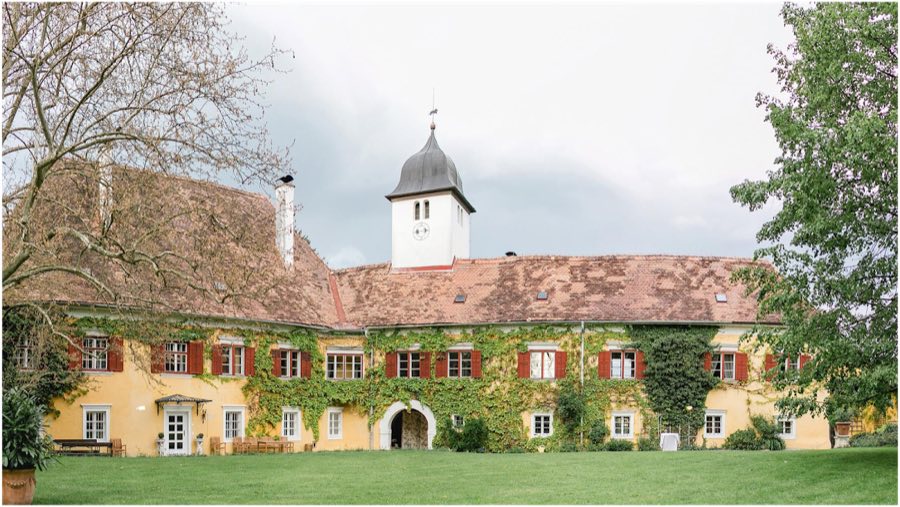
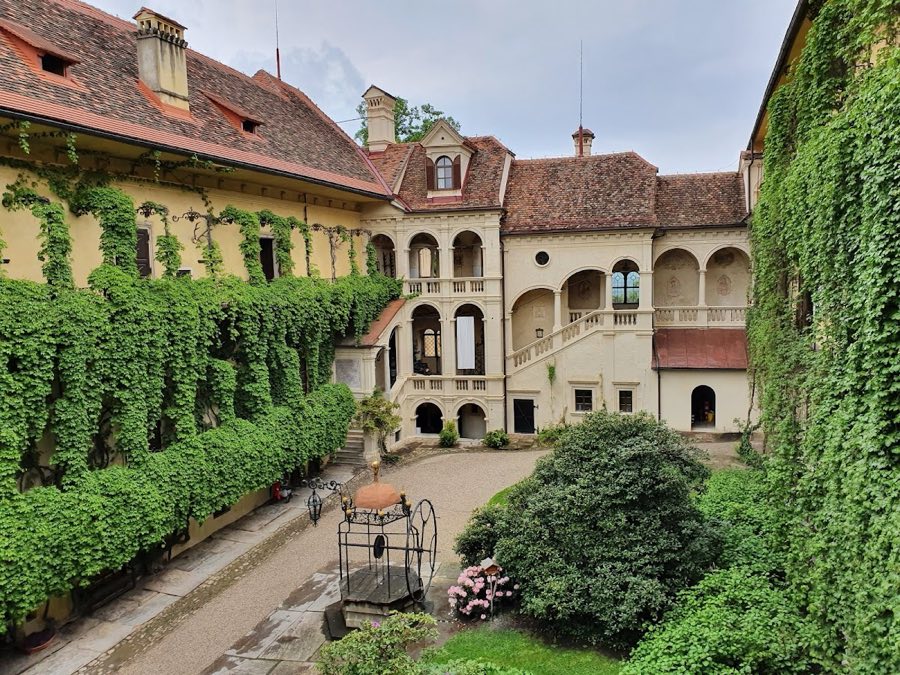
The complex stands as an ensemble made up of the main residential building, a southward service wing, a courthouse to the left, a pleasure house to the right and a historic mill in the foreground, all set beside the Sulm river. The mill and the castle together form a fully preserved group of buildings that read as a single estate. The river has been dammed at this location and from the site the water surface mirrors the distant Koralm ridge.
The main entrance originally lay to the north and passed beneath the chapel where the main wing meets a side wing, leading directly into the inner courtyard. That courtyard is bounded on its southern side by broad economic buildings. Today the arrival sequence approaches from the south, using the former service entrance into a forecourt and continuing through the south wing to reach the principal house.
Construction occurred in phases tied to the seventeenth century. The first structural element, raised by Hans von Murn in 1616, is the present north range with its pronounced hipped roof. Later in that century an east range was added to the southeast; it carries a small roof-mounted turret that served for belling or ventilation and incorporates the gate building together with the seventeenth-century chapel. The south wing was built at the same time as the service block and follows an L-shaped plan for economic use.
Passageways flanking the approach contain matching vaulted halls, each arranged with two aisles and three bays; these rooms once housed horses and carriages and now form part of the festival and banquet area. The museum occupies the entire first floor of the main building. The surrounding park was opened to the public in 2005 (a status later revoked) and contains a rose garden featuring an arbor about sixty metres long and a two-metre high metal rose.
No. 21050
No. 20605
No. 47150
No. 72194
Comments
Comments for Schloss Ottersbach will require a verified account before posting.
We'll send a verification link before your first comment is published.