No. 47150
Frauenthal Castle
Austria
PalaceIntact16th century
No. 72194
Castle · Austria
No. 72194 · 46.784 N, 15.225 E
For events
Schloss Hollenegg is marked as a château or castle venue lead. Capacity, indoor/outdoor spaces, catering rules, and accommodation options are published only after public verification.
Event types: Weddings, Private events, Cultural gatherings, Filming and photography
Ceremony spaces: Ceremony setting to verify
Quick summary
Schloss Hollenegg is a castle in Austria with origins associated with the 13th century.
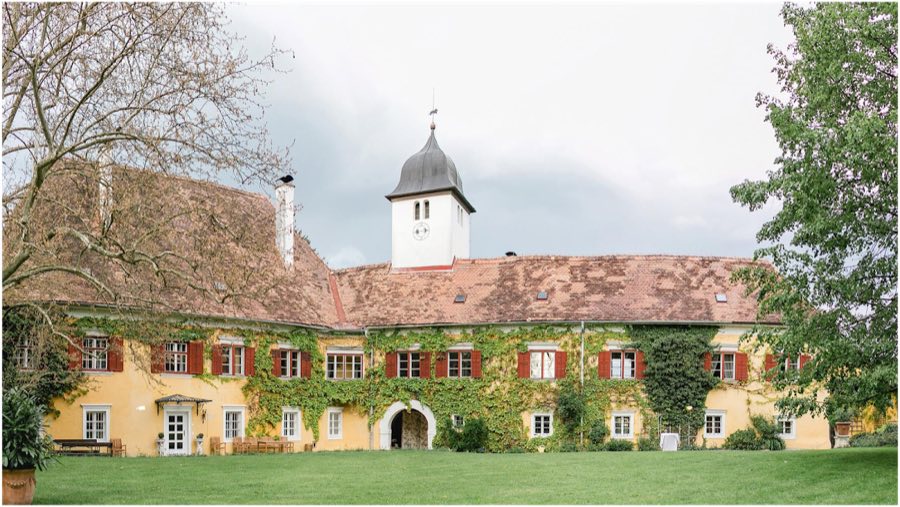
See all castles in AustriaSchloss Hollenegg in Hollenegg, Austria, is a medieval castle complex begun by the ministeriales who served the Archbishop of Salzburg, its fabric taking shape around the turn of the 13th century and receiving a major Renaissance reworking in the mid-1500s. The site controlled a strategic mountain road between Styria and Carinthia, housed a castle chapel dedicated to Saints Giles and Bartholomew, and served as the ancestral seat of the Hollenegg family, making it an important local stronghold and parish center from the High Middle Ages onward.
The place-name Hollenegg appears in a monastery document of 1163, and a parish church is recorded around 1165, indicating an early ecclesiastical presence. A fortified manor preceded the standing complex and protected the route across the Koralpe. Over the later Middle Ages the castle remained tied to the regional administration of the Archbishop of Salzburg through the Hollenegg family, and by 1445 the settlement is recorded as a parish.
In the 16th century the castle played both military and political roles. Abel von Hollenegg led the Styrian troops at the First Siege of Vienna in 1529, the Ottoman attempt to seize the Habsburg capital. Around 1550 Abel initiated a large conversion of the residence into Renaissance form modeled on prominent regional civic architecture; his son Friedrich, who served as councillor to Archduke Karl II, continued this transformation. In 1591 Friedrich traveled to Prague to seek imperial measures against Protestantism from Emperor Rudolf II; that effort did not succeed. The male line of the Hollenegg family ended in 1593 amid heavy debts.
The estate passed through several owners in the 17th century. It moved to Count Saurau in 1653, was sold three years later to the von Puechbaumb family, and in 1686 came into the hands of Maximilian, Count Khuenburg of Deutschlandsberg, who renewed interiors and enlarged the church. Park and garden elements date back in part to the late 1500s, while further landscape work and a kitchen garden were laid out between 1820 and 1850.
Since 1821 the Liechtenstein family has held the property; Prince Johann I bought the lordship Deutschlandsberg–Hollenegg for his son Franz de Paula, an ancestor of the present head of state Hans-Adam II. Major alterations followed: the outer defensive walls were levelled in 1825 and garden ornamentation close to the castle dates from the decades afterward. A new church building was erected in 1778; the church received a new organ in 1891 while the earlier instrument was transferred to St. Wolfgang. On 26 April 1865 two copper beech trees were planted before the castle to mark the wedding of Prince Alfred of Liechtenstein and Princess Henriette of Liechtenstein. The park later gained legal protection under the national Monument Protection Act, and the former horse stable north of the castle became an event and information centre under monument protection. In 2015 Alice Stori Liechtenstein established the non-profit cultural association “Schloss Hollenegg for Design,” which supports an annual designer residency and a yearly exhibition held in the castle’s historic representative rooms.
The castle complex is arranged around inner courtyards and grew up from an early medieval stronghold into a multi-period residence. The initial construction phase around 1200 produced the oldest surviving element, a rectangular tower at the northeast corner that still stands in its original role as a dominant structural feature. Two round towers at the northwest and southeast corners date to the period of Friedrich von Hollenegg and functioned as cannon towers, reflecting the adaptation of the site to gunpowder-era defense. Beside the northwest tower a Renaissance portal bears a dated coat of arms from 1573 commemorating Friedrich; the carved inscription remains visible.
A stone staircase dated 1577 provides access to the banqueting hall on the upper level, and that hall occupies the north wing where mid-18th-century decorative painting creates the impression of an open colonnaded space. The hall’s ceiling features a later painting from 1885 that depicts figures from Greek mythology. Much of the interior furniture and movable fittings come from the 18th century, including a coffered ceiling in the Blue Room and two intarsia doorways brought in from Limberg, together with elements transferred from Riegersburg. Representative reception rooms retain Rococo stucco ceilings, French wall coverings, and historic ovens from the 16th and 17th centuries; guest accommodations on the second floor were fitted in a Neo‑Gothic manner.
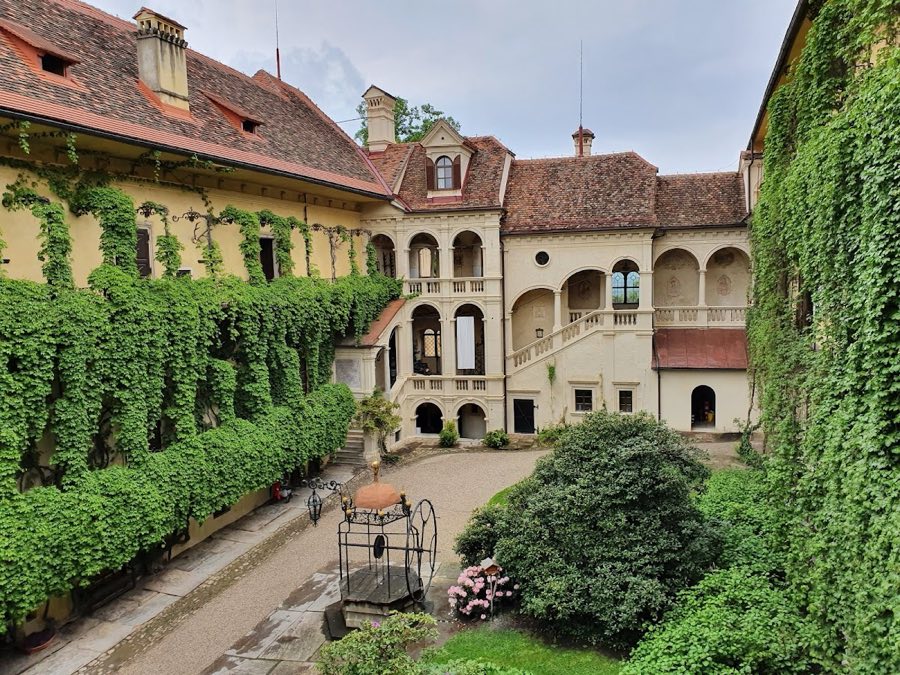
A 19th-century residential wing created two enclosed courtyards within the complex. The outer court contains the church consecrated in 1778 and is framed by a quadrangle that features a battlemented walkway with two-storey arcades. The inner court is ringed by living quarters and includes a fountain arbor dating to the 17th century. The former line of the castle’s outer defensive works, removed in 1825, can be traced in the stepped layout of the adjacent garden terraces. The terraced park directly beside the castle includes 19th-century garden ornaments, orchards and a service garden established between 1820 and 1850, and notable veteran trees, including the copper beeches planted in 1865. The park is listed under the national monument protection schedule as entry number 37 and is partly accessible to the public. North of the main buildings the former horse stable survives as a separate protected structure and serves as the castle’s and parish’s event and information centre.
No. 47150
No. 65137
No. 70688
No. 45350
Comments
Comments for Schloss Hollenegg will require a verified account before posting.
We'll send a verification link before your first comment is published.