No. 39829
Ardahan Castle
Turkey
CastleRuin12th century

No. 32323
Castle · Turkey
No. 32323 · 41.154 N, 43.131 E
Quick summary
Şeytan Castle, Yıldırımtepe is a castle in Yıldırımtepe, Turkey with origins associated with the 14th century.
See all castles in TurkeyŞeytan Castle, Yıldırımtepe, Turkey, is a hilltop fortress whose occupation begins in the Hellenistic period and continues through the Ottoman age. The strongpoint stood in a borderland long contested by regional powers, and its walls were rebuilt and altered by successive occupants, which kept the site in military and administrative use across many centuries. The castle figured in medieval Georgian polity and later entered Ottoman control during the conflicts of the late 1500s.
From its earliest visible phase the place served as a defended position on a rocky promontory. Some later writings propose the fortress dates back to the Urartian era, but that claim does not rest on documentary evidence. A number of later chronicles and records describe a castle here in the early medieval period, consistent with a defensible site that saw repeated repair and adaptation over time.
During the medieval era the fortress belonged for a long time to the Georgian kingdom and to the principality of Samtshe. Chronicles mention the site in narratives related to Alp Arslan in 1064. A report by Ekvtime Takaishvili refers to the presence of a prison within the castle complex. Inside the lower enclosure a single‑nave church dedicated to Saint Stephen was erected in the 14th century, indicating an enduring ecclesiastical presence alongside the military functions.
In the 16th century the castle passed into Ottoman hands in the opening phase of the Ottoman–Safavid War that lasted from 1578 to 1590. Contemporary and later narratives disagree about the exact sequence of sieges during the campaign. Late Georgian chronicles written in the 1700s describe the Ottoman advance opening with sieges of Mgeltsikhe and Kadjistsikhe, giving a date of 5 August 1578 for the fall of Kadjistsikhe and stating that its defenders were annihilated. Ottoman chronicles offer different details: one account mentions an initial siege of an unnamed fortress, perhaps Enikale, while another records the capture on 9 August 1578 of Vale and Enikale. These differing accounts result in multiple dates and named places for the beginning of the campaign.
Under Ottoman administration the site remained in use. A fiscal register of 1595 lists the castle under the form “Kacisiha,” showing that local fortress names had already been rendered into Turkish by that time; the name later appears translated as Şeytan Kala, literally “Devil’s Castle.” A market quarter termed Rabat developed nearby and later became an ordinary settlement, reflecting the castle’s role in local economic as well as military life.
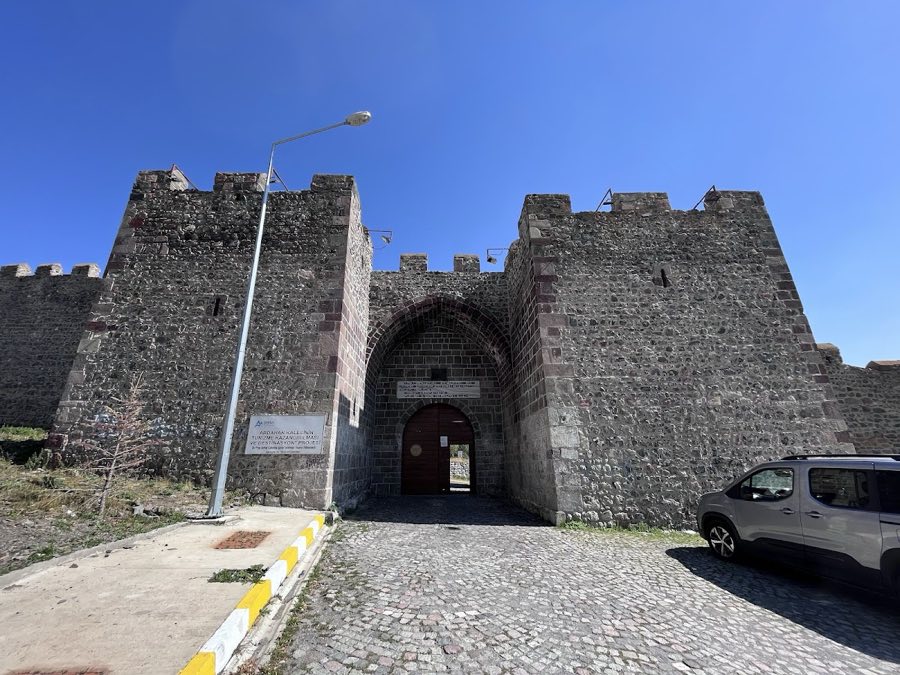
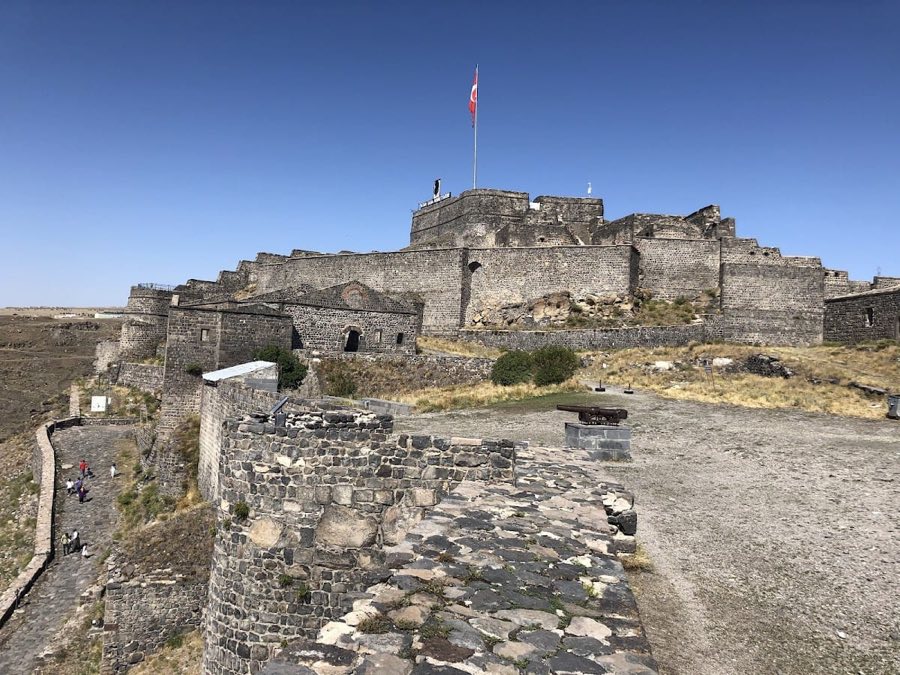
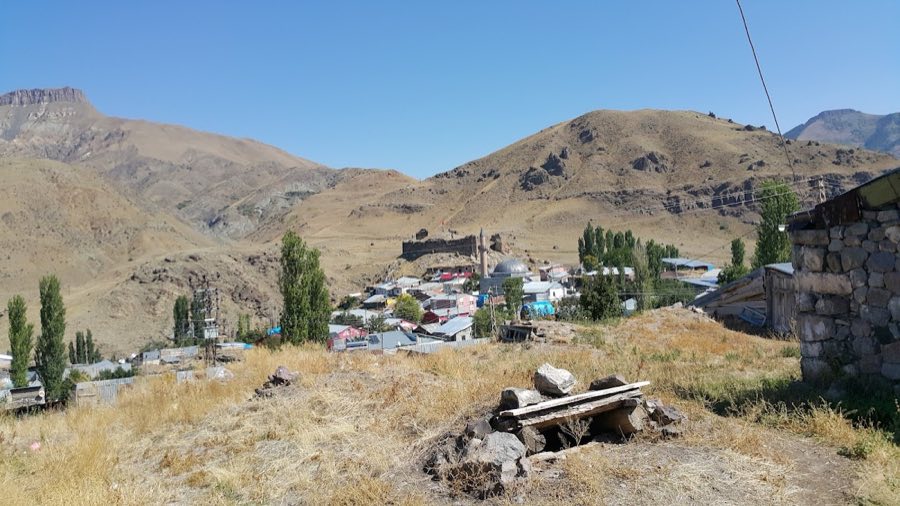
The fortress occupies a rocky hill on the right bank of a small stream near the village of Yıldırımtepe, at about 1,910 metres above sea level. Three sides of the hill drop away in steep cliffs so the site was defended by natural rock as well as by masonry enclosures, and access is possible only from the single gentler approach. The enceinte follows an irregular, asymmetrical plan measuring roughly 161 by 93 metres, adapting to the shape of the spur.
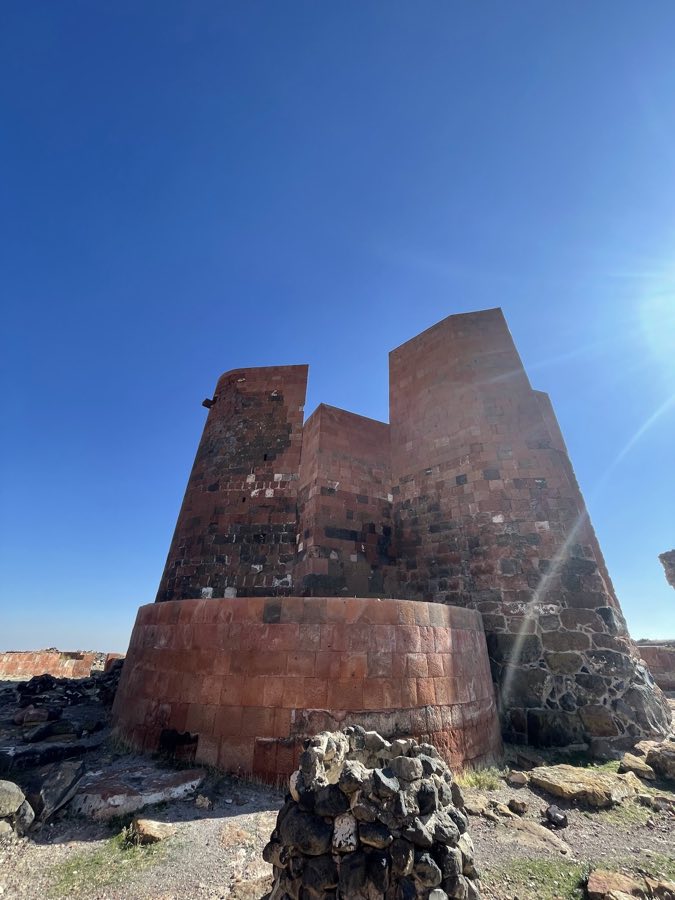
Three towers articulate the circuit, and one tower remains substantially intact so that its massing and height are still visible. Within the lower part of the complex stand the ruins of a single‑nave church built in the 14th century and dedicated to Saint Stephen; only four walls of that building survive. Water management features include cisterns and a stairway that descends to the stream, the stair steps surviving in place and the cisterns visible as enclosed rock-cut or built vats used for collecting and storing water.
A small chapel or chapel remains lie among the inner structures, attesting to the site’s religious use alongside its defensive role. Repairs and alterations by successive owners are visible in the varied fabric of walls and openings, reflecting repeated rebuilding over a long occupational span. The site is generally described as largely well preserved in its present condition. Vehicular access reaches a nearby viewing hill by paved road, and from that point a footpath leads to the fortress itself.
No. 39829
No. 66480
No. 39485
No. 34786
Comments
Comments for Şeytan Castle, Yıldırımtepe will require a verified account before posting.
We'll send a verification link before your first comment is published.