No. 66480
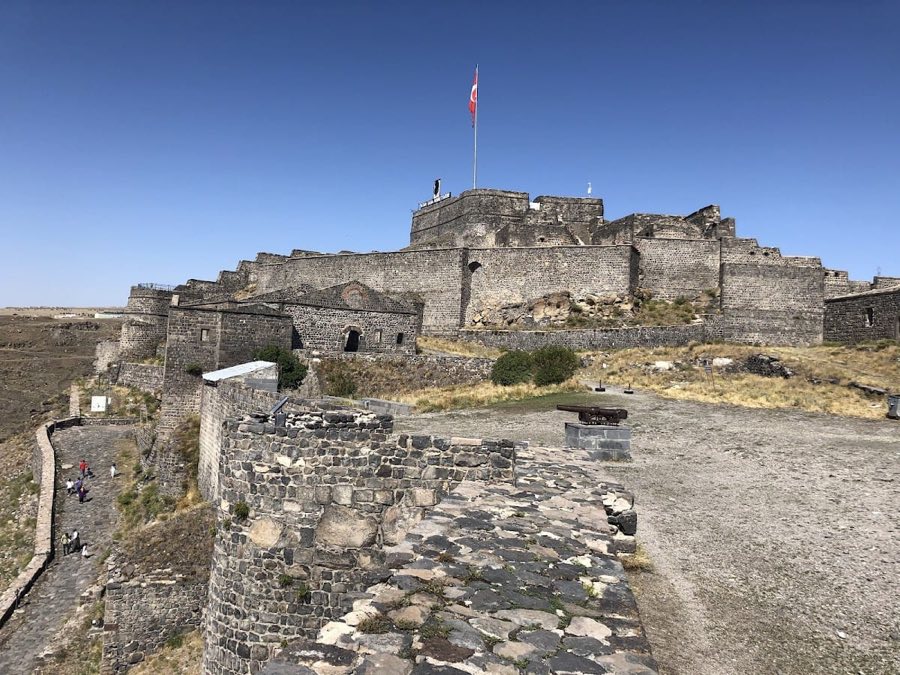
Castle of Kars
Turkey
CastleIntact12th century
No. 34786
No. 34786 · 40.338 N, 43.857 E
Quick summary
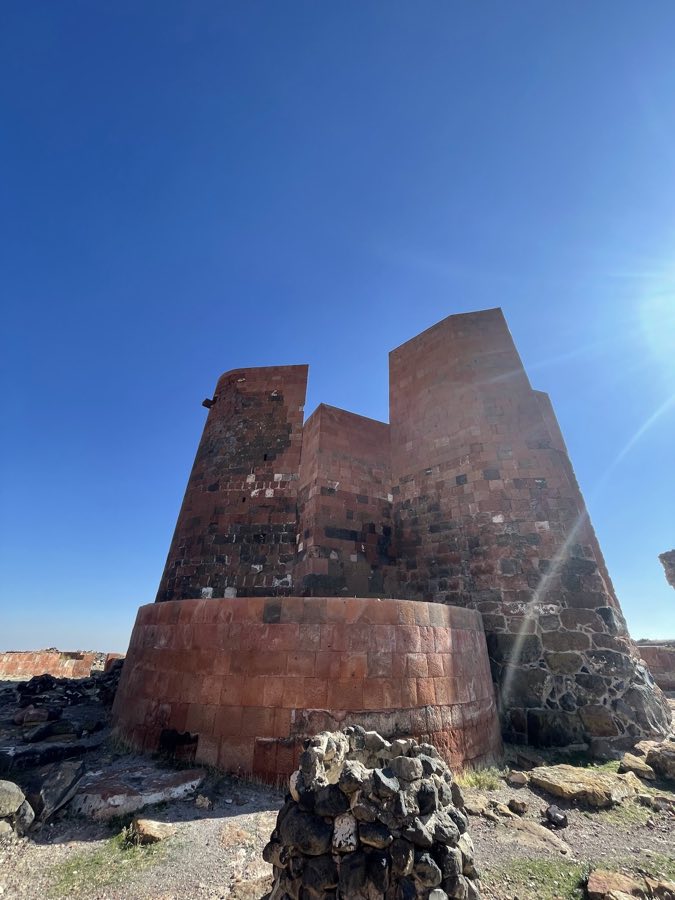
Dashtadem Fortress is a castle in Armenia with origins associated with the 10th century.
See all castles in ArmeniaDashtadem Fortress is located in Dashtadem municipality, Armenia, and originated as an Armenian fortification. The name Qagheni has also been used for the site.
The earliest documented phase of the complex includes Armenian fortifications dating to the 10th century. The central defensive core and surrounding works developed and were reused over many centuries. One chronology extends the site’s origins back to the 5th century and continues its occupation into the 19th century. Later masonry elements, and additions to the keep, were introduced as the stronghold evolved through the medieval period.
Work on the keep includes four semi-circular towers that were added probably in the 12th century to the earlier tenth-century defenses. An Arabic dedicatory inscription carved in Kufic script on the east wall of the keep is dated to 1174 and attributes construction activity to Sultan ibn Mahmud, Shahanshah of the Shaddadid dynasty. The chapel that stands beside the keep has been dated variously to the 5th century and to the 10th century, and it formed part of the internal arrangement of the fortress throughout medieval times. The fortress overlooks Kristapori Vank, which lies roughly 1.7 to 2 kilometres to the south.
At the beginning of the 19th century a new outer enceinte was built around the older works, forming an eight-sided defensive ring that enclosed the interior fortifications. The site saw partial renovation in the late 20th century and further restoration in recent years; during those works families of local shepherds who had lived inside the compound were displaced. The chapel has been completely rebuilt in the recent restoration campaign. The castle was recorded and described by investigators in the 19th century, and archaeological excavations were carried out in 1989–1990 under Yesai Asatryan, conducted intermittently during restoration in the 2000s, and undertaken systematically since 2015 by the Institute of Archaeology and Ethnography of Armenia.
The fortress stands as a multi-layered complex in which a later, 19th-century outer ring encloses older medieval fortifications. The outer defences form an eight-sided walled enclosure built at the start of the 1800s, made up of a continuous line of eight bastions joined by curtain walls and surrounding the inner works. Seven of these projecting bastions are polygonal in plan while the northern emplacement is a semi-circular, half-moon work. The entrance is aligned so that assailants must turn sharply to enter from the east of the northern bastion, and low-relief panels with lion figures remain above the arched gateway on the enclosure’s exterior.
Within the outer ring a low, roughly ten-sided inner wall encircles the keep and the adjacent chapel, separating the original stronghold from the later curtain. The inner circuit preserves traces of an earlier defensive layout that included ten semi-circular bastions in its plan, of which five survive standing today. The curtain walls between the semi-circular and polygonal bastions are set back at a slight angle so that the round northern bastion is flanked and covered by projecting works.
The keep is composed of four semi-circular towers that appear as later additions, most likely from the twelfth century, attached to older tenth-century Armenian walls. Substantial subterranean features lie beneath these towers: large cisterns and a network of tunnels that run up to the top of the keep. An Arabic inscription in Kufic script dated 1174 is carved on the keep’s east wall and records attribution to Sultan ibn Mahmud of the Shaddadid line.
The chapel that adjoins the keep has been associated with the fortress through its use and position; it has been dated both to early medieval centuries and to an earlier period, and it has been entirely rebuilt during recent restoration work. The wider compound shows evidence of phased repair and reuse up to the nineteenth century and into modern conservation efforts. Parts of the enceinte and of the inner fortifications survive substantially, while other elements stand in a restored condition following late twentieth- and early twenty-first-century interventions.
No. 66480
No. 94695

No. 32323
No. 39485
Comments
Comments for Dashtadem Fortress will require a verified account before posting.
We'll send a verification link before your first comment is published.