No. 26234
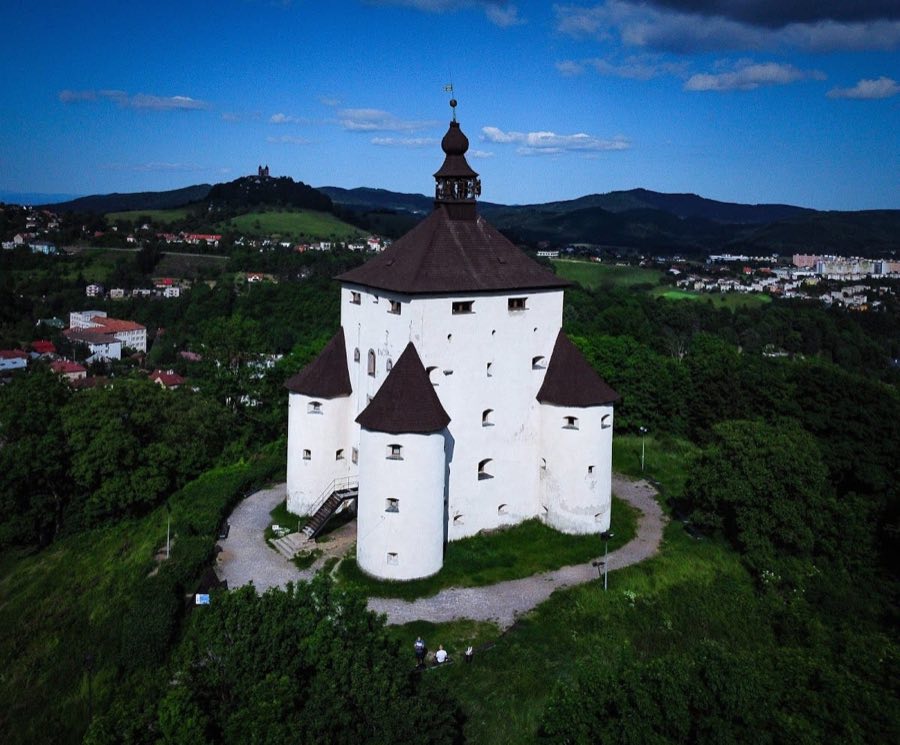
Nový zámok
Slovakia
CastleRestored16th century
No. 27060
Manor house · Slovakia
No. 27060 · 48.422 N, 18.942 E
Quick summary
Svätý Anton Manor is a manor house in Slovakia with origins associated with the 18th century.
See all castles in SlovakiaThe Manor in Svätý Anton, Svätý Anton, Slovakia, is a country house whose origins reach back to the medieval period under the Kingdom of Hungary, and whose present appearance reflects a major rebuilding carried out in the mid‑18th century in a late Baroque–Classicist manner. The site mattered as a local administrative and noble estate for centuries, passing through several prominent owners and evolving from a fortified toll station into a landscaped manor and family seat.
The settlement is first recorded in 1266. In 1405 the village passed into the hands of the sons of Ladilaslav Kakas from King Sigismund of Luxembourg. A small fortress was raised in 1415 to guard a local toll; by the latter part of the 15th century control of the strongpoint had passed to the lords of nearby Čabraď Castle. In the 16th century the estate belonged to Cardinal Tamás Bakócz and later to Peter Pálffy; the fortress was substantially rebuilt at that time to strengthen its defenses against Ottoman incursions.
In 1622 the lands of Čabraď and Svätý Anton became the property of the Koháry family. During the 1600s the medieval fortress was replaced by a two‑winged manor house. Between 1744 and 1750 Count Andrew Koháry enlarged and reconfigured that building into a four‑winged mansion around a large square inner courtyard, with the Baroque interior decoration completed by 1752. A chapel dedicated to Saint John of Nepomuk was erected on the estate between 1755 and 1758 and contains the Koháry family crypt.
Ferenc József Koháry was the last family member of that name to live at Svätý Anton; he was created a prince in 1815. His daughter Maria Antonia inherited the properties and on 30 November 1815 married Prince Ferdinand of Saxe‑Coburg and Gotha, establishing the Saxe‑Coburg and Gotha–Koháry line. Members of that family remained principal owners into the 20th century. Prince Ferdinand I of Bulgaria, a descendant, took up residence at Svätý Anton after his abdication following the First World War; he departed Slovakia in 1944 with the retreating German Army and later died in Coburg in 1948.
After the Second World War the Communist government confiscated the Koháry estates. In the 1950s the manor became the seat of a Forestry, Wood and Hunting Museum, with collections of natural history, history and art; later a hunting museum and a falconry exhibition were established after 1962. The manor and its grounds were placed under state protection and, since 1985, have been listed as a national cultural monument. The park chapel of Saint Hubert was consecrated in 1999 by Archbishop Jan Sokol.
The building occupies a rectangular plan formed by four wings that enclose a square inner courtyard. The present four‑storey manor reflects its mid‑18th century reconstruction, but its plan preserves earlier phases: the core began as an L‑shaped, two‑winged house, and two further wings were added shortly afterward, reusing parts of the former fortress within the new fabric. A vaulted arched passage in the north wing gives access into the inner courtyard and provides a view through to the representative staircase beyond.
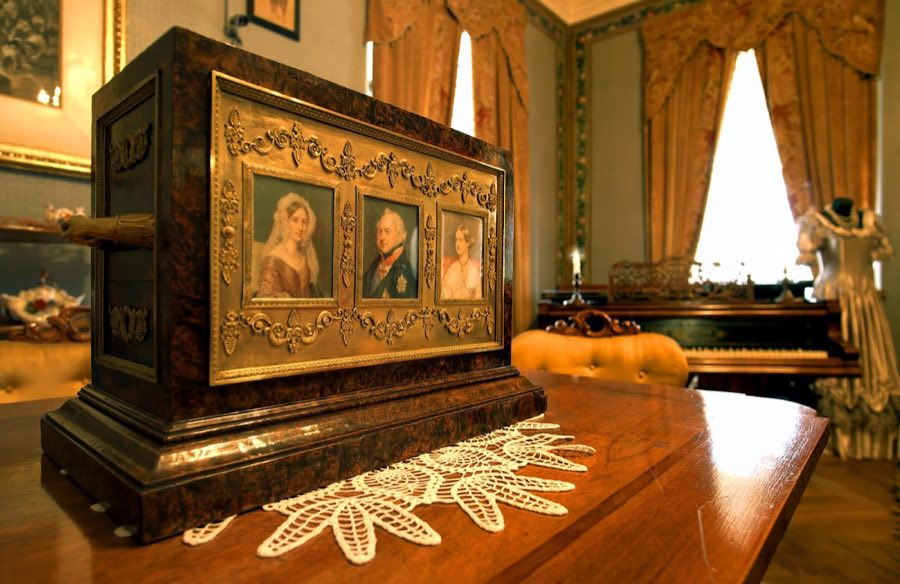
The principal staircase in the north wing is richly articulated, with painted decorations and sculptural work that show Italian and Austrian stylistic influences, and it leads up to the state rooms and connecting corridors on the first floor. Most main rooms, halls and corridors keep their original fittings and decoration in Baroque, Rococo and Empire styles; notable interior spaces include the staircase hall, a reception hall, the Chinese Hall and the Golden Salon.
The south wing houses a chapel dedicated to the Assumption of the Virgin Mary. Its interior is decorated with late‑Baroque illusionist frescoes, and the exterior façade carries a painted scene that links the church theme with an image of the donor; descriptions also note the chapel exterior as being marked by a small tower and a triangular tympanum. Inside the chapel stands a portable positive organ with five registers, probably dating to the second half of the 17th century and brought from Čabraď.
The estate is set within a designed park that blends a formal Baroque center with an English‑style natural section and then merges into surrounding forest. The central garden covers about five hectares and the adjacent managed woodland about twenty‑five hectares; close to the main house there remain traces of Baroque terraces. Water for the grounds is still supplied by the Kolpassky brook through a kilometre‑long channel complete with small aqueducts, and the park contains an artificial grotto locally known as “hell.” A giant sequoia was planted in 1878 to commemorate the birth of Prince Philipp’s son Leopold; after the original tree was lost to lightning a successor was planted at the park entrance in 1996. A small tower known as Sitna is reported to stand above the main entrance. Many of these elements survive in situ and preserve the layered history of the site from fortress to noble manor.
No. 26234
No. 53516

No. 62593
No. 37972
Comments
Comments for Svätý Anton Manor will require a verified account before posting.
We'll send a verification link before your first comment is published.