No. 75459
Trzebiatów Palace
Poland
PalaceRestoredFor sale12th century

No. 28307
No. 28307 · 53.773 N, 15.769 E
For events
Świdwin Castle is marked as a château or castle venue lead. Capacity, indoor/outdoor spaces, catering rules, and accommodation options are published only after public verification.
Event types: Private events, Cultural gatherings, Filming and photography
Quick summary
Świdwin Castle is a castle in Poland with origins associated with the 12th century.
See all castles in PolandŚwidwin Castle in the town of Świdwin, Poland, was founded by the Ascanian margraves of Brandenburg.
The margraves acquired the Świdwin area from the Bishopric of Cammin in 1258, and a first stronghold was established at the end of the thirteenth century. Ownership passed in 1319 to the Wedel family, who carried out extensions to the site. In 1384 the Wedels sold the property to the Teutonic Order, which converted the estate into the seat of a bailiff and began major rebuilding at the close of the fourteenth century. The order removed the older residential range, erected a new east wing, built a large brick building along the northern curtain wall for the bailiff, and created a new gate with an accompanying tower.
In 1445 Elector Frederick II of Brandenburg, known as “the Iron” and a member of the Hohenzollern family, bought the castle back into Brandenburg hands. By 1540, after a territorial exchange between the local administrative district and the commandery at Quartschen, the property passed to the Order of Saint John (the Johanniters). Veit von Thümen is recorded as patron for works carried out under the Johanniters. Commanders of the commandery named in later records include Melchior von Barfuß (active around 1540), Franz von Neumann (commander in 1545), Detlof von Winterfeld senior (1571), members of the Winterfeld family, Bogislaf von Schwerin, and Heino Henrich von Fleming, who is mentioned from 1688 and still after 1720.
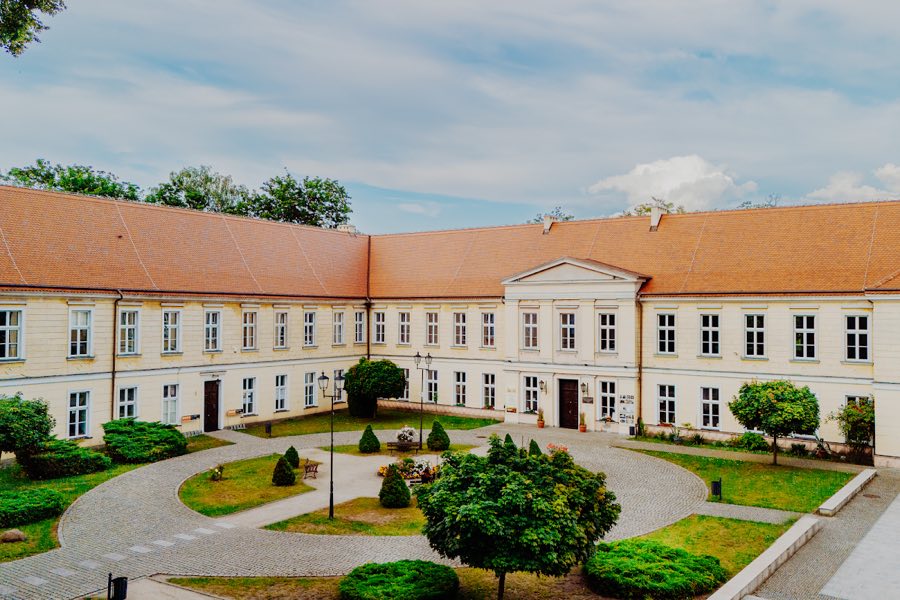
During the eighteenth century the Johanniters rebuilt and baroquized the complex, adding two wings that finally enclosed the courtyard. One of the final commanders was Count Leopold Alexander von Wartensleben (1710–1775), who died in office; coats of arms representing Wartensleben, Finckenstein and Kalckstein were placed above the entrance by order of King Frederick William III. The Johanniter commandery was dissolved in 1808 and, following reorganisation of the Bailiwick of Brandenburg, the castle became Prussian state property and served as government offices. Later nineteenth- and twentieth-century uses recorded include a castle mill and, by 1939, an agricultural farm of about 8.5 hectares, followed at a later date by a girls’ boarding school. After 1945 the building was plundered and put to use as an agricultural school; it suffered a destructive fire in 1952 and was rebuilt between 1962 and 1968. The site is registered as a monument under number A-1191, with entries dated 29 June 1953 and 28 August 2013, and today the rebuilt complex serves as a regional cultural centre that hosts an annual Jan Śpiewak poetry competition.
The castle preserves a medieval plan built around an irregular, trapezoid-shaped fortified circuit. That original layout included a long residential range positioned against the northern section of the curtain wall, establishing the basic relationship between living quarters and defensive enclosure.
At the turn of the fourteenth and fifteenth centuries the Teutonic Order replaced the earlier residential building and added an east wing. The order also constructed a substantial brick structure along the northern curtain to house the bailiff, indicating heavy brickwork in the site’s northern sector. A gate with a gate tower dates to the same period; this entrance was later remodelled in the early sixteenth century, when a foregate was added in front of the main doorway.
Sixteenth- to eighteenth-century work under the Johanniters changed the castle’s silhouette. In the eighteenth century two additional wings were built so that the ranges closed the perimeter and produced a fully enclosed inner courtyard. Above the entrance frieze three coats of arms are displayed, those of Wartensleben, Finckenstein and Kalckstein, set there by royal command; individual armorials, including one for Leopold Alexander von Wartensleben, are recorded in the entrance decoration.
The fabric of the building records more recent events: it was plundered around 1945, damaged by fire in 1952, and reconstructed between 1962 and 1968. The rebuilt complex survives in use as a cultural centre and is listed in the regional monuments register under number A-1191.
No. 75459
No. 48105
No. 34479
No. 95419
Comments
Comments for Świdwin Castle will require a verified account before posting.
We'll send a verification link before your first comment is published.