No. 71475
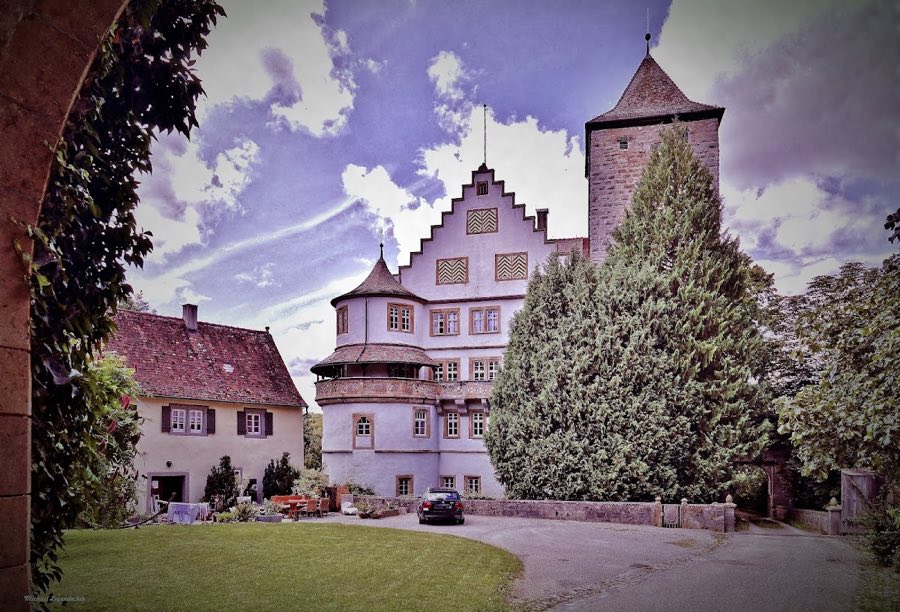
Schloss Rechenberg
Germany
CastleIntact13th century
No. 44794
Castle · Germany
No. 44794 · 49.031 N, 9.924 E
For events
Tannenburg is marked as a château or castle venue lead. Capacity, indoor/outdoor spaces, catering rules, and accommodation options are published only after public verification.
Event types: Weddings, Private events, Cultural gatherings, Filming and photography
Ceremony spaces: Ceremony setting to verify
Quick summary
Tannenburg is a castle in Germany with origins associated with the 12th century.
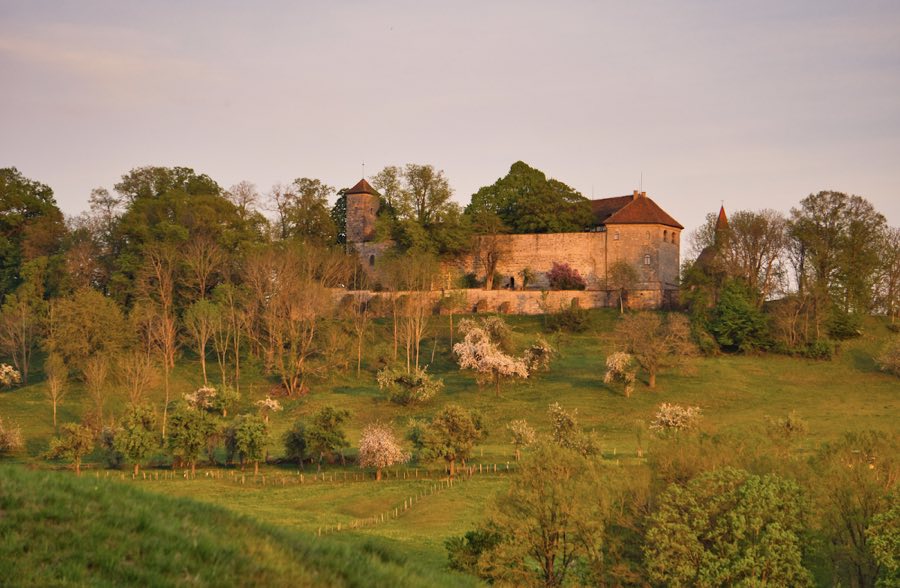
See all castles in GermanyTannenburg stands above the municipality of Bühlertann in modern Germany and was built by the Abbey of Ellwangen during the medieval period.
Construction of the castle probably took place in the 11th or 12th century as a border stronghold of the Abbey of Ellwangen. The site appears in a record of 1223 tied to the family von Tannenburg. A substantial campaign of extension followed between about 1230 and 1240, shaping the castle’s main medieval footprint.
At the end of the 14th century the site suffered destruction. Rebuilding took place in 1398, restoring the defensive complex. Further work to enlarge or alter the castle occurred in the 16th century and again with changes recorded in 1822.
A chapel near the forecourt has foundations dating to the 13th century. The chapel is first identified by name in 1632 and its bell carries the date 1649. The chapel supported its own chaplain until 1803. Ownership and administrative oversight moved from the Princely Provostry of Ellwangen to the parish board of Bühlertann after 1891, and the chapel continues to be used occasionally for services such as weddings.
In 1931 Ernst Zipperer senior acquired the property, and the estate has remained in the Zipperer family since that purchase. In recent decades the castle site has been adapted for educational and agricultural purposes, serving as a school country home, a school farm and an organic farm. Associated farmland extends across the spur plateau and into large steep-slope parcels used mainly for pasture. A lime tree that grows in the castle courtyard has been legally protected as a natural monument.
Tannenburg presents a late Staufer-period hilltop plan arranged along a narrowing rocky spur, with three successive defensive ditches cut across the approach, a large inner courtyard and a principal residential block containing a great hall. The castle occupies the western ridge of the Tannenberg at roughly 485.7 metres above sea level and stands about 110 metres above the Bühler valley; the Bühler river runs about one kilometre to the west. The spur narrows toward the west and falls below one hundred metres in width at a point roughly three hundred metres before the main shield wall.
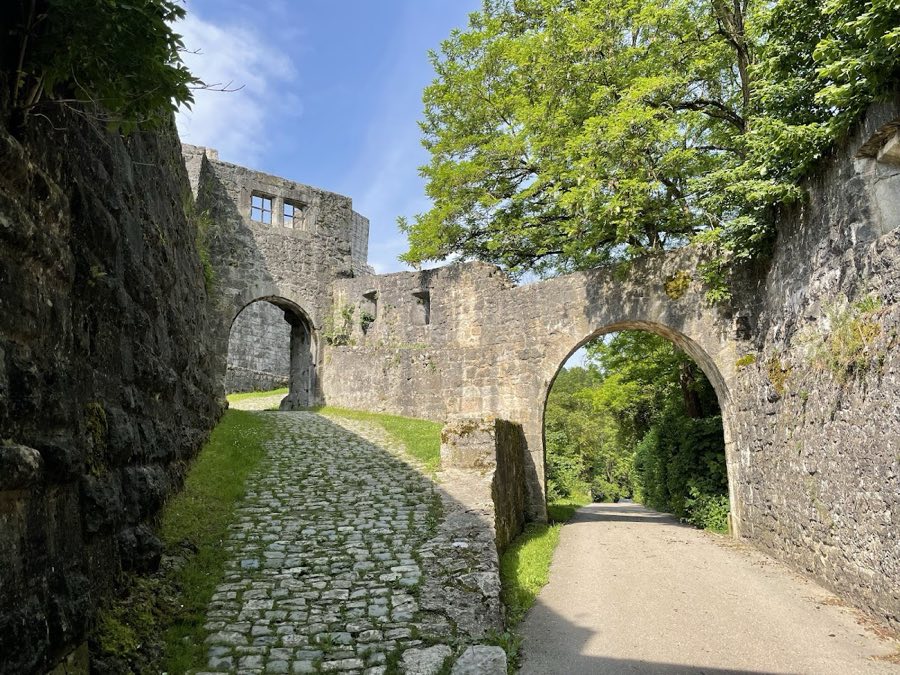
A massive, walkable shield wall defends the most exposed side of the site. Built to a thickness of about four metres, this barrier protected the approach and was paired with a gate building that controlled access on the attack side. The three neck ditches form a sequence of obstacles across the neck of the spur and remain visible as integral parts of the defensive layout.
The principal residential block, often called the palas, sits within the courtyard and includes the site’s great hall on a trapezoidal ground plan. Exterior wall faces display bossed ashlar masonry, where squared blocks carry raised rounded centres, indicating high-status medieval stonework. On the southern side the palas rises above its stone lower walls with projecting timber-frame storeys, a later technique that was built above the earlier masonry.
The small castle chapel dedicated to St. Mary Magdalene stands near the southwest corner of the outer yard that served as a cattle enclosure. The chapel measures about fifteen by ten metres and rests on 13th-century foundations. The building combines Gothic and Renaissance elements, and its mid-17th-century bell is marked with the date 1649. The chapel survived later administrative changes and continued in ecclesiastical use for long periods, remaining available for occasional services today.
Survival and later use are part of the site’s character. The curtain of defensive masonry, the palas with its surviving fabric, and the three neck ditches remain visible and substantial, making the castle one of the better-preserved examples of a shield-wall stronghold in the Württemberg region. The castle courtyard contains a summer lime tree that has been formally protected as a natural monument, and the surrounding lands continue to be used in connection with the property’s current functions as a school and organic farm.
No. 71475
No. 69258
No. 74654
No. 93638
Comments
Comments for Tannenburg will require a verified account before posting.
We'll send a verification link before your first comment is published.