No. 44794
Tannenburg
Germany
CastleRestoredFor events12th century
No. 71475
Castle · Germany
No. 71475 · 49.047 N, 10.142 E
Quick summary
Schloss Rechenberg is a castle in Germany with origins associated with the 13th century.
See all castles in GermanySchloss Rechenberg in Stimpfach, Germany, was erected during the Staufer era by medieval German builders and is first recorded in the early 13th century.
The castle was probably completed in 1227 and appears in documents from 1229. From 1229 until 1405 the local Rechenberg family acted as stewards and vassals under the Counts of Oettingen. Ownership then passed through a sequence of transfers: after a sale to the Burgraves of Nuremberg the estate reached the Wollmershausen family in 1409. In 1429 Ellwangen granted the Wollmershausens the lordship of Rechenberg as a feudal holding.
During the 15th century the Adelmann family held the site. Ellwangen repurchased the property in 1526 and granted part of the lordship as a fief to the Steinhäuser family of Neidenfels. In 1538 the emperor granted the right of high jurisdiction for the estate, and Heinrich Steinhäuser von Neidenfels began transforming the medieval stronghold into a residential castle in that year. Work continued into the later 16th century; the surviving south building dates from 1571. An alliance coat of arms belonging to Heinrich Steinhäuser and Dorothea von Wollmershausen dates to the 16th century and is visible on the castle, while the couple’s monumental epitaph stands in the choir of the Johanneskirche in Crailsheim.
The Steinhäuser line ended in 1608. Their allodial holdings passed to the Berlichingen zu Neunstetten heirs, while the feudal portion reverted to Ellwangen. Political control of the site shifted several times in the modern era: it came under Ansbach authority, passed to Prussia in 1796, to Bavaria in 1806, and to Württemberg in 1810. In the 20th century the complex took on a new role when a youth hostel opened there in 1953. The national youth hostelling association purchased the property in 1966, operated it until the summer of 2018, and then sold the castle to a private owner. A short distance from the castle stands the parish church known as the Schlosskirche, used by the Berlichingen family as a burial place; that church contains numerous Berlichingen grave slabs and displays of their coat of arms and now serves as the Protestant village church of Rechenberg.
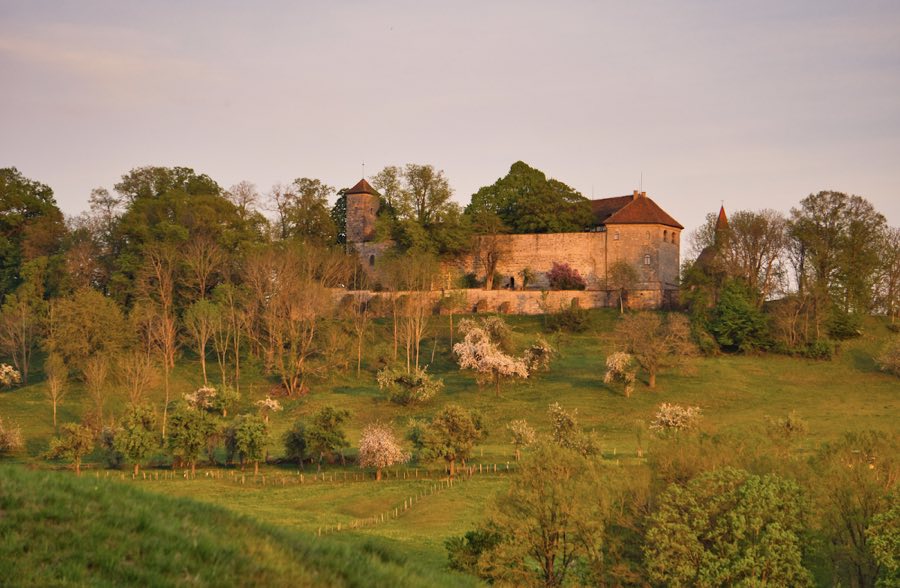
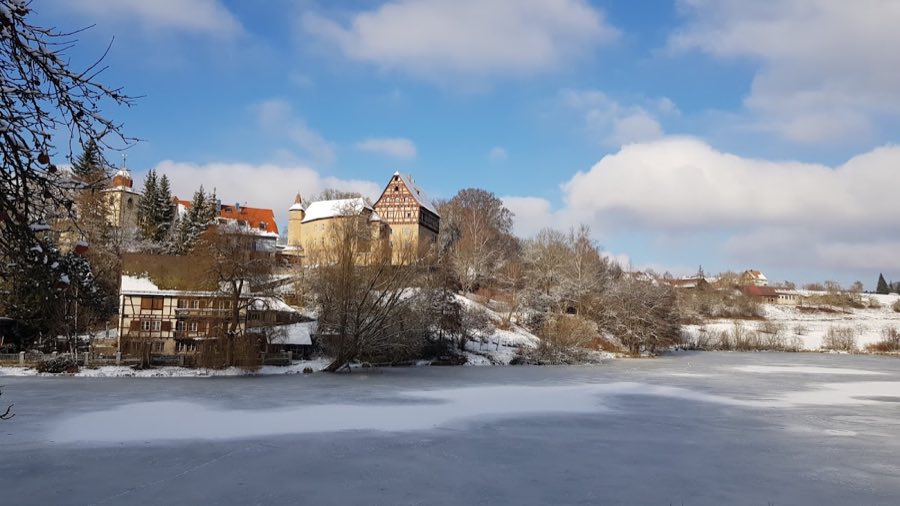
The site preserves the plan and fabric of a water-surrounded fortress, organized around a main residential hall and enclosed by a continuous defensive wall. The ensemble presents a largely intact curtain wall with defensive towers and a surviving residential range known as the south building, which dates to 1571. The whole group is described as being in good condition and retains its medieval layout around a protected inner area.
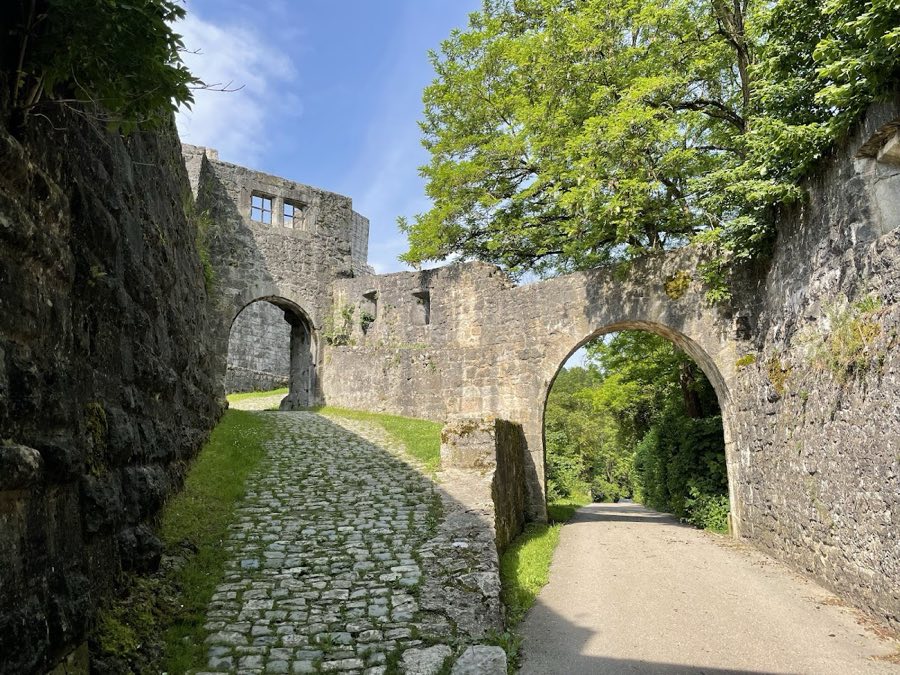
A dry neck ditch runs along the village side of the site and remains very well preserved; this defensive cut once separated the castle from the settlement and is an integral part of the water-castle arrangement. Access today is by a stone bridge built over this approach. It is assumed that earlier access was by a wooden structure equipped with a drawbridge, reflecting the original defensive practice.
The encircling wall is built of masonry and carries a substantial round defensive tower on the southwest flank and a smaller tower on the north side, both set into the circuit. The larger tower connects directly to the south building, so that the late 16th-century residence integrates with the castle’s defensive fabric. The south building itself survives as a recognizable construction from 1571 and forms the primary residential block on the southern side.
The main hall, located on the east side, originally had a stone ground floor and two upper stone storeys. Later alterations added a timber-framed upper storey beneath a steep roof; that roof contains three additional levels. These phases record the castle’s conversion from a purely defensive stronghold into a more domestic, Schloss-style residence under the Steinhäuser family. An alliance coat of arms from the 16th century is set into the castle fabric, and the couple commemorated there has a monumental epitaph preserved in the choir of the Johanneskirche in Crailsheim.
The nearby Schlosskirche serves as the family burial chapel for the Berlichingen lineage and contains numerous grave slabs and epitaph-like wall elements set into its walls. The Berlichingen coat of arms is mounted above the altar, and the pulpit stands over that display, all of which document the family’s long association with the estate and remain in situ within the church.
No. 44794
No. 69258
No. 18018
No. 74654
Comments
Comments for Schloss Rechenberg will require a verified account before posting.
We'll send a verification link before your first comment is published.