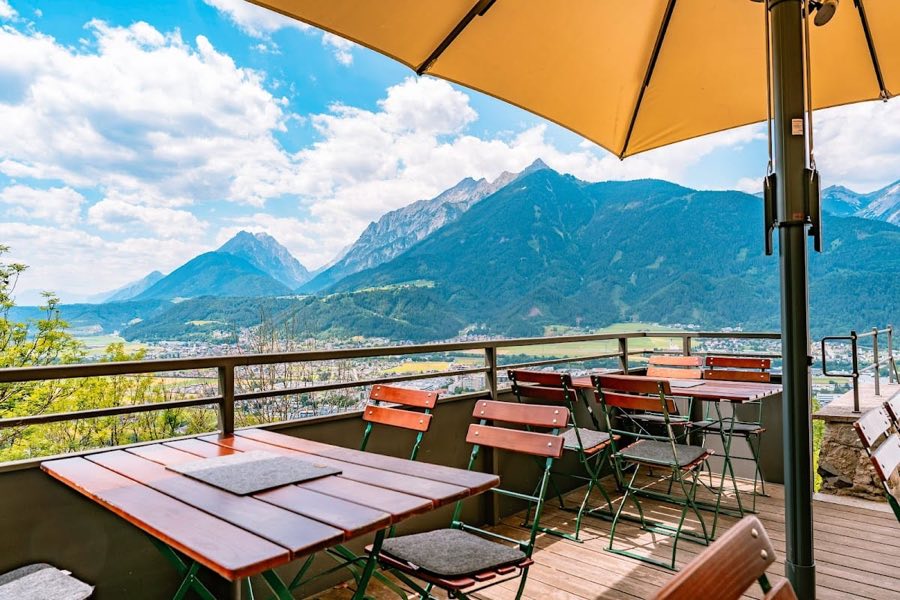
No. 16651
Burg Freundsberg
Austria
CastleIntact12th century
No. 24966
Castle · Austria
No. 24966 · 47.385 N, 11.743 E
Quick summary
Tratzberg Castle is a castle in Austria with origins associated with the 13th century.
See all castles in AustriaTratzberg Castle in Jenbach, Austria, is a medieval hilltop palace first recorded in 1296 and built by craftsmen and patrons operating within the medieval Holy Roman Empire. The fortified complex took on its present character around 1500, when late Gothic building forms met early Renaissance ornament, and it became an important regional seat linked to alpine mining wealth and prominent noble families. Its surviving fabric and furnishings make it a notable example of palace architecture in the alpine parts of the empire.
A fortress is mentioned at the site as “Trazperch” in 1296. During the late fifteenth century the building suffered severe damage in a large fire dated to 1490–1491, an event blamed in one account on the carelessness of the castle keeper, Zanazeller. Before that catastrophe, Archduke Sigismund enlarged the stronghold in 1462–1463.
In 1499 Emperor Maximilian I transferred the ruined property to the brothers Veit‑Jakob and Simon Tänzl in exchange for Berneck Castle in the Kaunertal, on the explicit condition that they rebuild the place. From about 1500 the Tänzl brothers reconstructed the castle over eight years, completing a three‑storey, four‑wing palace around an inner courtyard; they added high‑quality stonework and interior fittings and were elevated from wealthy commoners to nobility in 1502 because of their mining interests.
The Tänzl heirs sold the estate in 1553 and ownership changed hands frequently thereafter. In the second half of the sixteenth century the Augsburg knight Georg Ilsung closed the unfinished northern gaps and commissioned the large painted façade in the inner court; his family thereafter adopted the castle name into their surname. Georg Ilsung’s daughter Anna married Jakob III Fugger, and the property passed into Fugger hands in 1589, linking the castle to the same merchant and mining networks active at Schwaz.
Throughout the seventeenth and eighteenth centuries the castle belonged in turn to noble houses including Stauber‑Imhof, von der Halden and Josef Ignaz Reichsfreiherren von Tannenberg. In 1703 Bavarian forces seized Tratzberg during the War of the Spanish Succession and used parts of the premises as a hospital. By the middle of the eighteenth century the castle ceased to be occupied on a permanent basis. During the Napoleonic conflicts in 1809 Bavarian soldiers looted the armoury and damaged some furniture.
Inheritance brought the property to the Enzenberg family in 1847. They carried out extensive restoration work and by 1879 the castle was reported as restored. The site remains in private ownership by the Enzenberg and Goëss‑Enzenberg family; Count Ulrich Goëss‑Enzenberg and his wife Katrin Goëss‑Enzenberg have lived there since 1991 and undertook further restoration work in the early 1990s. The complex is recognised for preserving a rich group of late Gothic and early Renaissance interiors and fittings.
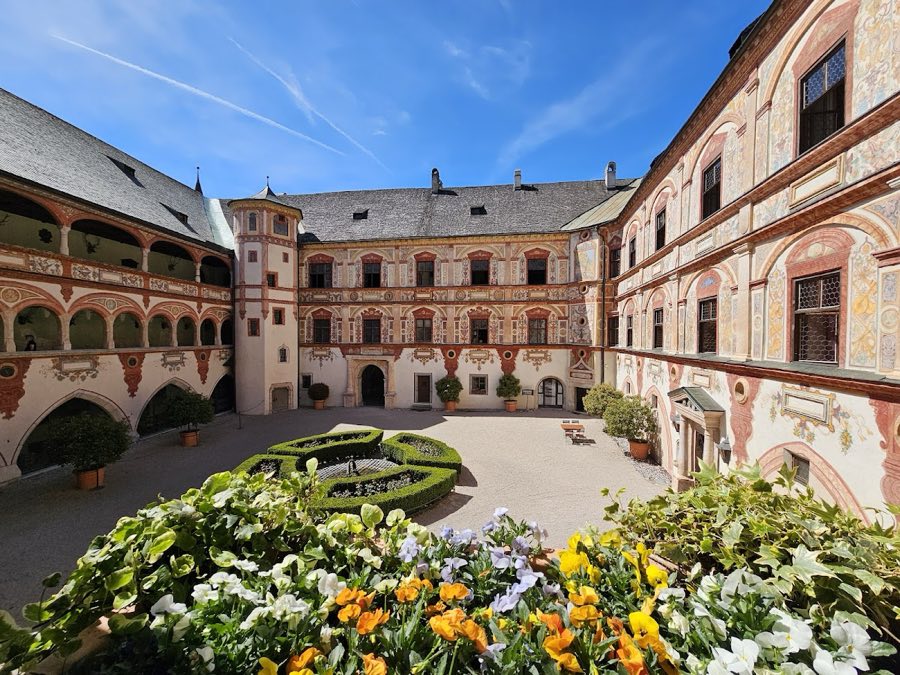
Tratzberg occupies a steep rocky ridge roughly 100 metres above the valley floor on the northern side of the Inn between Stans and Jenbach, giving the palace a dominant, elevated siting. The principal arrangement is a three‑storey, four‑wing building enclosing a rectangular inner courtyard, a layout completed around 1500 during the Tänzl rebuilding campaign. Construction combines robust medieval masonry with refined stone detailing added in the early sixteenth century.
A stair tower and a chapel bell tower mark the northern-east corner of the courtyard, providing vertical circulation and a visible chapel presence within the courtyard ensemble. The castle presents arcaded passages and formal portals that open onto the inner court; the inner‑court façade bears extensive mural painting executed in the sixteenth century under Georg Ilsung, which remains a defining decorative element of that elevation.
Many interior stone fittings date to the early‑sixteenth‑century rebuilding and are executed in Hagauer marble, including windowsills, columns and large fireplaces. The original north wing was left incomplete during the Tänzl works; this gap was later infilled in the latter half of the sixteenth century under Georg Ilsung, who also oversaw the decorative program that unified the courtyard elevations.
The chapel was built by the Tänzl brothers and features a late‑Gothic net vault (a decorative ribbed ceiling pattern), together with sculpted figures and painted panels from the Tänzl period. The high altar in the chapel dates to 1750 and depicts the martyrdom of Saint Catherine of Alexandria, the castle’s patron.
Interior rooms retain an unusual concentration of original furnishings and movable objects. The Habsburg Hall contains a room‑wide painted genealogy of the Habsburg family commissioned by the Tänzl brothers, showing figures such as Emperor Maximilian I and earlier Habsburg rulers. The Fugger Chamber and Fugger Parlour reflect the period of Fugger ownership and conserve furnishings associated with that household. Important listed objects include a late‑Gothic South Tyrolean cupboard from about 1460, Hans Schäufelein’s 1509 painting “Tournament at Innsbruck,” two inlaid oblique tables circa 1520, and several green‑glazed tiled stoves, one from a Nuremberg workshop linked to Georg Fest around 1620 in the so‑called “queen room.”
The armoury now contains fifteenth‑ and sixteenth‑century armour and weapons, although repeated plundering in earlier conflicts depleted original holdings; a significant portion of the present collection comes from Count Franz Enzenberg III. Overall the fabric and key interiors survive in very good condition following nineteenth‑ and late twentieth‑century restorations, with many original fittings preserved in situ.
No. 16651
No. 12135
No. 96875
No. 24998
Comments
Comments for Tratzberg Castle will require a verified account before posting.
We'll send a verification link before your first comment is published.