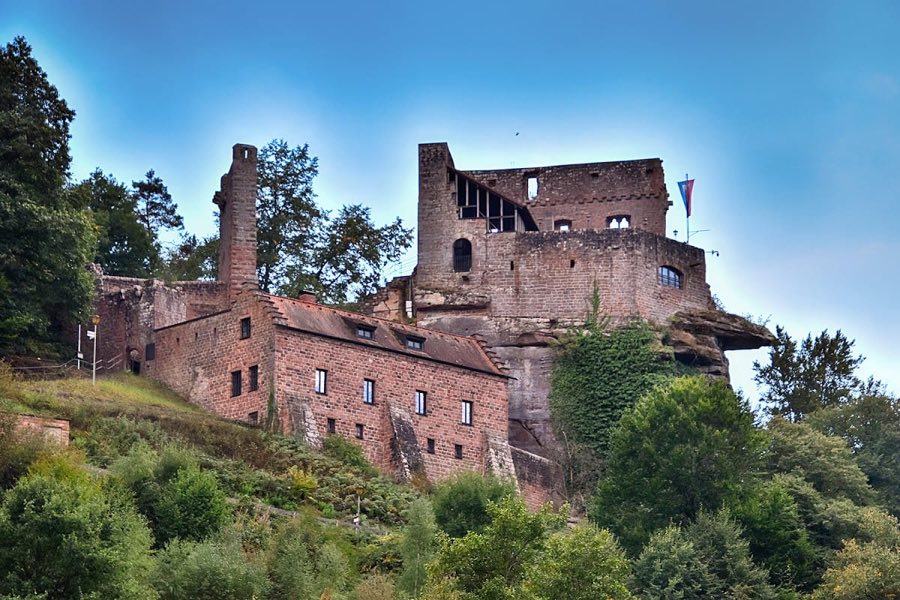
No. 90912
Spangenberg Castle
Germany
CastleRuin11th century
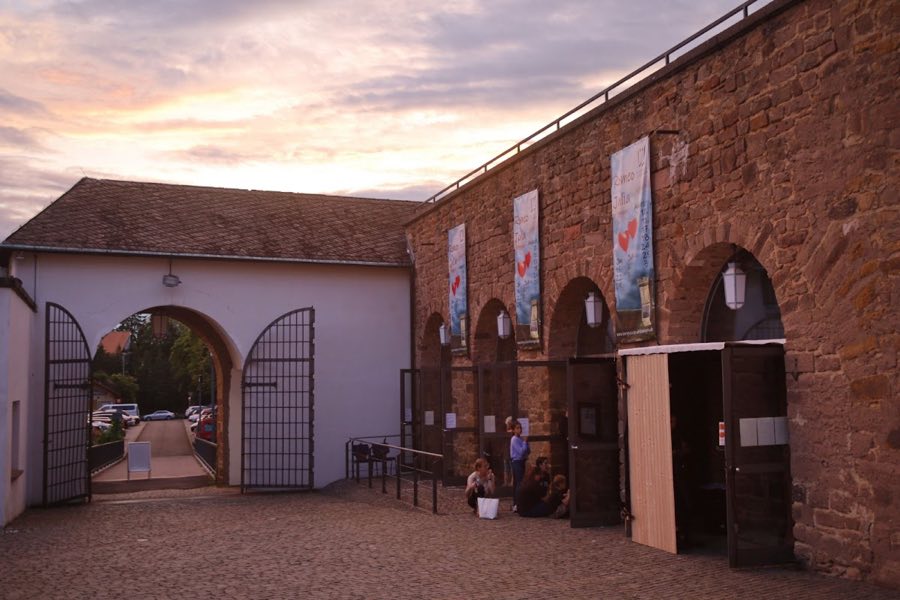
No. 57353
Castle · Germany
No. 57353 · 49.512 N, 8.083 E
Quick summary
Altleiningen Castle is a castle in Germany with origins associated with the 11th century.
See all castles in GermanyAltleiningen Castle stands in the municipality of Altleiningen, Germany, and was established by the medieval German noble family known as the Counts of Leiningen.
Construction of the fortress began around 1100 to 1110 under Emich I and his son Emich II, and the site was originally known as Burg Leiningen. Soon after, about 1120, Emich II founded a monastery at Höningen two kilometres to the south of the castle, linking the estate to a nearby religious foundation.
The stronghold suffered its first recorded destruction during the Peasants’ Uprising in 1525. Reconstruction began in 1528 when the Leininger counts Cuno II, Philipp I, Ludwig and Johann Casimir undertook rebuilding in a Renaissance manner. Local farmers were required to perform corvée labor to complete the work.
Around 1600 a deep gallery was cut into the rock beneath the castle to secure water. That tunnel supplies a twenty‑pipe well that has been described as the principal strong spring feeding the Eckbach. The castle returned to violent destruction in 1690 when French troops attacked it during the War of the Palatine Succession; that action ended the site’s role as an inhabited fortress.
In the years following 1690 stone was quarried from the ruins until the mid‑nineteenth century, when the Kingdom of Bavaria forbade further removal. The estate remained under the Leiningens (the Leiningen‑Westerburg‑Altleiningen line) until 1933, when the district authority of Frankenthal took ownership. In 1962 the ruins were placed under legal monument protection. Between 1962 and 1968 the palace wing was rebuilt, incorporating surviving wall fragments. A youth hostel was established within the partially reconstructed buildings in 1968. That hostel underwent comprehensive modernization between 1998 and 2000, during which the castle regained a gable roof. The main moat was renovated and reopened as an outdoor swimming pool in the first half of 2005. The site is listed as protected cultural property under the Hague Convention and is managed as a protected monument zone. For reasons of habitat conservation the vaulted cellars are closed to entry; in 2015 these cellars sheltered about 400 Greater Mouse‑eared Bats.
The castle occupies the eastern spur of a hill called the Ameiser and follows the triangular outline of the hilltop. The fortress was a spur castle built on bedrock, the hill rising to about 340 metres while the castle platform sits at roughly 283 metres above sea level. Construction adapted to the rock, so the plan of walls and courts traces the natural shape of the summit.
On the west side fragments of original masonry remain, including a surviving segment of a Staufian shield wall, a thick defensive masonry intended to protect the most vulnerable face of the site. Those wall remains are fragmentary but were substantial enough to be worked into later restorations and are still visible in situ.
The outer ward stood apart from the main castle and was protected by its own moat. A deep principal ditch hewn from the living rock separated the forecourt from the inner castle. A drawbridge once spanned that rock‑cut trench, controlling access between the two enclosures. The ditch and moat survive as archaeological features that mark the former defensive arrangement.
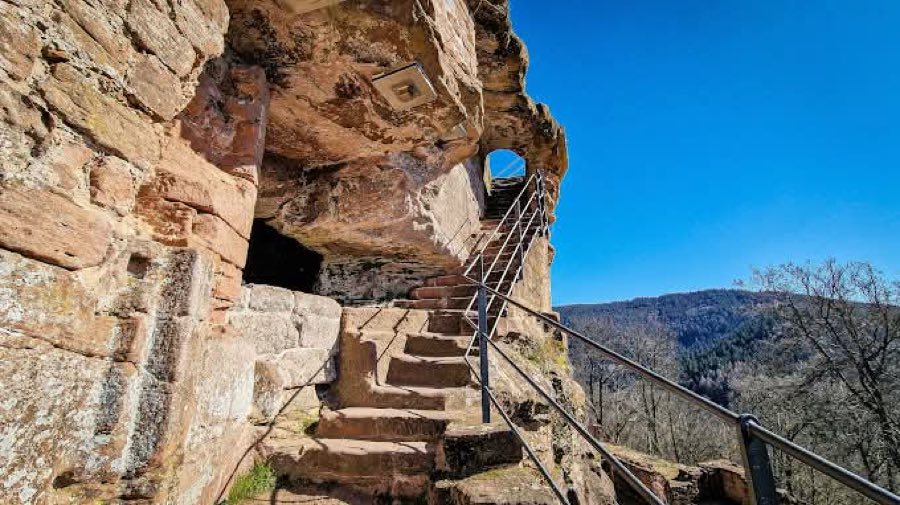
A rock‑cut gallery leads from beneath the castle down into the hillside. Driven around 1600 to secure a reliable water supply, this tunnel feeds a well fitted with twenty pipes. That well has been characterized as the strongest source of the Eckbach and remains connected to the surviving tunnel system.
The southeast palace wall, which preserved three storeys of window openings, survived the earlier destructions and was incorporated into the palace wing rebuilt between 1962 and 1968. Vaulted cellar rooms also survive beneath the castle. These subterranean, vaulted spaces are intact and now function as a wildlife refuge; they host a large colony of bats and are closed to protect that biotope.
Today the site exists as a partly ruined medieval castle with sections rebuilt or newly added in modern restorations. The reconstructed palace wing and other renovated parts were adapted for use as a youth hostel and associated facilities, while original stonework, rock‑cut ditches, the water gallery and the vaulted cellars remain as archaeologically confirmed features on the hilltop.
No. 90912
No. 17841
No. 46515
No. 36182
Comments
Comments for Altleiningen Castle will require a verified account before posting.
We'll send a verification link before your first comment is published.