
No. 19254
Bukelon Fortress
Bulgaria
CastleRuinFor events6th century
No. 76370
Castle · Bulgaria
No. 76370 · 41.987 N, 24.873 E
Quick summary
Asen's Fortress, Asenovgrad is a castle in Asenovgrad, Bulgaria with origins associated with the 13th century.
See all castles in BulgariaAsen’s Fortress stands above the Asenitsa valley within the municipality of Asenovgrad, Bulgaria, and was substantially built up and reshaped under the medieval Bulgarian state.
Human activity on the ridge reaches back to Thracian times, and the area was occupied during the Roman and early Byzantine eras. The medieval fortress itself appears in written records in the eleventh century, when it is named Petrich in the statute of a nearby monastery. During the campaigns of the Third Crusade the stronghold fell into the hands of crusader armies.
In 1205 Renier of Trit, the Latin duke of Philippopolis, sought shelter at the fortress and endured an eleven-month siege there before Latin imperial forces arrived to relieve him. In 1231 the fortress was substantially rebuilt during the reign of Tsar Ivan Asen II; an eight-line inscription placed on the walls records that reconstruction and states it was undertaken to guard against raids by Latin forces. After Ivan Asen II died the fortress passed into Byzantine control. It returned to Bulgarian rule under Ivan Alexander, a change noted in 1344. Ottoman forces later conquered and destroyed the fortress during their rule, after which it was largely abandoned as a military site; the fortress church, however, continued to serve the local Christian population. Conservation and partial restoration work on the church were finished in 1991, and restoration of the fortress is also recorded as completed in 1991. The nearby town adopted the fortress-associated name Asenovgrad; its earlier name was Stanimaka.
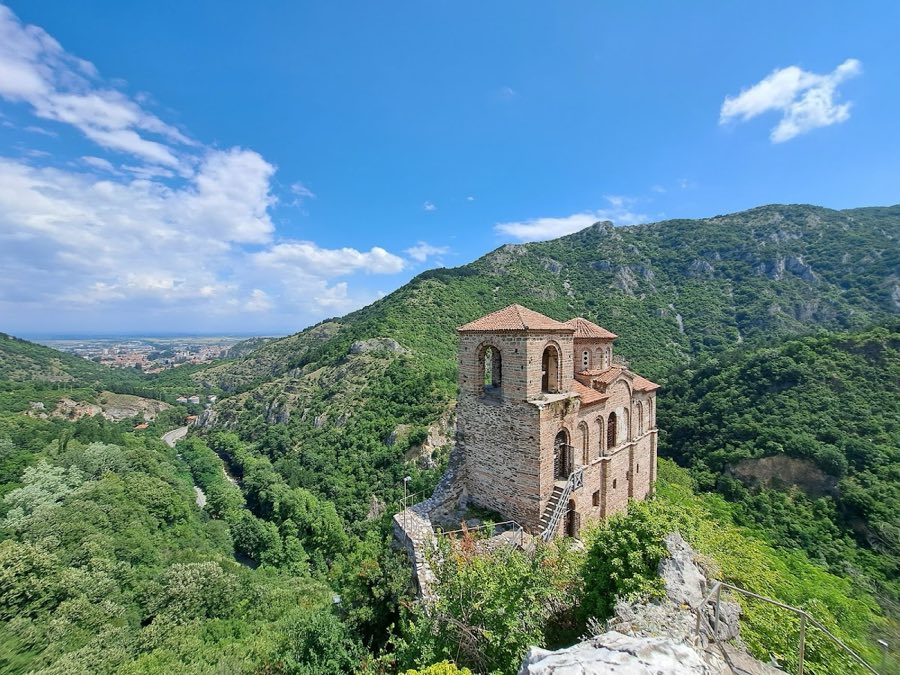
The fortress crowns a rocky ridge on the left bank of the Asenitsa (Chepelarska) River, about two to three kilometres south of Asenovgrad, at roughly 279 metres above sea level. The defensive circuit is represented today mainly by the surviving foundations of the fortifications; these show the original defensive layout that enclosed the ridge and protected the settlement and its buildings.
Sections of the outer curtain wall survive with considerable solidity. The wall foundations and lower courses remain, and the outer wall measures about 2.9 metres in thickness where preserved. Surviving wall fragments rise up to approximately three metres, while the walls are reported to have originally reached between nine and twelve metres in height. These preserved remains convey the scale of the medieval defensive system.
Excavations uncovered the traces of a feudal stronghold established during the thirteenth-century rebuilding. Archaeologists exposed a compact castle plan that included around thirty rooms arranged for habitation and service, together with three water repositories that would have supplied the garrison and household. These features date to the major reconstruction undertaken under Ivan Asen II and reflect the fortress’s role as a manorial and military center.
The most intact monument on the rock is the fortress church, dedicated to the Holy Mother of God, built in the twelfth to thirteenth centuries. It is a two-storey building with a single nave beneath a cross-shaped dome, a broad narthex at its western end, and a large rectangular tower attached. Painted decoration survives inside the church; the mural cycle has been dated to the fourteenth century. An eight-line inscription from 1231 remains on one wall of the fortification complex and directly links the rebuilding campaign to Tsar Ivan Asen II. The church underwent conservation and partial restoration that was completed in 1991, and the complex’s restoration is likewise recorded as finished in 1991. Today the church stands as the best-preserved element of the site, while the rest of the fortress survives largely as foundations and lower wall courses.
No. 19254
No. 84501
No. 43689
No. 66809
Comments
Comments for Asen's Fortress, Asenovgrad will require a verified account before posting.
We'll send a verification link before your first comment is published.