No. 79994
Cloncaird Castle
United Kingdom
PalaceRestored16th century

No. 70481
Castle · United Kingdom
No. 70481 · 55.421 N, 4.380 W
For events
Auchencloigh Castle is marked as a château or castle venue lead. Capacity, indoor/outdoor spaces, catering rules, and accommodation options are published only after public verification.
Event types: Private events, Cultural gatherings, Filming and photography
Quick summary
Auchencloigh Castle is a castle in United Kingdom with origins associated with the 15th century.
See all castles in United KingdomAuchencloigh Castle is situated near the village of Ochiltree in Scotland, built by the medieval Scottish people likely during the 15th century. The castle stood within lands traditionally held by the Craufurd Clan, reflecting its place in the feudal structure of the region. Its construction aligns with a period in Scottish history when fortified dwellings were commonly established for protection and control over surrounding estates.
The castle may have been part of a network of small fortified sites designed to secure the area. This group included other similar structures such as Drongan Castle and Martnaham Castle, suggesting a coordinated defensive strategy in the region. Although direct records about specific events at Auchencloigh Castle are limited, these earlier fortifications played a role in the territorial management and local security during turbulent times in Scotland’s medieval period.
Documents from the late 16th century reference individuals connected to the lands around the castle. Notably, in 1579, a William Wallace of “Auchincloych” is recorded as a witness to a legal document, while a year earlier, William and James Cuninghame of Polquharne transferred lands including Auchencloigh to John Cuninghame. These records affirm the castle’s occupation and involvement in regional landholding practices during the Renaissance era. Over time, the castle’s name evolved from its Gaelic roots, combining “achadh,” meaning field, with “cloiche,” meaning stone, a naming pattern seen at other Scottish sites as well.
Maps produced from the 1600s onwards provide a visual history of the castle’s condition. Early 17th-century surveys show the structure standing intact, whereas by the late 1700s and early 1800s, the site had fallen into ruin. In recognition of its historical importance, the castle site was later designated a Scheduled Monument, protecting it under national heritage legislation.
The surrounding landscape also features historical traces such as a nearby holloway, or sunken lane, which aligns with an old Roman road leading to the castle grounds. This lane was cobbled in parts and covered with clay, dating back to the 17th century, indicating continued use of ancient routes connected to the site. Additionally, the area once supported opencast mining operations, which have since been reclaimed for farming.
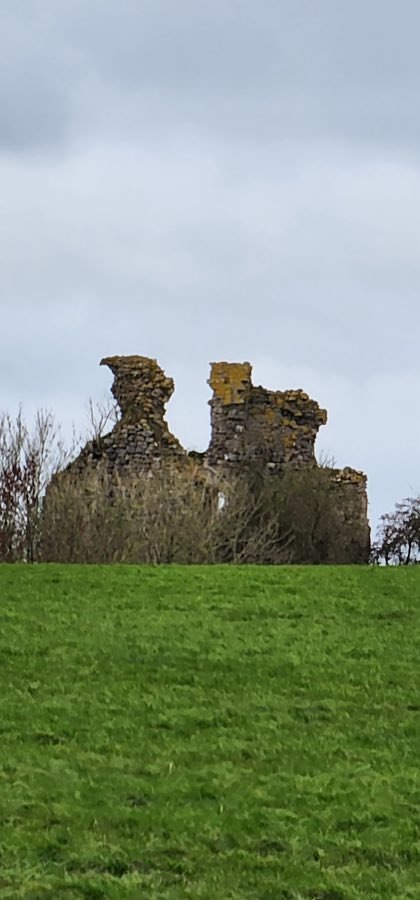
The remains of Auchencloigh Castle lie on a raised mound close to Auchencloigh Farm, surrounded by a fringe of light woodland. Archaeological records from the late 20th century describe the surviving walls as forming a rectangular enclosure, with sections rising to between 0.6 and 1.6 meters above ground. These walls are built from dark whinstone, a hard volcanic rock common in the area, bonded with lime mortar. Their thickness—measured at several feet—suggests a defensive purpose consistent with medieval fortifications.
Inside the ruined walls, evidence points to the castle’s interior being divided into several small rooms, although detailed layouts have not survived. Early cartographers depicted the castle as smaller than nearby Kerse Castle, set within a wooded enclosure. Originally, the castle was protected on its southern side by a pale—a type of fence or wooden enclosure—and bounded by watercourses to the north, east, and west, utilizing natural features for added defense.
The site shows no inscriptions, carved decorations, or associated artifacts such as tools or pottery in the recorded findings. The nearby historic holloway, aligned with a Roman road, features a cobbled base beneath a clay surface, indicating the long-standing importance of this approach to the castle. These remains, now stabilized as a scheduled monument, allow for an understanding of the castle’s scale and construction style, reflecting the medieval period’s approach to fortified dwellings in this part of Scotland.
No. 79994
No. 64366
No. 76326
No. 42389
Comments
Comments for Auchencloigh Castle will require a verified account before posting.
We'll send a verification link before your first comment is published.