No. 85990
Buittle Castle
United Kingdom
Tower houseRestored8th century
No. 33137
Tower house · United Kingdom
No. 33137 · 55.102 N, 4.102 W
Quick summary
Barscobe Castle is a tower house in United Kingdom with origins associated with the 17th century.
See all castles in United KingdomBarscobe Castle stands in Balmaclellan, United Kingdom, and was raised in 1648 by Scottish proprietors, the Maclellan family. A dated stone set over the main doorway records the year 1648 and names William Maclellan and his wife Mary (sometimes given as Margaret) Gordon as the builders. Mary (or Margaret) Gordon is identified as the natural daughter of Sir Robert Gordon of Lochinvar, the fourth Viscount Kenmure, who served as Commissioner of War for the Stewartry between 1645 and 1648. Stones for the house were taken from nearby Threave Castle during its construction.
William Maclellan died in 1654 and his eldest son Robert succeeded him. Robert Maclellan became closely involved with the Covenanter movement. He took part in a skirmish at the Clachan Inn in 1666 and in November 1666 was responsible for the capture of Sir James Turner. He joined a march toward Edinburgh that ended in defeat at the Battle of Rullion Green. In 1682 he was captured by forces under Claverhouse; he accepted the Test to avoid execution. In 1683 Robert Maclellan was murdered at Barscobe by Robert Grierson of Mylnemark. During the later seventeenth century Barscobe served as a meeting place for Covenanters, where clandestine assemblies were held and baptisms were conducted at the Holy Linn waterfall in Barscobe Wood.
The estate remained in the Maclellan family until 1775, when it passed to the Carson family. In the 1920s Hugh Laing acquired the property and built a nearby house called Barscobe House. The castle passed to Sir Hugh Wontner in 1961. It had stood empty for many years before work of repair began in 1971; restoration continued under Sir Hugh in the 1970s with guidance from his tenant Dame Bridget D’Oyly Carte and the architect Ian G. Lindsay. The building was placed on the statutory list in the highest protection category, Category A, in 1971. After Sir Hugh’s death in 1992 the estate passed to his daughter Jenifer Emery, and she transferred ownership to her son Alistair Emery in 2007. The castle was occupied from November 2011 by Stewart Gibson and Lorraine Belshaw, and by 2015 it was described as operating as a small seasonal bed and breakfast.
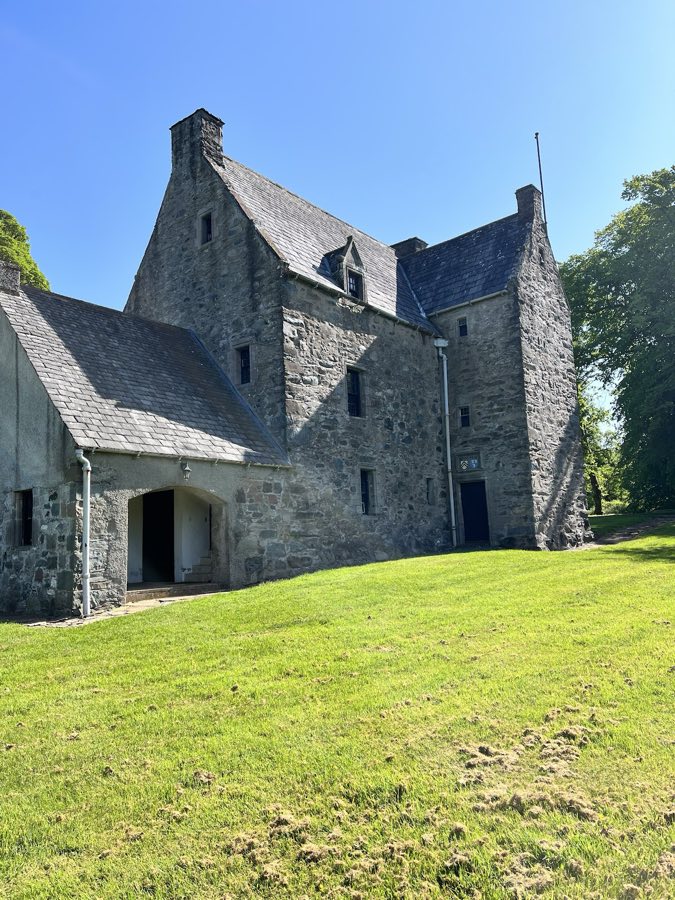
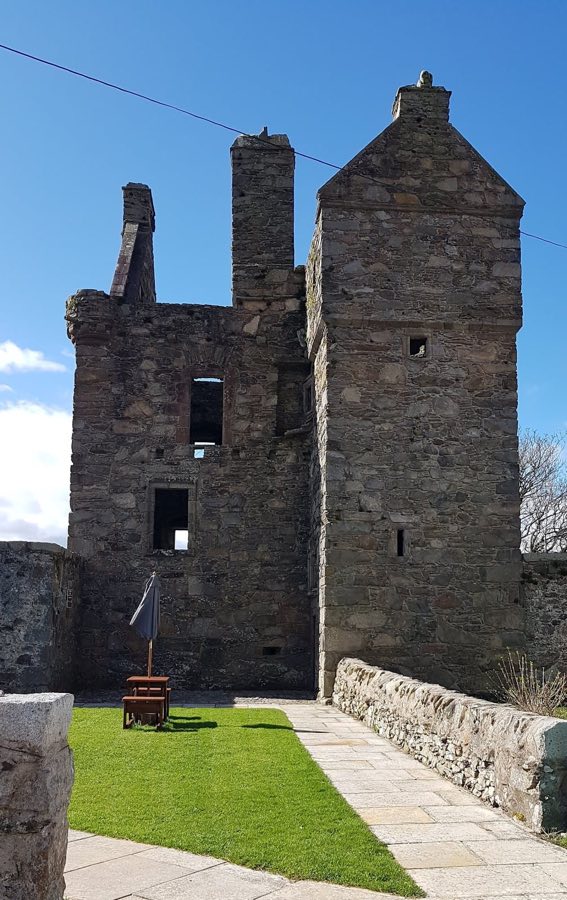
The surviving structure is an L‑shaped tower house dating to the mid‑seventeenth century. The plan consists of a main block with a projecting stair wing, a form commonly used for domestic strongholds of the period. Construction used stone removed from Threave Castle. One description records the main block as three storeys with the stair wing rising one storey higher, while another describes the house as two storeys of rubble masonry; both observations record the same seventeenth‑century fabric and later repairs. The roof is gabled and fitted with dormer openings, and the gable ends display a local variant of crowstep form found in Galloway.
A carved armorial stone above the entrance shows the Maclellan and Gordon heraldry together with the initials of the couple who built the house and the date 1648; the doorway sits within the inner angle formed by the L‑plan. On the west elevation carved initials and dates remain, recording “WMG” with 1648, and a later marking, “HW” with 1971, which records modern restoration. A single‑storey annex was attached on the western side in the eighteenth or nineteenth century. At the rear a later doorway occupies the position of an original window opening, indicating alteration of the elevations at a post‑construction date.
A modern byre or barn projects from the castle and has been adapted to serve as a garage. This attached range exhibits flat segmental arches in its openings and has been coated with a harled finish. The whole building underwent restoration beginning in 1971 and work in the 1970s repaired and conserved the main house; today the castle stands in restored condition and is recognised as a fine example of a mid‑seventeenth‑century house protected as a Category A listed building. The woodlands nearby retain the Holy Linn waterfall, which was used historically for Covenanter baptisms and secret gatherings.
No. 85990
No. 41841
No. 24331
No. 34680
Comments
Comments for Barscobe Castle will require a verified account before posting.
We'll send a verification link before your first comment is published.