No. 55308
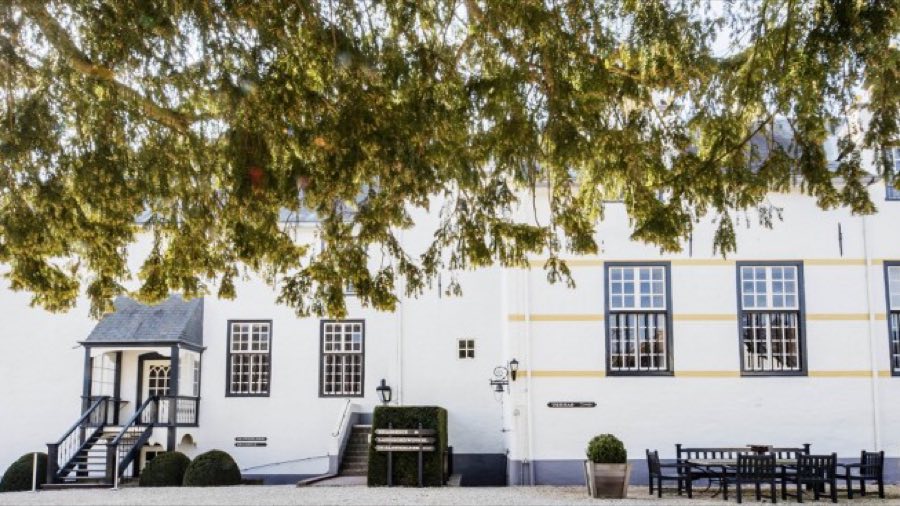
Huis Doddendaal
Netherlands
CastleRestoredFor events14th century
No. 79711
Castle · Netherlands
No. 79711 · 51.824 N, 5.631 E
Quick summary
Batenburg Castle is a castle in Netherlands with origins associated with the 13th century.
See all castles in NetherlandsBatenburg Castle stands near the village of Batenburg in the municipality of Wijchen, in the modern Netherlands. Its origins trace back to early medieval times within the territory historically influenced by Frankish and later feudal rulers.
Local tradition holds that the site initially hosted a temple dedicated to Mars Victor, a Roman god of war, before the castle’s establishment. An old Gothic inscription above the castle entrance claims that the first fortification was founded as early as the year 527 on this religious foundation, highlighting a symbolic continuity from sacred to secular power.
The first documented evidence of the Lords of Batenburg dates to around 1080. This noble family held the castle and lordship for over a century before their line ended during the 13th century. Following this, the estate passed through marriage when Johanna Batenburg married William I of Bronckhorst-Batenburg. The Bronckhorst family thereafter controlled the castle, becoming embroiled in intense regional conflicts with a rival noble house known as the Heeckerens.
Construction and modification of Batenburg Castle occurred in several notable stages. Around 1300, William III of Bronckhorst undertook a significant building campaign, erecting a new castle on previous foundations. About three centuries later, around 1600, the structure was rebuilt by Maximilian of Bronckhorst, reflecting ongoing efforts to reinforce and modernize the fortress.
During the late Middle Ages and into the early modern period, the castle found itself embroiled in warfare. It suffered sieges and assaults, notably in 1497 and 1503. In 1586, during the wider conflicts affecting the region, the castle was involved in the siege of Grave, enduring damage as a result.
Ownership shifted in the mid-17th century when the castle came into the possession of the Count of Hoorne in 1641. Later, toward the end of the 1600s, control passed to the Counts of Bentheim and Steinfurt, who retained ownership until the 20th century.
The castle’s final destruction occurred during the tumultuous period of French revolutionary incursions in 1794 or 1795. French troops set fire to the stronghold after filling it with hay and sabotaging its water supply by destroying the pump, leaving the structure in ruins. It was never reconstructed and gradually fell into decay. Throughout the 19th century, parts of the ruin were dismantled for building materials, a process partially overseen by the Bentheim-Steinfurt family.
After the Second World War, the Dutch government confiscated the property. In 1953, ownership was transferred to a preservation society, the “Friends of Gelderland Castles” foundation, which has since worked to stabilize the remains and prevent further deterioration. Batenburg Castle today is recognized as one of the oldest and most historically significant castles within its province.
Batenburg Castle was constructed on an artificial mound known as a motte, an elevated earthwork designed for defense, which is surrounded by a moat. The castle’s layout was almost circular, with a diameter close to 40 meters, enclosing its defensive and residential structures within this compact form.
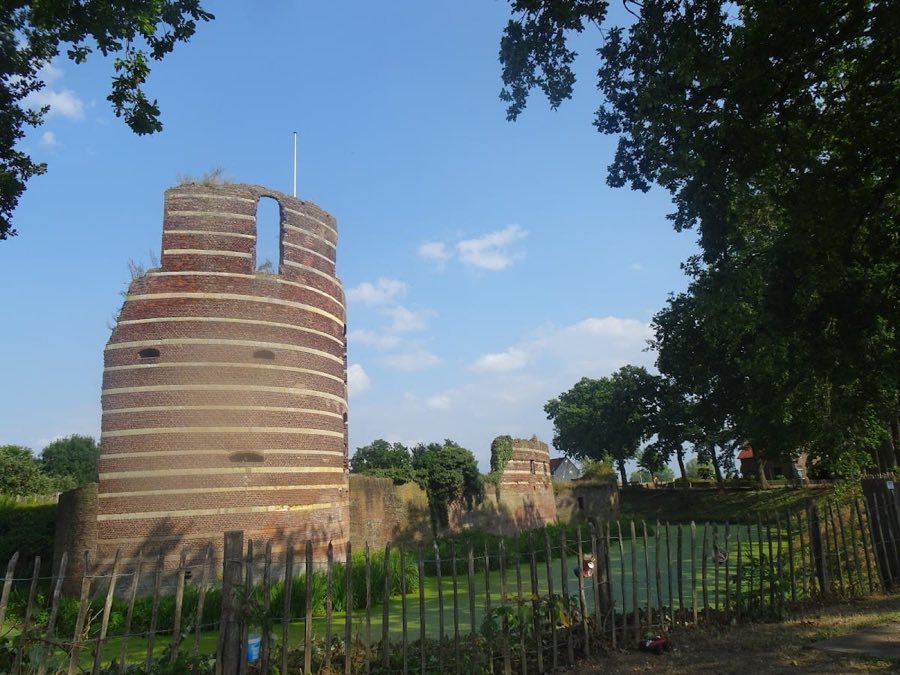
Surviving elements include the curtain wall that encircled the castle, reinforced by bastions—projecting parts built for defensive fire—and several protruding front towers. The gatehouse, though partial, remains flanked by two semicircular towers. These towers were built using brick interspersed with bands of marlstone, a local sedimentary rock, creating a distinct striped masonry pattern also visible in the other round towers nearby.
Opposite the entrance stood a well, known for its sacred spring water believed to ease fever. Historical accounts describe how gatekeepers sold this water by the bucket to visitors seeking its reputed healing properties, integrating the site’s earlier sacred associations into its medieval function.
Among the ruins is a substantial round tower containing traces of chimneys and cross frames, suggesting domestic use such as heating and structural support. These features were also constructed with the characteristic alternating red brick and marlstone courses.
Within the enclosure, three residential wings once formed a courtyard set facing the gate. The castle’s circular rampart was fortified during a rebuilding phase in the 15th century, indicating strategic enhancements. The roughly circular shape combined with these bastioned walls reflect medieval defensive architecture adapted over several centuries.
Today, the remains present as stabilized ruins, with conservation efforts having arrested further decline since the mid-20th century. The foundations and traces of the original surface floors beneath the towers and walls remain visible, preserving the footprint of this historic complex. These ruins continue to mark the site where a formidable feudal castle once stood, blending layers of religious, residential, and military history.
No. 55308
No. 43547
No. 47464
No. 38604
Comments
Comments for Batenburg Castle will require a verified account before posting.
We'll send a verification link before your first comment is published.