No. 59745
Altwied Castle
Germany
CastleRuin12th century
No. 58069
Castle · Germany
No. 58069 · 50.492 N, 7.521 E
Quick summary
Burg Braunsberg is a castle in Germany with origins associated with the 12th century.
See all castles in GermanyBurg Braunsberg stands near the village of Anhausen in Germany and was erected around 1200 by Bruno I of Isenburg, a member of the medieval German nobility.
The castle originated as the seat of the Isenburg line that later became known as Isenburg-Braunsberg. After the death of the last male heir, Bruno II, son of Bruno I, established what is recorded as the second comital house of the Counts of Wied. Over time the stronghold was counted among the ancestral residences of that family.
In the decades after the Thirty Years’ War the site was involved in a regional conflict referred to as the Braunsberg War. During this episode Count Friedrich III of Wied opposed forces of the Electorate of Cologne and the Electorate of the Palatinate, and the castle endured a siege in which men died. From the 1700s the site was largely left to decline. In March 1945 United States artillery fire destroyed most of the higher masonry that had previously reached the eaves. Following the Second World War parts of the lower castle were repaired and altered to serve the forestry administration of the princely Wied family, and the estate contained a forestry district office of that administration as of 2010.
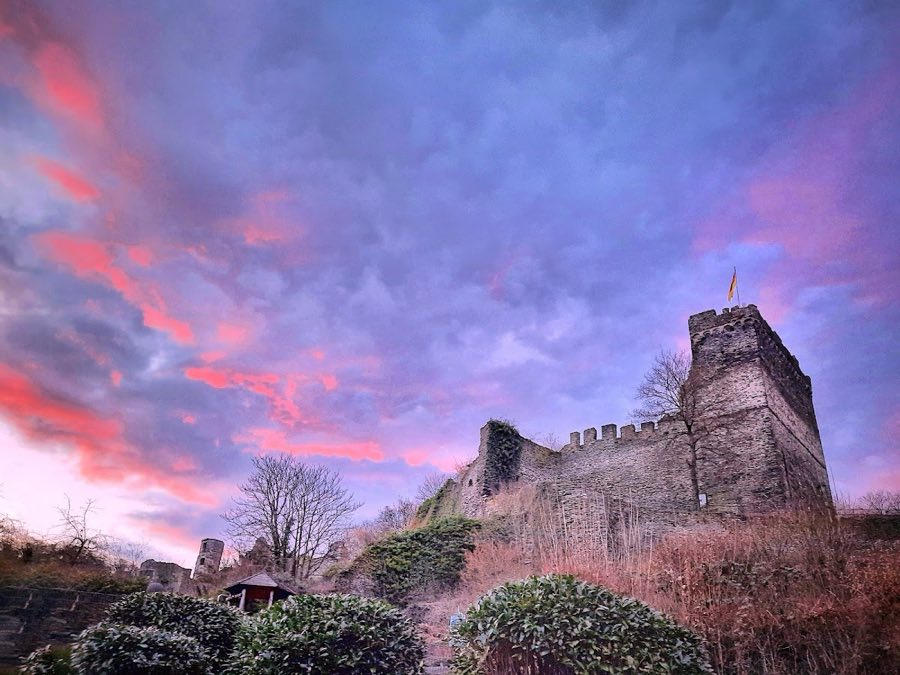
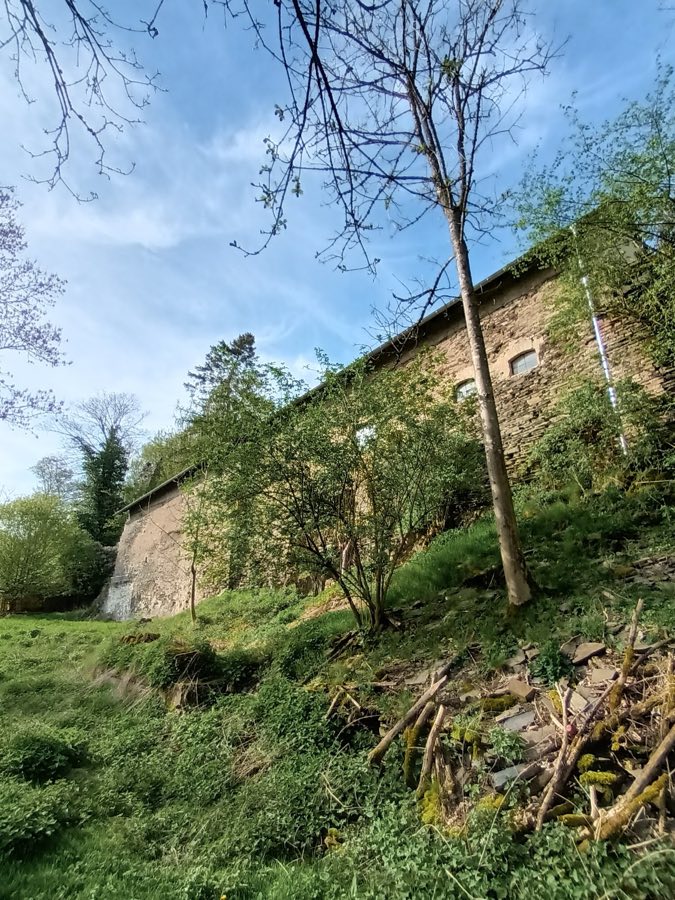
The ruin occupies a rocky spur above the Aubach valley at about 265 metres above sea level, set on the Burgberg field known locally as Braunsberg on the Sayn-Wied plateau. The site is a rock castle built directly into its natural setting, with primary construction on the left slope of the Aubach. The surviving fabric is stone masonry erected against and on the rock outcrop.
Approach to the castle was practical from only a single side. That vulnerable side was defended by a broad neck ditch hewn into the bedrock and by a natural rock barrier that stood beside it. The remaining three sides drop steeply down into the Aubachtal, creating natural steep declines that formed part of the defensive scheme.
The standing masonry preserves the form of a compact, many‑angled residential tower, a comparatively uncommon shape, though that outward appearance reflects later alterations to the structure. Before March 1945 parts of the wall rose nearly as high as their original eaves; those upper sections were almost entirely obliterated by artillery fire in that month. The surviving tower fabric and adjacent walls remain fragmentary and altered.
The lower castle area was repaired and adapted in the postwar period for use by the princely Wied forest administration. These interventions produced a contemporary‑appearing forestry facility and living quarters within the castle precincts. An archaeological investigation has been proposed as a means to clarify the original form of the tower, since the current remains and available historical photographs do not allow a reconstruction of its earliest appearance.
No. 59745
No. 49079
No. 80922
No. 65580
Comments
Comments for Burg Braunsberg will require a verified account before posting.
We'll send a verification link before your first comment is published.