No. 73211
Feistritz Castle
Austria
CastleRestoredFor events12th century
No. 25778
Castle · Austria
No. 25778 · 47.632 N, 16.120 E
Quick summary
Burg Grimmenstein is a castle in Austria with origins associated with the 12th century.
See all castles in AustriaBurg Grimmenstein is a medieval stone fortress situated in the municipality of Grimmenstein, Austria. This stronghold was established by medieval European builders, with origins tracing back to at least the 12th century, and some research suggesting earlier fortifications may have been present on the site as far back as the 9th century.
In its early history, Burg Grimmenstein occupied a vital strategic location atop a hill, with steep cliffs on three sides, offering natural defense. Its position helped protect the region from eastern incursions, especially by Hungarian forces. The first recorded owner was Albert von Grimmenstein, a vassal under Count Ekbert III von Formbach-Pitten, who is mentioned between 1144 and 1158. The von Grimmenstein family continued to play a role in regional affairs, with Albert’s son participating in the Fifth Crusade in 1218. The castle’s original stone walls were likely erected in the 13th century, strengthening its defenses.
Following the probable extinction of the von Grimmenstein line around 1309, the castle passed into the hands of Hadmar von Falkenberg and, later on, the ducal authorities. During the 14th and 15th centuries, Burg Grimmenstein was managed by burgraves and occasionally used as collateral, reflecting its importance within a larger network of fortifications and monasteries designed to guard against Hungarian advances.
The castle’s military role diminished over time, culminating in Emperor Frederick III’s sale of the fortress in 1444. Soon after, its challenging access and limited comfort led to progressive neglect and decay. To prevent its complete ruin, Frederick III transferred ownership after 1470 to the Order of Saint George, which undertook some restoration efforts to maintain the stone fortifications.
In 1522, Burg Grimmenstein was handed to the Diocese of Wiener Neustadt, though it returned to imperial administration ten years later. The last known resident was the castellan Hans Leroch. Over the 17th and 18th centuries, the castle further deteriorated as it passed through several noble families’ hands, including Baron Kasimir von Petrovich and later the Counts Stella-Caracciolo, who never made it their permanent residence.
By the early 19th century, the fortress had fallen into ruin and was used by local peasants as a source of stone and as storage space. The nearby village, originally called Am Treitl, eventually adopted the name Grimmenstein during the 20th century. In the mid-20th century, Johann Rigler purchased the decaying remains and initiated significant restoration, converting the site into a medieval-style home and museum. In the 21st century, a descendant, Markus Albero Grimmenstein, resumed restoration efforts beginning in 2014, leading to the castle’s reopening to the public in 2016. Today, it stands as a protected historic monument among three former fortifications in the Kulmriegel ridge area overlooking the Pittental valley.
Burg Grimmenstein’s layout centers around a compact rectangular enclosure measuring approximately 25 by 30 meters. Constructed primarily of stone, the original walls are notably thick at their base, around 2.7 meters, tapering to 1.3 meters towards the top. These walls curve slightly outward, conforming to the contours of the rocky hill on which the castle was built. Their substantial thickness and curvature contributed to the fortress’s defensive strength.
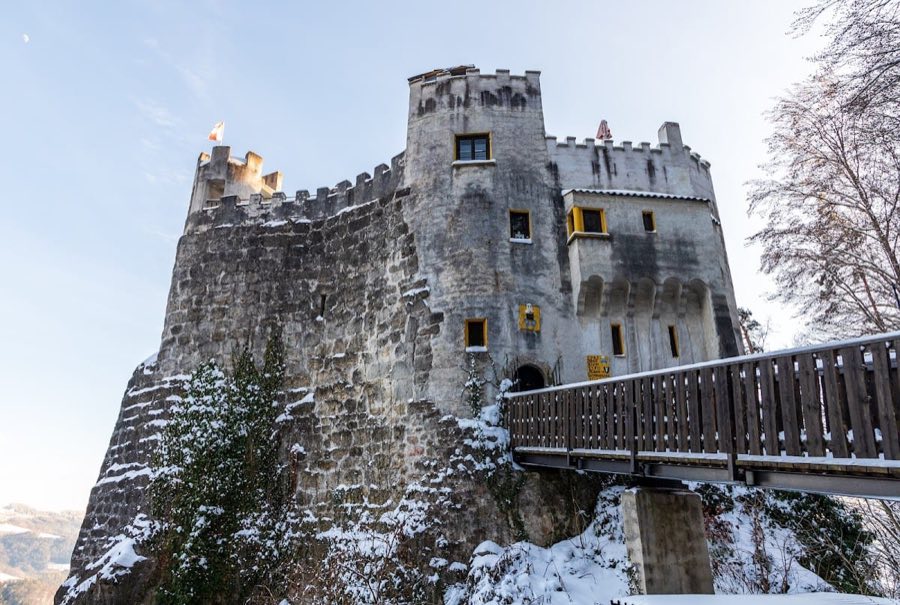
A key defensive feature was the deep moat carved directly into the rock on the side of the castle where the terrain slopes more gently. This moat was historically spanned by a drawbridge, a typical medieval mechanism allowing controlled access. Although the original drawbridge no longer exists, it has been replaced by a permanent bridge today. The most robust defensive wall, known as the Mantelmauer, was constructed along this accessible approach, reinforcing the castle’s security.
The castle’s position is further secured by dense forest surrounding it on all sides, which historically would have added an additional natural barrier. The northern wall’s lower portion of the original 13th-century structure survives and was reused as a foundation for subsequent construction phases in later centuries. This surviving masonry visibly contrasts with newer building blocks, highlighting the castle’s layered architectural history.
Modern restoration efforts have largely followed the 13th-century building traditions. These included characteristic elements such as projecting oriel windows (called erkers), battlemented walls designed for defense, and specially shaped niches within the structure. While contemporary materials like concrete were incorporated to ensure structural stability, the restoration respected the original medieval floor plan as much as possible, preserving the essence of the fortress’s historic design.
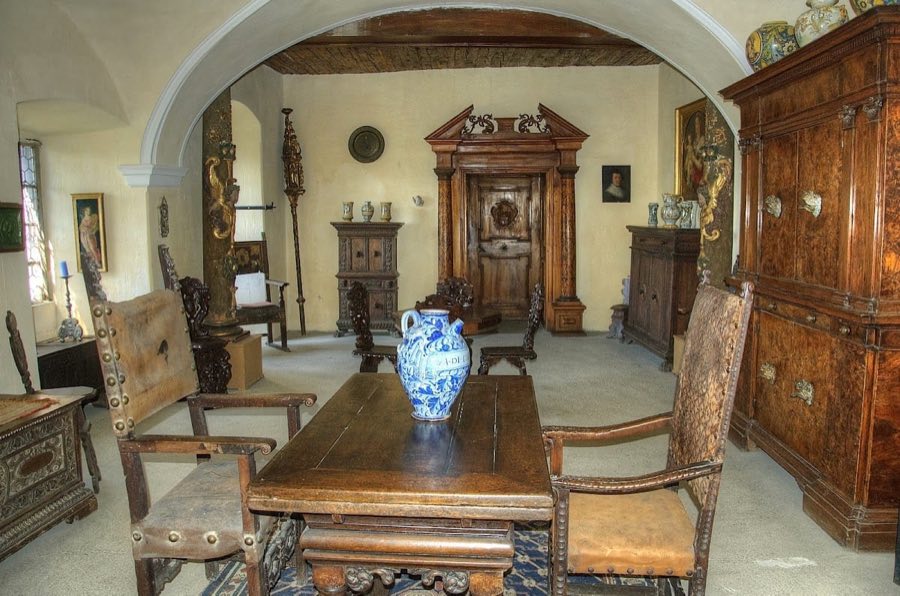
Today’s visible castle consists of a three-story residential building, which includes living quarters and a knight’s hall, alongside a dedicated museum area that exhibits medieval coats of arms and armor. Photographs of Burg Grimmenstein show it perched against the backdrop of the Kulmriegel mountain, emphasizing its elevated and commanding presence consistent with its defensive origins.
No. 73211
No. 19328

No. 88132
No. 27395
Comments
Comments for Burg Grimmenstein will require a verified account before posting.
We'll send a verification link before your first comment is published.