No. 32356
Burg Schwärzenberg
Germany
CastleRuin12th century
No. 93225
No. 93225 · 49.274 N, 12.546 E
Quick summary
Burg Kürnberg is a castle in Germany with origins associated with the 14th century.
See all castles in GermanyBurg Kürnberg stands above the market town of Stamsried on the Haidberg and was founded by local medieval nobility after 1346. Dietrich der Kürner received Stamsried as a fief from Count Palatine Ruprecht II and, with the count’s permission, erected a fortified residence on the hill, from which he and his descendants took the name Kürner von Kürnberg. Dietrich died in 1360 and his sons Marquart, Hans and Dietrich inherited the site. A 1367 record names “Vlreich der Tanner” as living at Kürnberg while Marquart der Kürner served as manorial judge for both local manors. In 1406 Dietrich the Younger died; his widow remarried Hermann den Hertenberger and remained at Stamsried while her sons Marquart, Hans, Degenhard and Dietrich continued to hold Kürnberg.
On 16 January 1422 Hans der Kürner issued a written agreement (a Revers) to Bishop Friedrich of Bamberg concerning the free fief of Kurinberg and the bailiwick of Roding, since the castle was held as a Bamberg fief. On 12 September 1429 Ulrich Warberger bought Kürnberg with the consent of Count Palatine Johann; his son Christoph is recorded as holder in 1452 and Balthasar Warberger in 1467. Later holders included Hans von Plankenfels in the late fifteenth century and, from 1499, Ludwig von Habsberg (d.1520) with his descendants noted in 1530. The Murach family followed: Georg von Murach is named in 1539 and Andreas Georg von Murach in 1580, after which the castle’s holdings were merged administratively with those of Stamsried.
During the Thirty Years’ War the castle was besieged by Swedish forces and in 1634 was destroyed; the site then fell into ruin. At the end of the 1970s the ruins underwent comprehensive conservation and restoration. The place is recorded today as a protected monument (registration D-3-72-161-17) and archaeological finds from the area of the medieval ruin are logged under D-3-6741-0056.
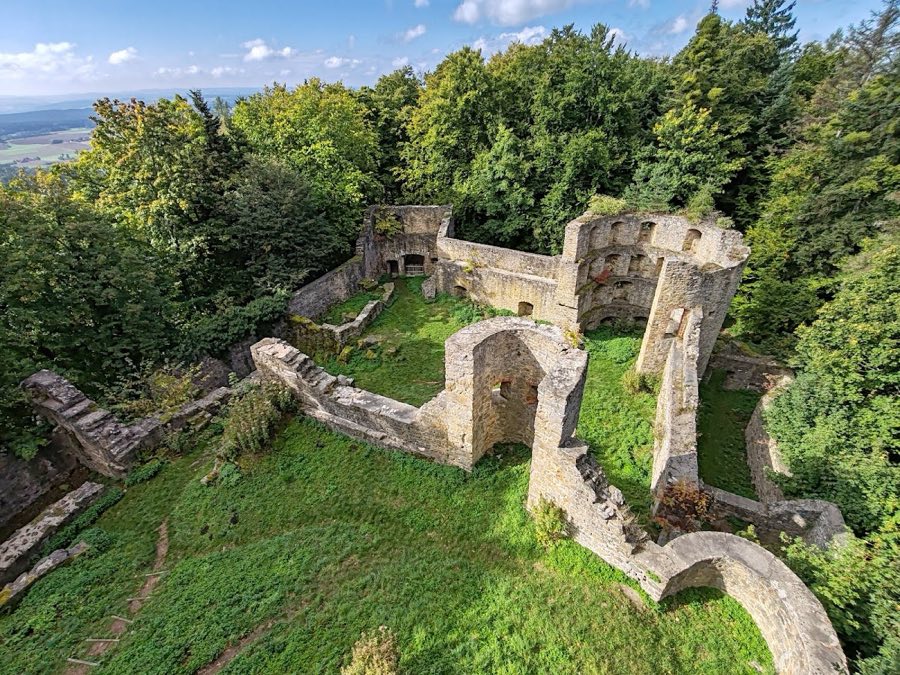
The ruin represents a late Gothic complex and is among the later medieval foundations in the area. The plan extends across the Haidberg and originally combined a defended core with outworks to the west and north; the surviving masonry reveals the footprint of a substantial defensive and domestic ensemble dating to the later Middle Ages. Defensive waterworks and outer earthworks remain visible, notably a broad moat to the west that marked the outer limit of the enclosure.
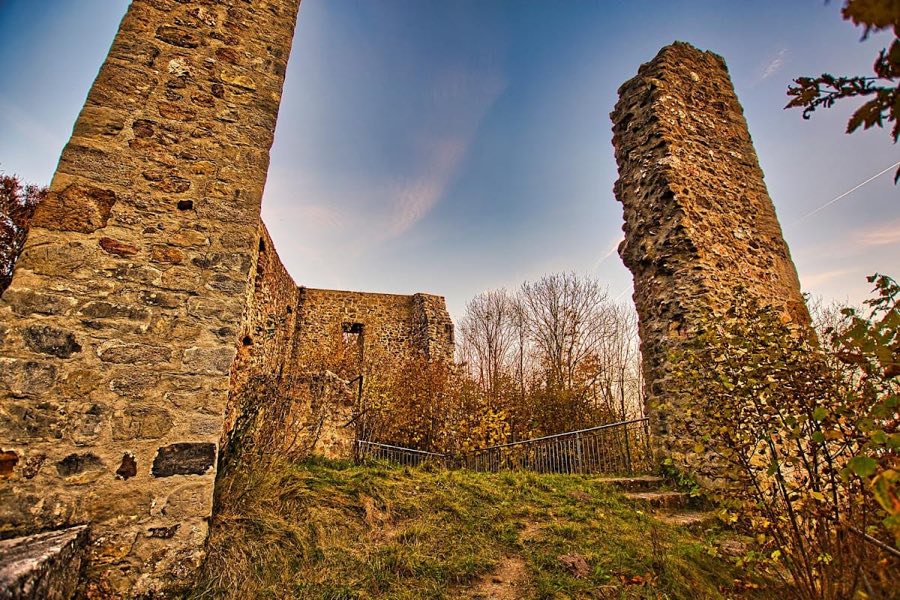
The site contains three successive courtyards, whose organization is still legible in the remaining foundations and long stretches of curtain wall. Two gate buildings controlled access through the ramparts and their positions remain traceable in the standing fabric. Several towers, some with partly semicircular plans, project from the curtain walls; among these is a large artillery or battery tower whose mass and form are apparent in the ruin. Wall fragments and tower bases indicate the former vertical rhythm of the fortification.
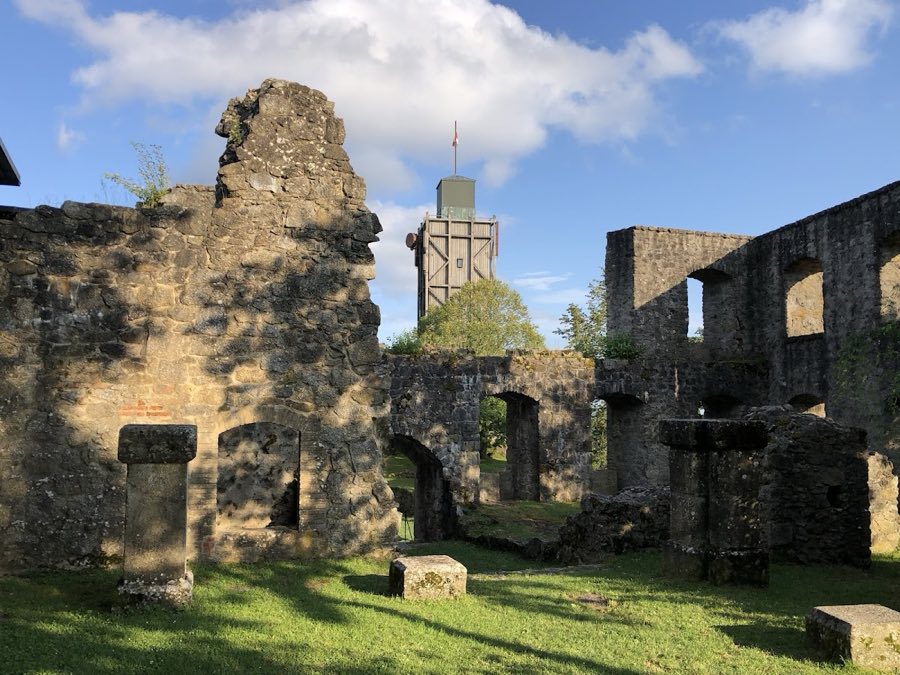
A rectangular, tower-like residential hall (palas) stands within the main compound and is undercellared; its upper storey projects by about 25 centimetres on corbelled stones, a detail that is still visible. The complex comprises a main castle, an outer bailey and an inner narrow ward, with extensive wall remains of these elements preserved in situ. The ruin sits at about 571 metres above sea level on the Haidberg, roughly one kilometre northeast of Stamsried. The remains were stabilised and conserved at the end of the 1970s, a viewing platform has been installed, and the site is freely accessible. The monument’s protective status and its entry in the archaeological registry record the surviving fabric and the finds from the medieval ruin.
No. 32356
No. 19570
No. 75875
No. 42103
Comments
Comments for Burg Kürnberg will require a verified account before posting.
We'll send a verification link before your first comment is published.