No. 76649
Wasserburg Gauangelloch
Germany
CastleRuin15th century
No. 59704
No. 59704 · 49.407 N, 8.825 E
Quick summary
Burg Schadeck is a castle in Germany with origins associated with the 14th century.
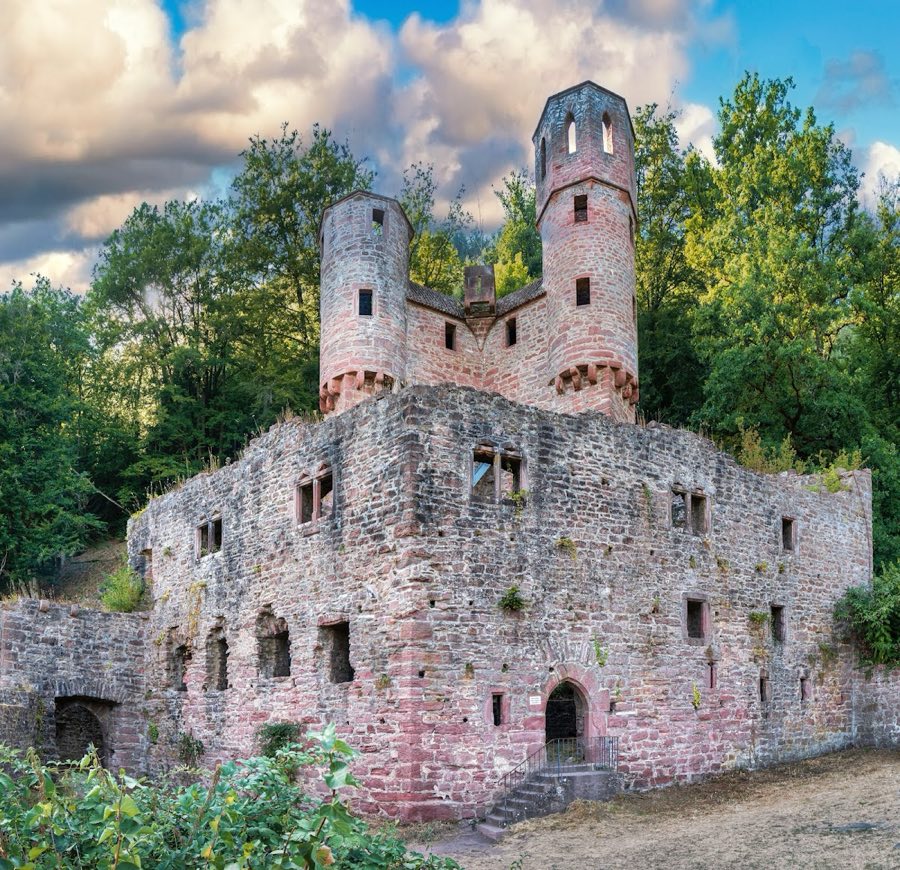
See all castles in GermanyBurg Schadeck stands near Neckarsteinach, Germany; it was established by members of a medieval German noble family. The castle is the youngest of the four fortifications at Neckarsteinach and was likely founded by Ulrich II, the youngest son of Ulrich I von Steinach. Building the site required removing a large portion of the cliff to create a usable platform. The place name appeared early as Schadheck and later as Schadeck, a form meaning “swallow’s nest,” and this name became associated with the Landschad von Steinach family.
In 1335 two members of the Landschad family, Bligger X and Dieter I, each sold a half share of the castle to the religious chapters of Worms and Mainz. Around 1350 the Worms share seems to have been taken over by Mainz by force. By 1395 the holdings were held in several divided shares, pledged to descendants of the sons of Eberhard von Rosenberg, who served as Mainz’s official at Walldürn; those descendants in turn alienated portions to other lesser nobles.
In 1428 Archbishop Konrad of Mainz controlled the entire site and pledged it to Dieter II Landschad von Steinach. When that pledge was not redeemed, the castle passed into the Landschad family as an allodial possession. The Landschad lineage maintained the property until the main Hansian line ended with Dieter VIII in 1625. On 6 May 1657 Dieter VIII’s daughter, Eva Elisabeth, sold Schadeck together with the remaining Landschad allods to Wolf Heinrich Metternich zu Burscheid. After the Burscheid Metternich line died out in 1753 the castle and its earlier ties passed to the chapters of Speyer and Worms. In 1803 the territorial possessions of those chapters were transferred to the state of Hesse, which remains the owner.
The castle’s internal plan changed over time. In the fifteenth century a major alteration moved the great hall into the sheltered angle formed by the main defensive wall, and the defensive walkway along that wall received a tower at each end. In the nineteenth century a northern tower was given an octagonal upper structure as part of a period of romanticizing restorations. One of the upper towers carries a dated inscription of 1871; no connection between that inscription and the Franco–Prussian War has been established in the available record.
Burg Schadeck occupies a rocky, steep slope facing the Neckar rather than the higher ridge where the other Neckarsteinach castles sit. The site was created in part by cutting away a substantial section of the cliff to make room for buildings. The original route up to the castle followed a winding path carved into the hillside; at a later stage access was provided by a neck ditch cut directly into the rock, forming a deliberate defensive approach.
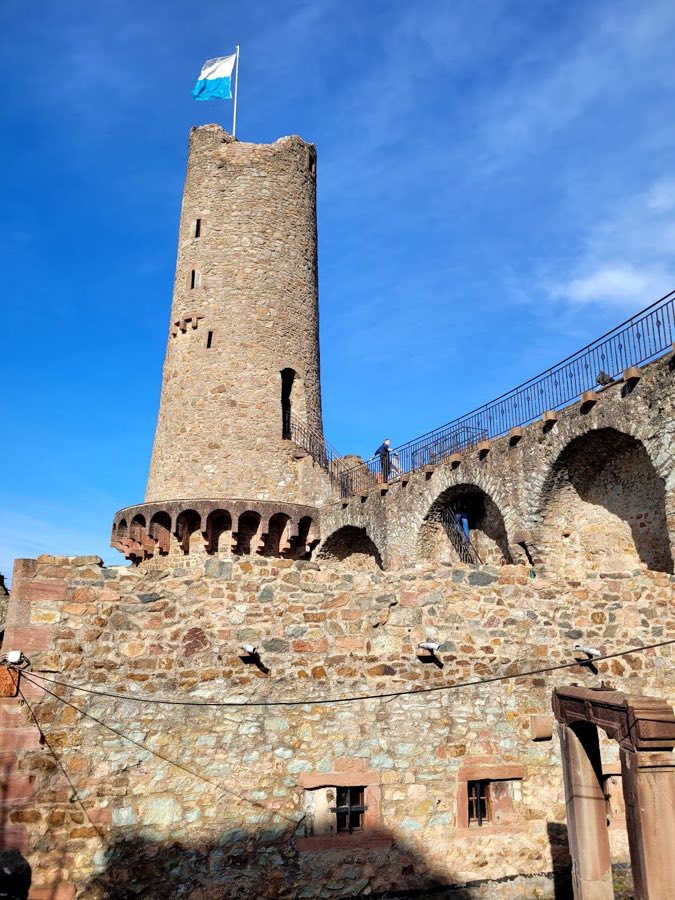
The castle’s defensive layout is centered on a two-winged shield wall whose point faces the rock massif instead of a freestanding central keep. A defensive walkway runs along this shield wall. In the fifteenth-century remodeling the great hall was relocated into the protected but damp angle formed by the two wings, and the defensive walk was extended to include a tower at each end. The northern tower received an octagonal upper structure in the nineteenth century, a modification carried out in a romanticizing spirit and comparable to changes made at the nearby Mittelburg. Today these wall elements and towers survive in ruined form.
Within the enclosed area, the remains of earlier residential buildings stand in the core ward and one former great-hall building lay where the present courtyard now is. Surviving window openings in that courtyard face toward Neckarsteinach and still give a view down the slope. Overall the site is a ruin; masonry and rock-cut features remain in situ and one of the upper towers bears a clear inscription dated 1871, recording that later nineteenth-century intervention.
No. 76649
No. 94192
No. 49675
No. 73431
Comments
Comments for Burg Schadeck will require a verified account before posting.
We'll send a verification link before your first comment is published.