No. 94192
Burg Schauenburg
Germany
CastleRuin14th century
No. 49675
Castle · Germany
No. 49675 · 49.475 N, 8.669 E
Quick summary
Strahlenburg Castle is a castle in Germany with origins associated with the 13th century.
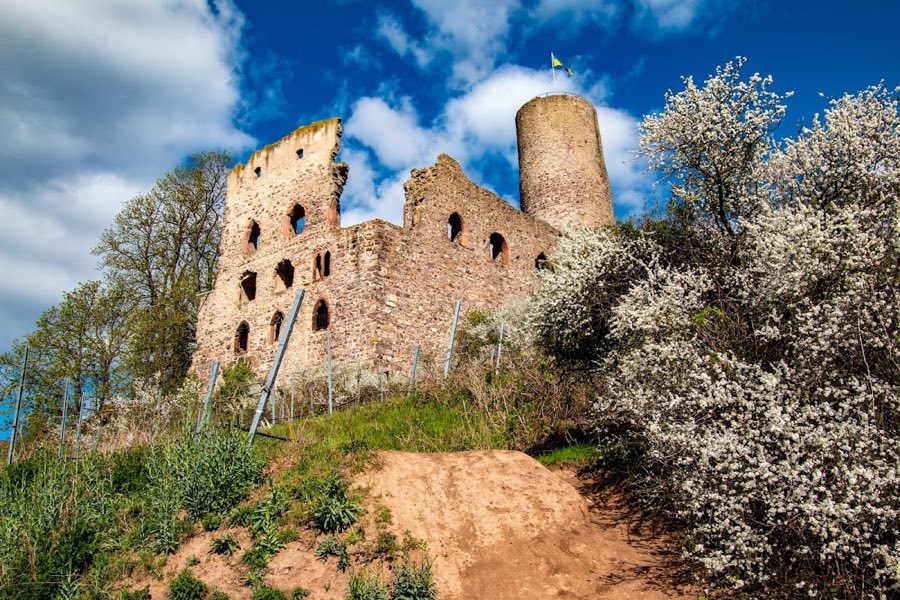
See all castles in GermanyStrahlenburg is a medieval castle located in the municipality of Schriesheim, Germany. It was constructed in the early 13th century by members of the Strahlenberg family, a local noble lineage.
The castle’s origins trace back to around 1235 when Conrad I von Strahlenberg began its construction as the family’s ancestral home. He is first recorded in historical documents in 1240 as the Vogt, or protector, of Schriesheim. From the outset, Strahlenburg was a fiefdom under the Benedictine monastery of Ellwangen. This relationship sparked territorial disputes but ultimately led to Conrad being acknowledged as the monastery’s beneficiary. Early building phases included the erection of a tall bergfried (a defensive tower roughly 30 meters high) and accompanying inner structures, while the main residential building, known as the palas, was likely added during the 14th century.
Financial hardships forced Rennewart von Strahlenberg, a later family member, to pledge the castle and the nearby town to Hartmut V. von Cronberg in 1329. Cronberg undertook significant refurbishments during his stewardship until he died in 1338. Although an agreement was made to sell Strahlenburg to the Archbishopric of Mainz in 1346, this transaction did not proceed because Rennewart managed to redeem the pledge. However, the following year, he sold the castle to Elector Ruprecht I of the Palatinate, a key territorial ruler in the region.
Following Ruprecht I’s death in 1410, Strahlenburg changed hands among various branches of the Palatinate family. By 1468, ownership had passed to Ludwig I of Veldenz-Zweibrücken. A notable conflict occurred in May 1470 during a feud between Ludwig I and Elector Friedrich I of the Palatinate. Palatinate forces laid siege to Strahlenburg, successfully capturing it after overcoming its defenders. The entire garrison was taken prisoner, and sixteen foot soldiers were executed for breaking their oath of allegiance. The aftermath saw the demolition of Schriesheim’s town fortifications and the castle set on fire. Subsequently, the town lost its status and associated rights.
Despite the destruction, Strahlenburg remained occupied at least until 1485. It suffered another fire on 8 February 1488, this time without evidence of military involvement. Over the following centuries, the ruins gradually deteriorated. In 1733, authorities authorized the removal of building stones from the castle remnants for use in constructing vineyard retaining walls nearby. Ownership eventually passed to the Counts of Oberndorff, who became hereditary leaseholders in 1784 and then full proprietors in 1828. They undertook efforts to preserve the remaining ruins, marking an early phase of conservation.
Today, Strahlenburg remains privately owned, standing as a historical monument reflecting the complex feudal and military history of the region.
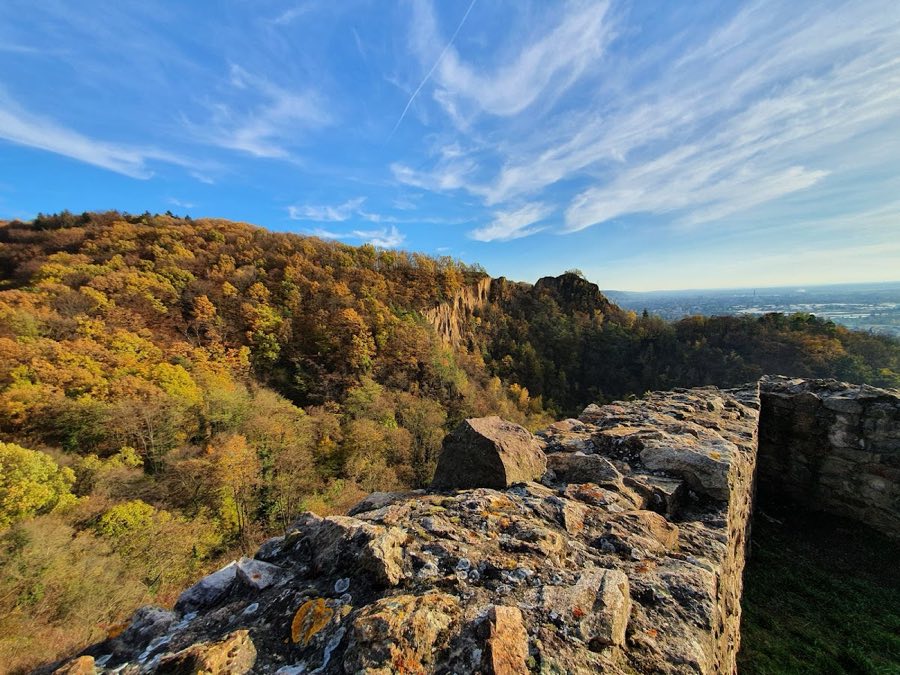
Strahlenburg is situated on the slope of the Ölberg, also known locally as the Schriesheimer Schlossberg, offering commanding views over Schriesheim and the nearby Upper Rhine Plain. On clear days, the vistas extend to the Palatinate Forest and the Donnersberg, the highest peak in the Palatinate region. The castle’s construction prominently features local materials, including porphyry and granite quarried directly from the rocky outcrop beneath.
One of the most prominent surviving elements is the bergfried, a slender, tall tower approximately 27 meters in height. This round tower, which originally served a defensive purpose, is built simply but solidly. Due to emerging structural concerns, it is currently closed to visitors. Adjacent to the bergfried is the palas, the main residential section of the castle. Though partly gutted and collapsed, it retains significant architectural details. Among these are three early Gothic windows dating back to around or before 1237. Each window is composed of two tall, narrow lancet openings topped by a circular light, a style characteristic of the period.
Encircling the castle is a ring wall designed in the shape of an almost regular pentagon. One corner of this wall faces toward the mountain slope, which was considered the most vulnerable angle in the castle’s defensive layout. The fortifications demonstrate an understanding of both natural terrain and building materials to maximize protection.
Within the castle grounds today, a modern establishment known as the Burggasthof Strahlenburg operates as a restaurant. Although integrated into the historic environment, this contemporary usage takes place within the bounds of the preserved ruins, which remain an important testament to the castle’s long and eventful history.
No. 94192
No. 73431
No. 59704
No. 76649
Comments
Comments for Strahlenburg Castle will require a verified account before posting.
We'll send a verification link before your first comment is published.