
No. 78726
Tomen yr Allt
United Kingdom
CastleRuin12th century
No. 14587
Castle · United Kingdom
No. 14587 · 52.979 N, 3.160 W
Quick summary
Castell Dinas Brân is a castle in United Kingdom with origins associated with the 8th century.
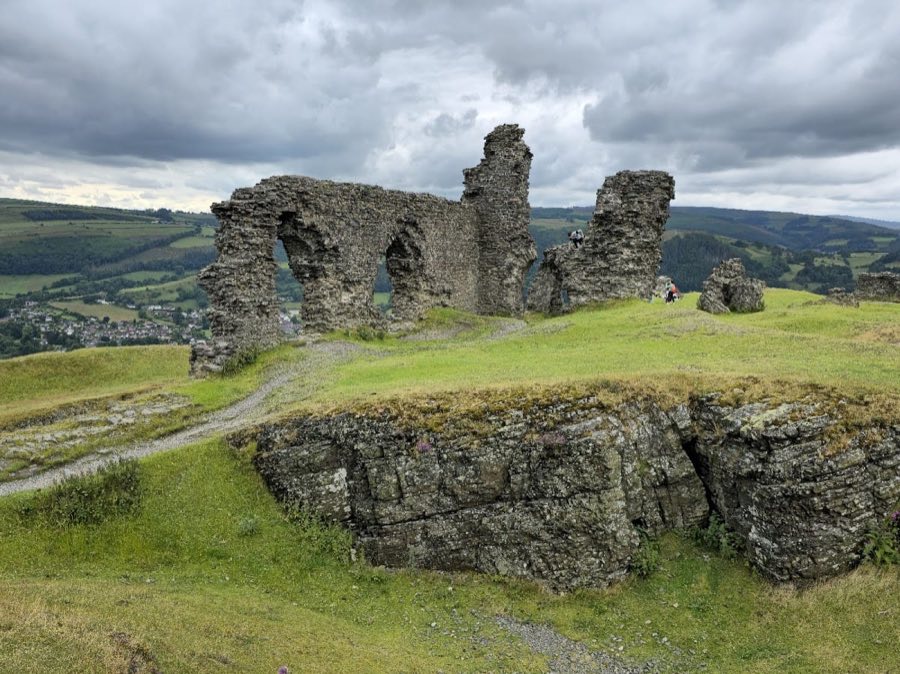
See all castles in United KingdomCastell Dinas Brân sits atop a hill overlooking the town of Llangollen in Wales. This site has a long history of human use, beginning with the Celtic Ordovices tribe who fortified the hill around 600 BCE, constructing earthworks and wooden defenses to guard the southern slopes.
During the early medieval period, the location is thought to have hosted a wooden fortification possibly linked to Elisedd ap Gwylog, a Romano-British ruler credited with founding the kingdom of Powys. Although no direct archaeological evidence survives from this time, historical tradition suggests a continuation of the site’s strategic importance through the 8th century.
In the 13th century, Gruffydd Maelor II, prince of Powys Fadog, replaced earlier wooden structures with a stone castle. Built in the 1260s, this construction reflected Powys Fadog’s role as a border principality allied with Llywelyn ap Gruffudd, Prince of Wales. The stone fortress served both defensive and administrative purposes during a period marked by tension between Welsh princes and the expanding English crown.
Following Gruffydd II’s death around 1270, his four sons inherited the castle. In 1277, when Edward I launched his campaign to conquer North Wales, the castle’s defenders abandoned it, setting fire to the structure to deny its use to the advancing English forces. The English repaired the castle and maintained a garrison until the Treaty of Aberconwy later that year. Its role during the 1282 conflict is less clear, but the castle likely succumbed to English control and was then overshadowed by nearby Holt Castle, which became the preferred stronghold. After this, Castell Dinas Brân was left in ruin and ceased to function as a military or residential site.
Centuries later, the romantic ruins of the castle inspired artists such as J. M. W. Turner and Richard Wilson, who captured its dramatic presence overlooking the Dee Valley.
Castell Dinas Brân occupies a rectangular hilltop enclosure defined by stone walls laid out along an east-west axis. The castle takes full advantage of natural defenses, with the northern side protected by a steep cliff dropping several hundred feet, while the southern and eastern walls are bolstered by a deep, 20-foot rock-cut ditch accompanied by an earthen bank called a counterscarp.
At the south-eastern corner stands the castle’s keep, a strong, two-storey stone building stationed to overlook the most accessible approach to the fortress from the River Dee. Next to the keep on the north-eastern corner is the gatehouse, flanked by two towers and once reached by a wooden bridge over the defensive ditch. Although only minimal remains of this bridge survive, its original design allowed defenders to control access closely. The gatehouse passage was covered and decorated, providing a vantage point for archers positioned in the adjoining keep.
Along the southern side lies the Great Hall, distinguished by enlarged windows facing the valley, which allowed light and views across the landscape. At its western end, an arched gateway leads to the former kitchens, located beneath the adjacent Welsh Tower. This D-shaped, or apsidal, tower projects into the defensive ditch and rises three storeys, with living spaces above. It offered archers a clear line of fire along the southern curtain wall.
In the south-west corner of the enclosure, a postern gate served as a sally port—a secret exit used during sieges. Remnants of its arch and the slot for a door’s drawbar remain visible today. Inside the castle walls, wooden buildings such as stables, workshops, storage areas, and possibly a chapel once stood, although no above-ground traces survive.
Local tradition from the 19th century recorded a tower at Tower Farm, situated about a mile from the castle, which may have functioned as an outwork linked to the castle’s defenses, though this is not archaeologically confirmed.
The castle is perched on a hill rising over 300 meters above sea level, composed of Silurian-era marine mudstones. The stone used for the castle’s walls and defensive ditches was quarried on site, with the ditches also serving as formidable obstacles to attackers. The surrounding geology preserves fossils of ancient sea creatures including nautiloids, brachiopods, and trilobites, some of which can be found in rubble below the castle slope.
No. 78726
No. 40393
No. 85855
No. 27475
Comments
Comments for Castell Dinas Brân will require a verified account before posting.
We'll send a verification link before your first comment is published.