No. 25807
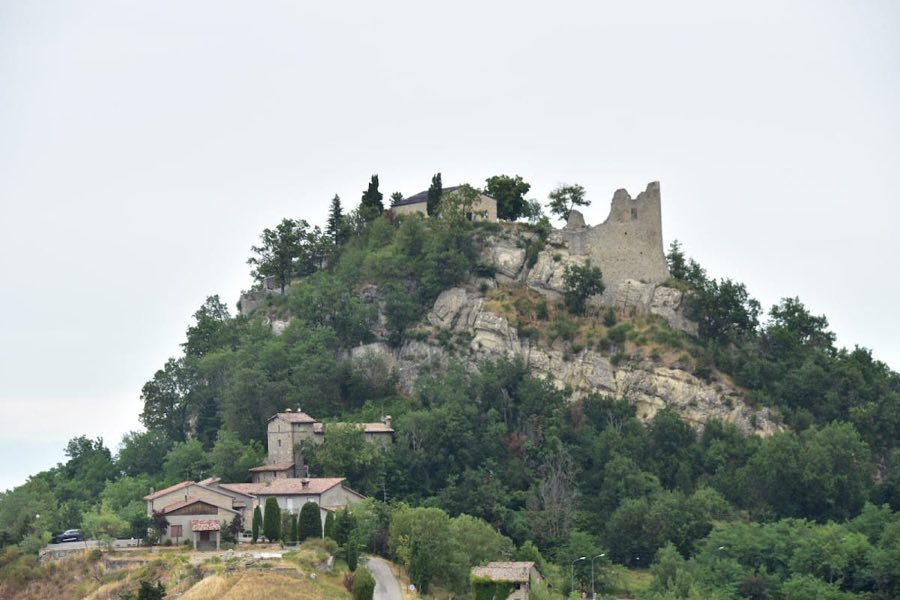
Canossa Castle
Italy
CastleRuin10th century
No. 59741
No. 59741 · 44.701 N, 10.446 E
Quick summary
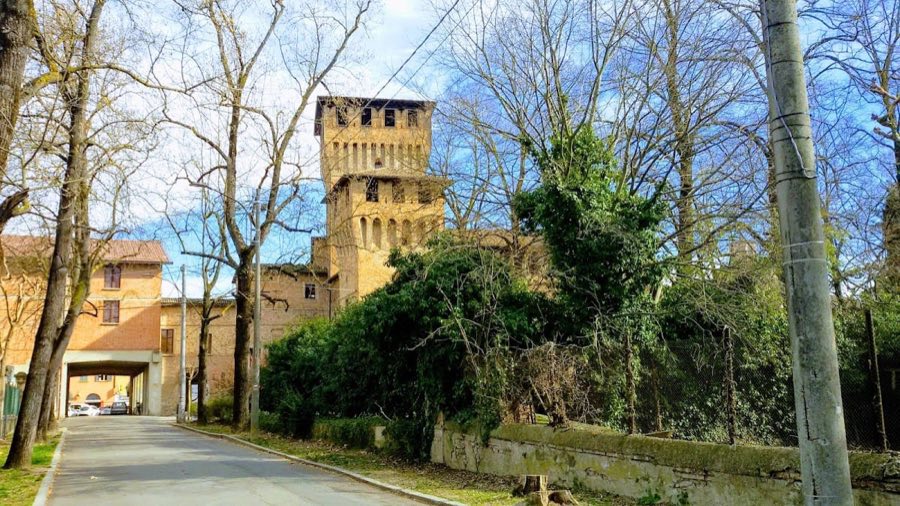
Castello di Montecchio Emilia is a castle in Italy with origins associated with the 13th century.
See all castles in ItalyThe Castello di Montecchio Emilia, situated in the town of Montecchio Emilia in Italy, was originally constructed by the medieval Canossa family as part of their defensive strategy along the Enza river. Its earliest known record appears in 1114 within a charter endorsed by Matilde di Canossa, a powerful noble who played a significant role in northern Italy during the 11th and 12th centuries. The castle’s location was chosen carefully to guard the foothills and form a line of fortifications protecting the surrounding territory.
During the 13th century, control of Montecchio shifted to the commune of Parma. Amid ongoing conflicts between regional lordships and religious authorities, Parma sought to maintain dominance over the area. In 1247, while Parma aligned with the Guelph faction, which supported the papacy, Montecchio remained loyal to the Holy Roman Emperor, reflecting the castle’s role as a site of imperial allegiance in a divided political landscape.
Leadership of the castle passed to the Vicedomini family, who maintained authority until 1348. This period saw violent confrontations affecting the fortress, including its partial destruction and dismantling in 1317 at the hands of Giberto III da Correggio, a local lord known for territorial disputes. In 1348, the Este lord Obizzo III transferred control to the Visconti family, who ousted previous rulers, appointed a new official to administer the castle, and undertook significant strengthening efforts to secure their hold.
The 15th century brought restoration and further improvements. In 1426, Agnolo della Pergola directed repair works, followed by additional updates between 1440 and 1455. Later enhancements were overseen by Guido Torelli and members of the Este family, who established permanent residence at Montecchio in 1486, signaling a shift from military outpost to noble estate.
In 1638, Luigi I d’Este took up residence as Marquis of Montecchio. His tenure involved notable changes, including the closure of the castle’s defensive moats in 1649, reflecting evolving military needs and possibly the reduced threat of siege warfare. The castle’s appearance was further altered in the early 19th century, when porticos were constructed facing the town square between 1813 and 1823, indicating adaptation for more peaceful, residential purposes.
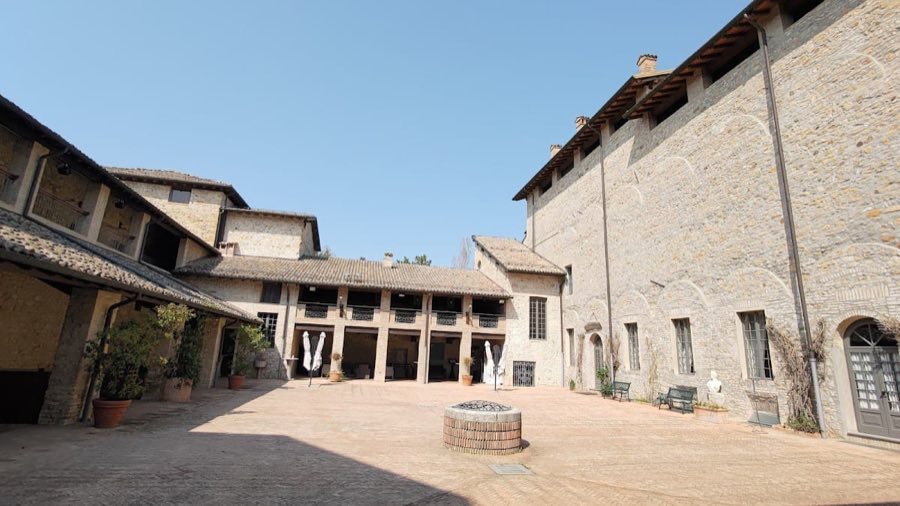
The Castello di Montecchio Emilia occupies an irregular quadrilateral footprint shaped by centuries of repair and modification, marking the western edge of the town’s historic center. Its oldest portion dates from the early 12th century, identifiable by the inclusion of an historic clock and attributed to the original Matildian construction phase under Matilde di Canossa. The layout exemplifies how the structure evolved over time, integrating defensive needs with domestic functions.
Two prominent towers dominate the castle, both featuring solid roofs and encircled at the top by battlement walkways. These walkways are lined with full crenellations, the notched parapets typical of medieval fortifications that provided cover for defenders. This continuous battlement design allows movement and defense around the towers’ summits, reflecting the castle’s military origins and ongoing strategic importance through successive occupations.
Surrounding the castle were once extensive defensive moats, known locally as the Fosse della Rocchetta. These water-filled trenches were standard elements of medieval military architecture to hinder enemy approach. However, in the mid-17th century under Luigi I d’Este’s command, these moats were intentionally filled in, a change that signaled both shifting defensive strategies and adaptations suited to peacetime residence.
Facing the adjacent town square are porticos built in the early 19th century. These covered walkways provided sheltered spaces and architectural refinement, demonstrating the castle’s transformation from a purely defensive stronghold to a structure integrated into the civic life of Montecchio Emilia. Today, these porticos remain a visible reminder of the castle’s layered history and evolving role within the community.
No. 25807
No. 90829
No. 91559

No. 54031
Comments
Comments for Castello di Montecchio Emilia will require a verified account before posting.
We'll send a verification link before your first comment is published.