No. 89607
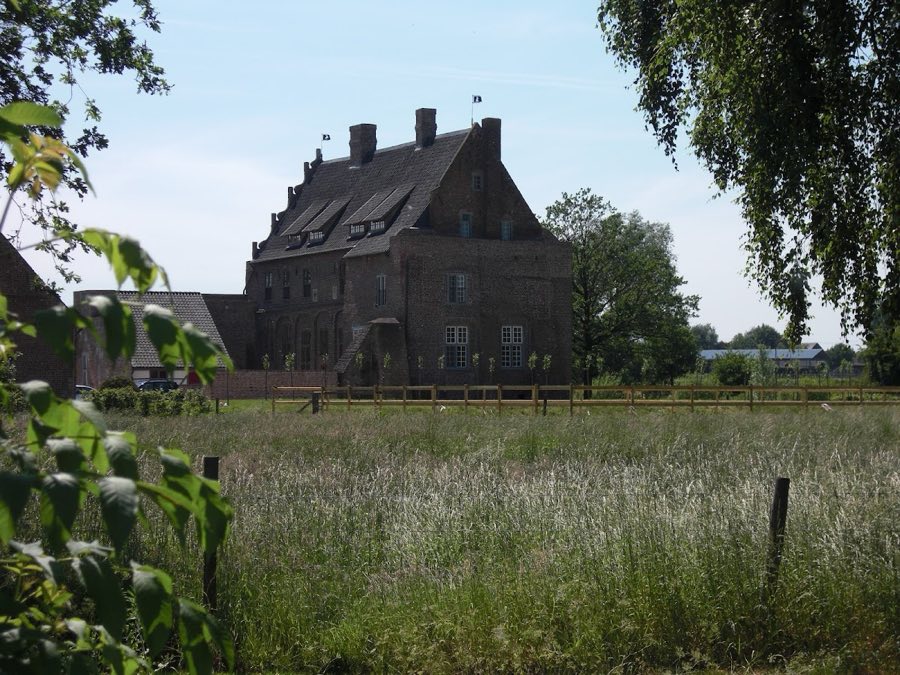
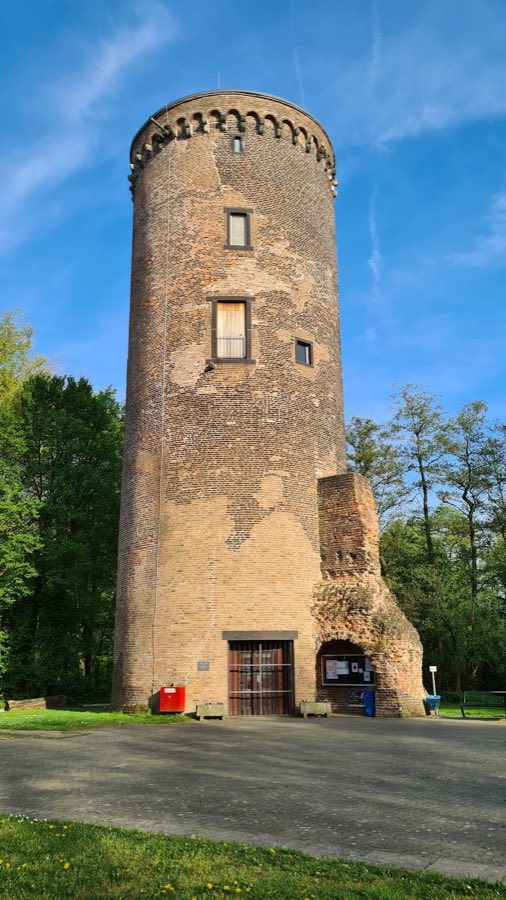
Haus Vlassrath
Germany
Manor houseRestored14th century
No. 92616
Castle · Netherlands
No. 92616 · 51.471 N, 6.185 E
Quick summary
Castle Arcen is a castle in Netherlands with origins associated with the 16th century.
See all castles in NetherlandsCastle Arcen in Arcen, Netherlands, occupies a site with medieval origins and was developed by local noble houses tied to the lords of Gelre. The place has known occupation from the 14th and 15th centuries and underwent major building phases in the early 1500s and again in the early 1700s, so its story spans late medieval lordship through early modern rebuilding. The site served as a local manorial residence and was repeatedly refashioned after conflict and damage, making it an enduring element in the region’s landscape.
The earliest recognizable occupation bore the name Den Kamp. Excavations recovered fragments of marlstone walling and pottery dated to the 14th and 15th centuries, which point to a medieval settlement there that was probably destroyed in 1511. In 1498 the location appears under the name “hoff op ten Kamp” and belonged to Wynand Schenck van Nydeggen, lord of Arcen. A later reference, in 1556, uses the name “huyss den Kamp” to refer to the house rebuilt after the 1511 destruction.
A change of ownership and rebuilding followed at the start of the 16th century. In 1503 Reiner van Gelre, an illegitimate brother of Duke Karel van Gelre, married Aleid, heiress of Wynand Schenck van Nydeggen, and thus came into control of both the older house and the Aldt Huys. After Den Kamp was lost in 1511, Reiner erected a new residence on the same site between about 1511 and 1522, known as Nije Huys, or New House. Dirk van Gelder, Reiner’s son, succeeded to Nije Huys and the lordship of Arcen in 1536.
Nije Huys did not survive the seventeenth century intact. The house was destroyed in 1646 during the siege of Venlo, a military action that affected the surrounding estates. On the footprint of the ruined buildings the fortified outer courtyard was rebuilt in 1653 by Marcelis van Gelder. His grandson Adolf later established the existing main house in the early 18th century, creating the principal structure that stands today. A fire in the 19th century led to the removal of the projecting north side wing that once balanced the building’s composition.
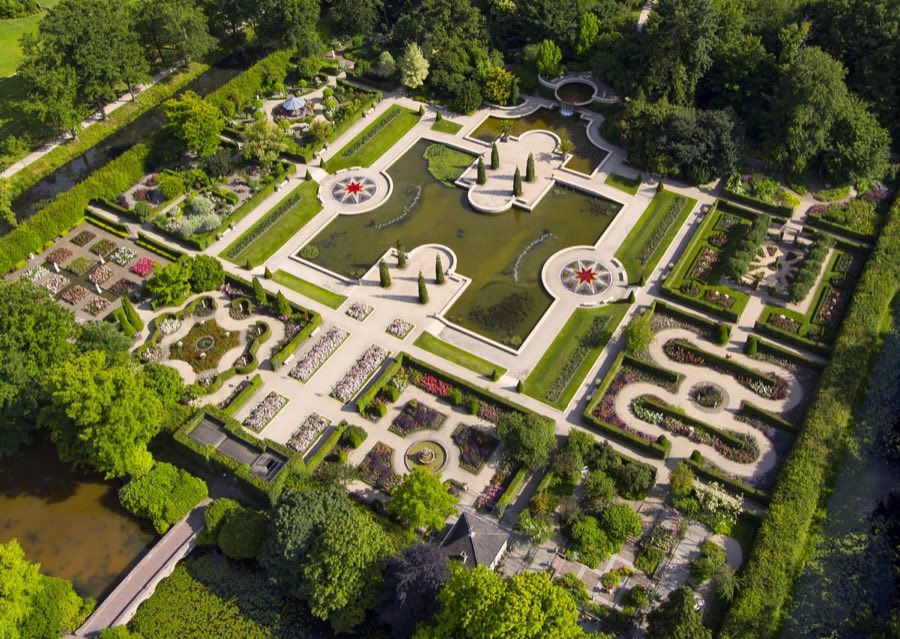
Over time the castle and its grounds were treated as a single estate, including extensive gardens. The property changed administrative hands in recent years and returned to the care of a regional landscape foundation following financial collapse in 2012, the park reopening to the public in April 2013. The grounds also preserve traces of earlier landscape features, including two historic garden mazes that survive as archaeological remains and date at least to before 1805 and possibly to the early 18th century.
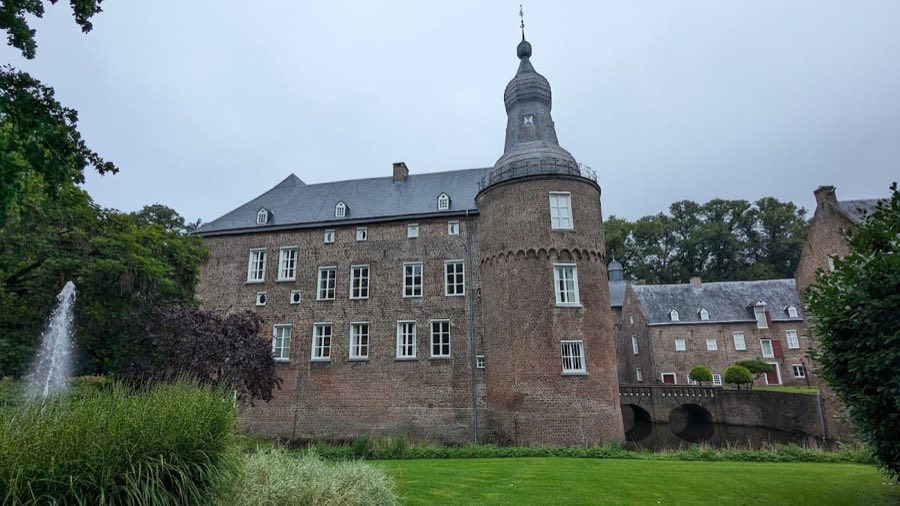
The site sits surrounded by two concentric water defenses, a double moat that defines the castle’s setting and underlines its defensive and high-status character. The buildings are mainly of brick, while the main entrance is framed in natural stone, a contrasting material used to emphasize the gateway. Above the entrance to the outer courtyard, a carved stone bears the combined coat of arms of Gelder–van Lützenrode, and a separate heraldic stone with the Gelder–van Nesselrode alliance stands on the south side of the square, having been brought in from another location.
The fortified outer courtyard (a defended outer area in front of the main house) occupies ground that once held earlier service buildings destroyed in the mid-1600s; its construction dates to 1653. The present principal house was erected in the early 18th century and originally featured two projecting side wings in a French-inspired layout, the paired wings giving the façade a wide, formal composition. After a fire in the 1800s the projecting north wing was taken down, altering that original bilateral plan.
Archaeological remains on the estate document the site’s longer history. Marlstone wall fragments and pottery sherds from the 14th and 15th centuries were uncovered in 1984, attesting to the medieval Den Kamp occupation that preceded the 1511 destruction. On the planted grounds are the vestiges of two historical mazes, traces of paths and earthworks that date to at least before 1805 and possibly to the early 18th century; these two garden mazes represent the oldest known examples of their type in the Netherlands. The surviving features range from in situ masonry fragments to earthwork outlines and are preserved as part of the castle landscape.
No. 89607
No. 11277
No. 35486
No. 36564
Comments
Comments for Castle Arcen will require a verified account before posting.
We'll send a verification link before your first comment is published.