No. 35486
Well Castle
Netherlands
CastleIntact14th century
No. 11277
Castle · Netherlands
No. 11277 · 51.531 N, 6.112 E
Quick summary
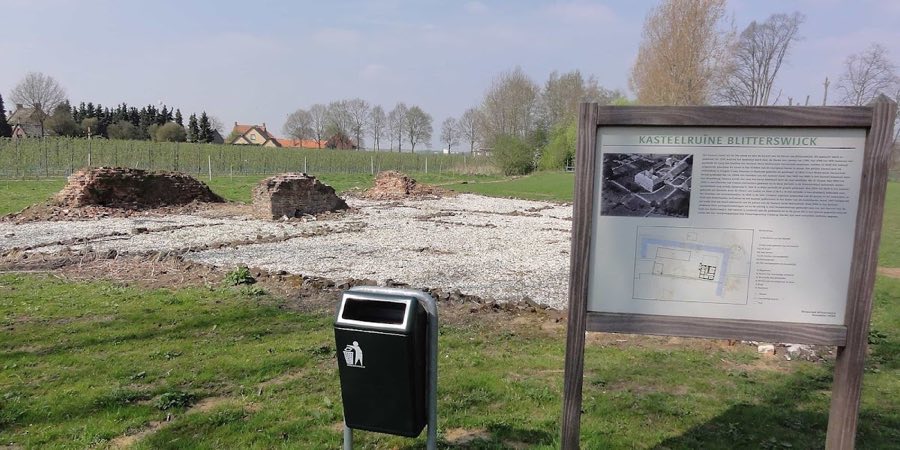
Kasteel Blitterswijck is a castle in Netherlands with origins associated with the 13th century.
See all castles in NetherlandsKasteel Blitterswijck stands near Blitterswijck in the municipality of Venray, Netherlands, and was erected by medieval local lords.
The site appears in surviving records from the later Middle Ages. Members of the Blitterswijck family are named from the thirteenth century, beginning with Willem van Blitterswijck in 1242. Later family members recorded include Wouter (1316), Robbert (1330), and Sybrecht, who is attested in 1359 and was married to Elisabeth van Broeckhuysen; Sybrecht died around 1406. His successor Arnt van Blitterswijck, who married Elisabeth van der Donck, died in 1449. Johan van Blitterswijck followed in the line of succession and in 1502 Dirk van Blitterswijck became lord, dying about 1515, after which his sister Walburga inherited the lordship.
Walburga’s marriage transferred the heerlijkheid into the Van Lynden family. She married Dirk van Lynden, who also held Hemmen, and their son Jasper van Lynden received the lordship in 1516. The Van Lynden family retained control into the eighteenth century, apart from a period between 1683 and 1692 during which the property changed hands and was later repurchased. Around 1585 the house described as “Blitterswijck and Gysteren” was seized and occupied by soldiers loyal to Spain; the Van Lynden family are documented as Protestant. Johanna Elisabeth van Lynden married Johan van Ossenbroich, who obtained the usufruct of the heerlijkheid in 1603 and died in 1615, with burial recorded at Kalkum. By 1670 Frans van Lynden had repaired and made the castle habitable once more after a period of decay.
Named lords continue to appear in later records: Diederik Wolter van Lynden is noted in 1700 and Frans Godart van Lynden in 1749. In 1788 hereditary rights passed to Barthold baron de Cocq van Haeften, a grandson of Frans Godart. The castle was given decorative work in 1789 and underwent alteration in 1806. In 1822 Arnoldina Margaretha Mackay, wife of Barthold, arranged for a Protestant church to be built at Blitterswijck. Throughout the nineteenth and early twentieth centuries the property changed owners several times: Frederik Willern baron von Hamelberg acquired it in 1857; Anna Ephenia Schinasen purchased it in 1885; Joseph Servatius Hubertus Brouwers in 1899; a community of French sisters in 1904; the Fathers of the African Missions of Saint Paul in 1920; and Alfons Cremers in 1935.
In November 1944, German troops in retreat destroyed the castle by explosion, leaving the site as a ruin. The municipality of Meerlo‑Wanssum bought the ruined property in 1964. Archaeological work carried out in 1969 investigated the remains.
Excavation and investigation established that the standing fabric at the site consists predominantly of medieval wall sections dating to the fourteenth century, with deeper structural remains belonging to an earlier building. The surviving walls were identified by archaeologists as belonging to the castle phase of the site and were recorded in situ during fieldwork in 1969.
Beneath and alongside those wall sections, foundations from an older construction were exposed, showing that the present medieval walls were built upon earlier structural footprints. The investigation confirmed a sequence of building activity rather than a single construction event. Today the property survives as a fragmentary ruin, the visible masonry from the fourteenth century remaining as the principal archaeological feature and the older foundations preserved below ground level.
No. 35486
No. 92616
No. 89607
No. 73641
Comments
Comments for Kasteel Blitterswijck will require a verified account before posting.
We'll send a verification link before your first comment is published.