No. 54467
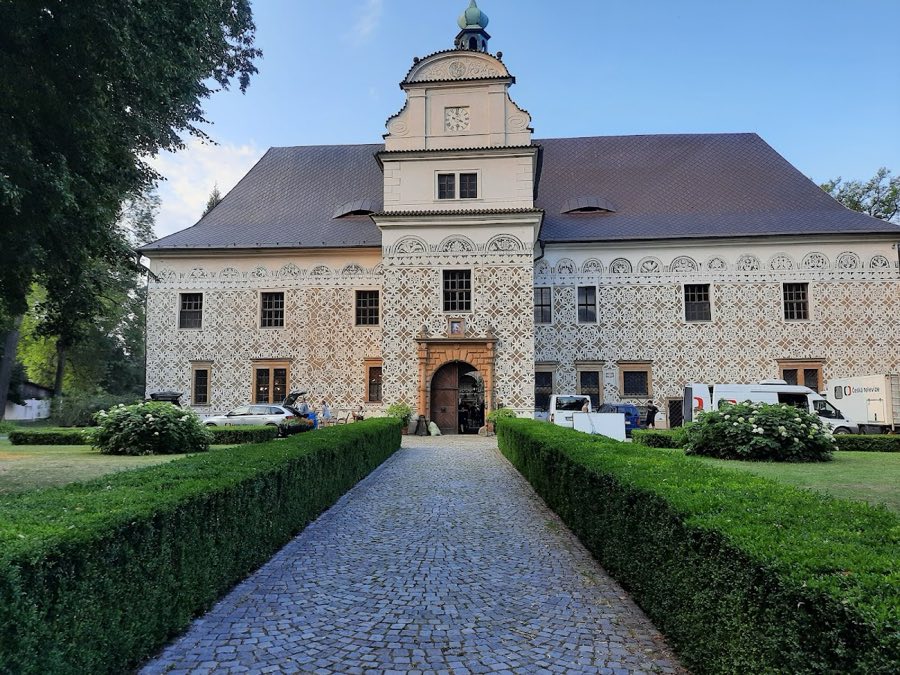
Doudleby Castle
Czechia
CastleRestored17th century
No. 35595
Château · Czechia
No. 35595 · 50.131 N, 16.187 E
Quick summary
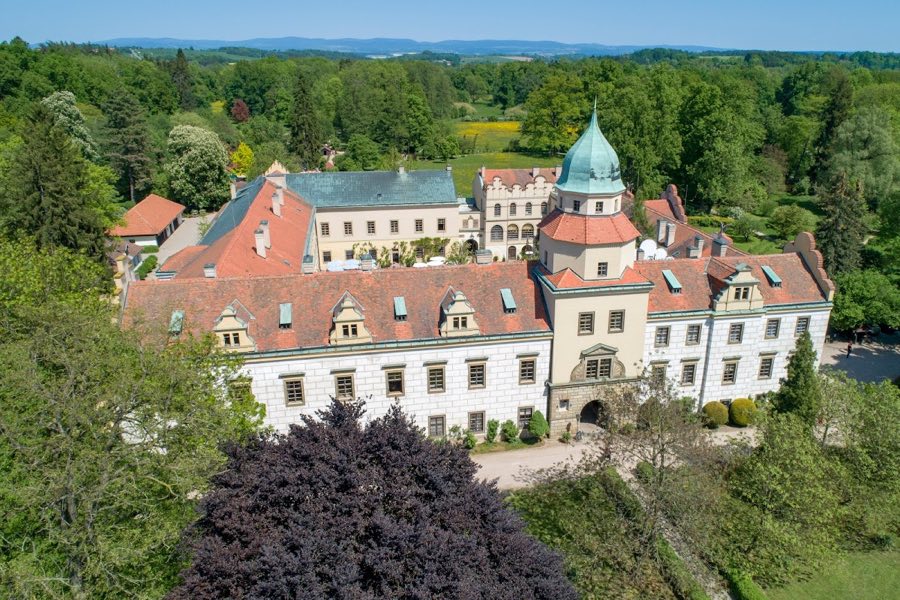
Častolovice Castle is a château in Czechia with origins associated with the 13th century.
See all castles in CzechiaČastolovice Castle in Častolovice, Czechia began as a water castle built by the Wild Adler in the 13th century and developed into a Renaissance palace that played a sustained role in regional noble administration. Its origins in a swampy foreland beside the Eagle Mountains gave it a defensive setting typical of medieval moated sites, and its later transformation into a Renaissance chateau under the Oppersdorff family marked its shift toward residential and cultural functions. Over the centuries the site belonged to leading local magnates and entered networks of Bohemian political life.
The first named proprietor, recorded in 1342, was the land judge Puta the Elder of Častolowitz; his son, known as Puta the Younger, later served as provincial governor and held pledges of the towns Glatz, Frankenstein and Münsterberg. The male line of that family ended in 1434. Ownership subsequently passed through several high-ranking hands, including the Bohemian king George of Poděbrady, his son Henry the Elder of Münsterberg, and Wilhelm II of Pernstein.
By 1559 the castle had been left uninhabited. In 1577 the brothers Johann, Wilhelm and Georg von Oppersdorff bought the deserted stronghold and its domains. Under Friedrich von Oppersdorff, between 1588 and 1615, the complex was rebuilt as a Renaissance chateau, replacing much of the medieval domestic fabric with a palace suited to late Renaissance noble life.
During the 17th century the property moved into other lines of the nobility. From 1684 it belonged to Count Thomas Czernin of Chudenitz, and in 1694 it passed to Adolf Wratislaw von Sternberg, who carried out a comprehensive renewal of the buildings. In the 18th and 19th centuries the Sternberg family continued to modify and occupy the estate; large-scale rebuilding took place between 1858 and 1874 under Jaroslav von Sternberg, and further work was carried out in 1910.
Under Franz Joseph von Sternberg-Manderscheid the castle became a local center for Enlightenment-era cultural life; the Czech linguist Josef Dobrovský visited several times and the historian František Palacký served as an archivist to the Sternbergs. The writer Bohuslav Balbín lived at Častolovice from 1625 to 1630 following his father’s death. In the mid-20th century ownership changed as state actions removed the Sternberg family from the property: the castle was nationalized following the February 1948 coup; other records place nationalization immediately after the Second World War. Leopold Sternberg (1896–1957) was dispossessed and emigrated to the United States with his wife Cecilia and daughter Diana after the 1948 nationalization.
The estate returned to the family line in the late 20th century. Records give two dates for restitution to heir Diana Phipps (Šternberková): 1990 in some accounts and 1993 in others. The castle library was returned along with the property in 1992, while remaining administratively under the National Museum in Prague.
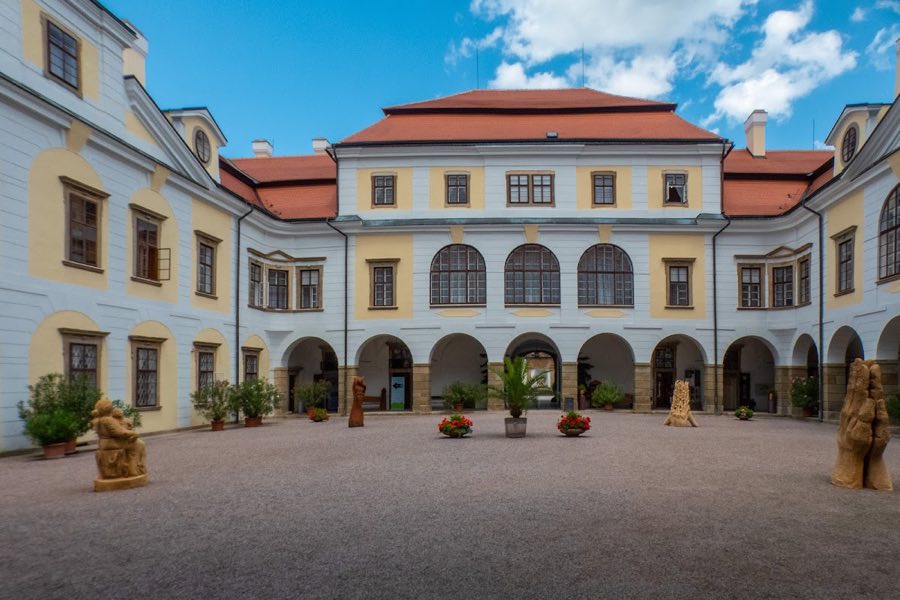
The castle stands around a square inner courtyard lined with arcades, a layout that reflects its transformation from fortified residence to Renaissance palace. The medieval core began as a moated stronghold sited in swampy ground near the Wild Adler, using water and earthwork to strengthen its defenses. That original fortification was adapted and absorbed into later building phases rather than being entirely replaced.
The principal visible phase dates to the Oppersdorff rebuilding between 1588 and 1615, when the complex was turned into a Renaissance-style chateau. During the 17th and 18th centuries the Sternberg family carried out further renewals; in 1694 Adolf Wratislaw von Sternberg ordered comprehensive works that reshaped interiors and façades. Major 19th‑century remodeling, undertaken between 1858 and 1874 under Jaroslav von Sternberg, introduced features in an English manner and altered the building’s appearance again; further alterations were made in 1910. These successive campaigns left layers of construction from the Renaissance and the 19th century visible today.
Interior fittings preserve richly decorated rooms that reflect the castle’s noble use. The dining-room contains a picture gallery of portraits of Bohemian rulers dated 1453–1705, a cycle originally from Neuhaus commissioned by Adam II of Neuhaus. The knights’ hall displays portraits of members of the Sternberg and Slavata families along its walls. A coffered ceiling with twenty-four painted panels shows scenes from the Old Testament, and valuable period furniture complements the palace rooms. The chapel houses an altar from the early 17th century said to have come from Tyrol.
The castle is set within an extensive English-style park that frames the palace and its approaches. In front of the main building stands a Marian column dated 1744, its pedestal bearing the coats of arms of Ulrich Adolf von Sternberg and his wife Anna Lucia Slavata. A historic fountain carrying the Sternberg coat of arms is also associated with the palace forecourt. The library was returned to family ownership in 1992 while remaining under the administration of the National Museum in Prague. Records indicate the palace is currently accessible to visitors.
No. 54467
No. 22336
No. 38226
No. 90554
Comments
Comments for Častolovice Castle will require a verified account before posting.
We'll send a verification link before your first comment is published.