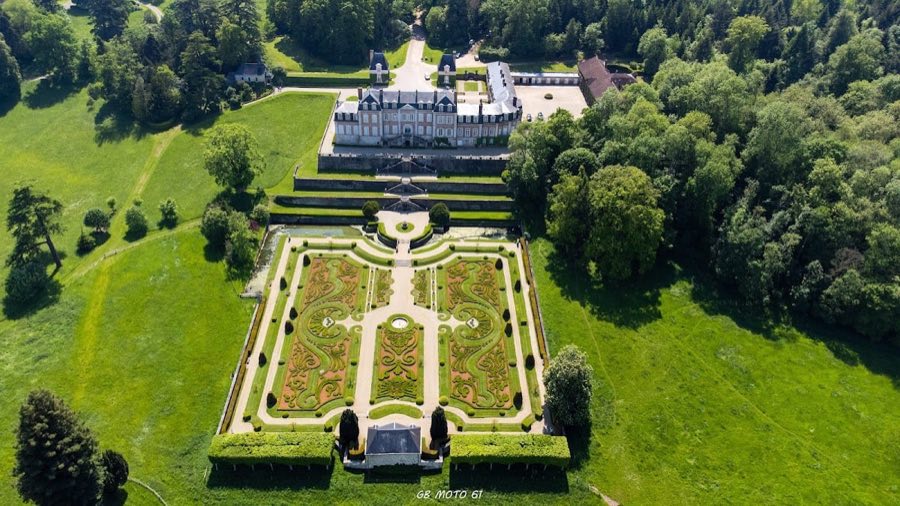
No. 53908
Château de Sassy
France
ChâteauIntactFor events18th century

No. 65266
No. 65266 · 48.648 N, 0.088 E
Quick summary
Château d'Ô is a château in France with origins associated with the 11th century.
See all castles in FranceChâteau d’Ô is situated in Mortrée, a commune in modern-day France. The estate originated as a fortified manor established by the Norman d’Ô family during the 11th century, marking its roots deeply within the medieval Norman nobility.
The earliest known member of the d’Ô lineage, Robert d’Ô, is recorded in 1035 for joining Duke Robert I of Normandy on a pilgrimage to the Holy Land, reflecting the family’s prominence and connection to the Norman ducal court. The site initially hosted a defensive manor designed to secure the family’s lands and influence in the region.
At the close of the 15th century, the castle as it stands today began to take shape under Robert VII d’Ô. Despite his death in 1415 at the Battle of Agincourt, his successors continued to develop the estate. Notably, Robert VIII d’Ô, Jean I d’Ô—who served as a counselor and chamberlain to King Charles VIII—and Jean II d’Ô, captain of the bodyguards under Henry II and Grand Seneschal of Normandy, all contributed to its expansion and refinement, highlighting the family’s ongoing roles in royal service and local governance.
During the 15th and 16th centuries, Charles II d’Ô and François d’Ô further enhanced the castle’s structure and ornamentation. François d’Ô, favored by King Henry III, invested heavily in improvements before his death in 1594 left the family burdened by debts, forcing the sale of the property.
In 1616, under the reign of Louis XIII, the estate was elevated to the status of a marquisate granted to Alexandre de La Guesle, a colonel in the Champagne regiment. Ownership passed through several hands thereafter, including the Montagu family from 1648 and later the Rocques family from 1795. Over time, the estate was gradually divided and sold in parts in 1878.
Remarkably, the château survived the turbulent periods of both World Wars without damage. Recognizing its historical importance, the French government designated it a historic monument in 1964, with the castle’s park receiving additional protection in 2002. In the 1970s, Jacques and Yolande de Lacretelle undertook significant restoration efforts, stabilizing the structure and reviving elements of its interior decoration.
Château d’Ô occupies a small rectangular artificial island within a pond that draws water from the Thouanne River, surrounded by moats that originally served defensive purposes. The foundation partly rests on oak piles driven into the wet ground, a common medieval technique for ensuring stability in waterlogged sites.
The castle complex is arranged around three main wings topped with steep, hipped roofs. The eastern wing, the oldest section, exhibits Gothic architectural style and contains the principal entrance. Adjacent to this, the southern wing features an elegant gallery held up by sculpted Ionic columns, a classical touch reflecting Renaissance influence. The northwestern section, or corps de logis, dates from the 17th century and stands between two cylindrical towers that belong to the 15th century, combining medieval fortification with later domestic enhancements.
Central to the castle courtyard is a polygonal stair turret and an upper-floor gallery that once connected major rooms. The courtyard itself is bounded on three sides by buildings and towers, while the northern side remains open or edged by a low balustrade, the former presence of a curtain wall is inferred at this location.
The gatehouse (châtelet) stands as the oldest surviving structure dating to the late 15th century. It is a three-story pavilion with a steep mansard roof clad in slate, topped by a polygonal tower capped with a matching polygonal helmet. Remains of the original drawbridge mechanism can still be seen here, indicating its defensive function. The gatehouse’s exterior walls display a checkerboard pattern composed of light natural stone and red brick. This decorative approach, combined with flamboyant Gothic features such as dormers adorned with pinnacles, reflects the artistic styles of the period.
Inside, the corps de logis reveals sculptural details inspired by the Italian Renaissance, bridging Gothic foundations with emerging Renaissance aesthetics. A long gallery connects the Gothic facade to principal chambers, including a former knight’s hall that was transformed during the 18th century into a spacious salon decorated with mural paintings. Another notable interior space, the Salon des Muses, is adorned with neoclassical trompe-l’œil paintings and furnished in Louis XVI style, illustrating the layered history of the residence’s decoration.
The estate grounds host several ancillary buildings with historical significance. A chapel dating from the 14th century reflects the site’s long-standing religious associations. The Renaissance-era dovecote marks the importance of estate agriculture, while an orangery constructed in the 18th century by the Rocques family evidences later improvements to garden amenities. Additionally, old farm buildings and a former commandery, now repurposed as a restaurant, represent the varied uses of the property over time.
The surrounding lands consist of walled gardens that include lawns, an orchard, and a vegetable garden. A landscaped park features paths lined with trees, canals and bridges enhancing the water landscape, and a water mill positioned on the Thouanne River. Access to the château is granted by two wooden bridges leading to the island, replacing the original single drawbridge on the southern approach. An iron gate on the eastern side is set between masonry pillars topped with decorative vases, which frame the entrance.
All core buildings and surrounding landscape features, including the dovecote, orangery, farm structures, chapel, and park elements, have been recognized under French heritage preservation laws as protected historic monuments, ensuring their survival and conservation.
No. 53908
No. 41191
No. 85685
No. 39261
Comments
Comments for Château d'Ô will require a verified account before posting.
We'll send a verification link before your first comment is published.