
No. 26624
Château des Brétignolles
France
ChâteauRestored15th century
No. 39842
Château · France
No. 39842 · 47.122 N, 0.565 E
For rent
Château de Brou is marked for bookable castle accommodation. Nightly pricing, sleeps count, stay rules, and amenities are displayed only when public operator data is available.
Rental type: Hotel / bookable stay, Short-stay rental
Short-term availability: Bookable accommodation signal
Quick summary
Château de Brou is a château in France with origins associated with the 15th century.
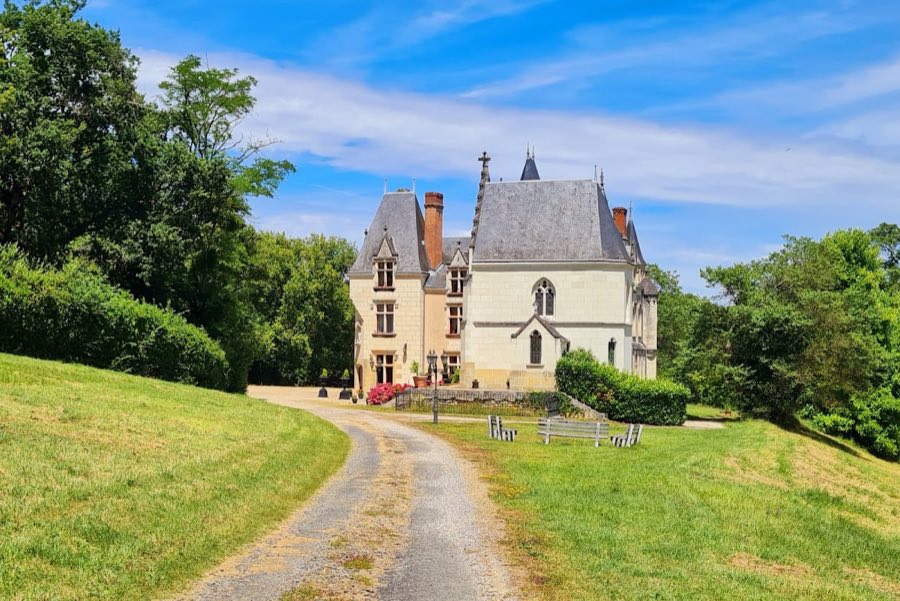
See all castles in FranceThe Château de Brou in Noyant-de-Touraine, France, is a late medieval residence erected in 1475 under the initiative of the French knight François de Gebert, built on the site of an earlier 13th‑century fortress. Its origins in the medieval period and continuous occupation by successive generations of the same family gave the place a long local prominence, and the building that stands today reflects both its fifteenth‑century origins and later nineteenth‑ and twentieth‑century changes.
The site began as a thirteenth‑century stronghold owned by Guillaume de Chergé. In 1475 François de Gebert, lord of Noyant and Le Rivau, replaced that fortress with the château that established the estate’s core. Members of the Gebert line continued to hold the property for centuries. In 1571 Jean de Gebert served as maréchal de camp, a senior royal military rank. In 1680 Gabriel de Gebert held the office of Treasurer of France for the generality of Tours, and in 1748 Joseph François de Gebert was captain of the grenadiers of the 1st Battalion of Bourbonnais. The Gebert family retained possession of the estate until 1813.
Through marriage the château then passed into the d’Absac family. In 1746 Louise‑Magdeleine de Gebert married Antoine Armand Félix d’Absac, marquis of Mayac and a captain in the Regiment of Penthièvre. Louise‑Magdeleine, widowed later, took part in the 1789 electoral assembly of the nobility of Touraine, an event tied to the opening phase of the French Revolution. A brother of Antoine, Guillaume Joseph d’Absac, served as dean of the church of Tours from 1751 to 1774 and later became bishop of Saint‑Papoul.
In the mid‑nineteenth century the property changed hands. On 22 December 1860 Monsieur and Madame Troncin‑Mersan purchased the estate from the Marquise de Carbonnières and expanded their holdings with further purchases in 1861 and 1863. They sold the château on 27 October 1865 to the Marquis de Moges and his wife. Between 1866 and 1868 the Marquis and his wife undertook extensive restoration work that reshaped the building’s exterior and interior, producing the appearance the property retains today; the regional heritage authority Buildings of France judged that those works very likely prevented the château from being entered in the Supplementary Inventory of Historic Monuments.
Around 1906 the parish priest of Noyant, Abbé Brault, encouraged Ida des Acres de l’Aigle and Madame de Chézelles to found an orphanage at the estate called the Work of the Little Gardeners of Brou. New service buildings were constructed then to provide a dormitory, refectory (dining hall), kitchen, and classroom. During the First World War the château operated as an annex to the hospital of Sainte‑Maure‑de‑Touraine, and Ida des Acres de l’Aigle served as head nurse.
On 30 June 1950 Ida des Acres de l’Aigle transferred ownership to the society Les Amis des Jeunes, the Friends of Youth, whose purpose was to create and support vocational, moral, family, and domestic training. Dominican sisters who had lived with Ida remained on the estate, which functioned as a Family House until 1996 when the sisters decided to sell. New owners in 1997 opened the property to the public and launched a comprehensive restoration led by a master builder and carried out by regional firms and craftsmen, including stonecutters, painters, a decorator, a master glazier who succeeded the Lobin workshop, and the lighting designer Bidault. The château became a hotel‑restaurant in 1998 and, since 2016, has been operated as a domain available for private rental, film production, and photographic sessions.
The château occupies the footprint of a medieval fortress and presents a mix of surviving medieval elements and later additions. The overall plan reflects a castle replaced and reshaped over centuries, with the fifteenth‑century residence built atop earlier defensive works and twentieth‑ and later‑century service structures grouped nearby. The external aspect visible today largely reflects the substantial nineteenth‑century restorations completed in the 1860s.
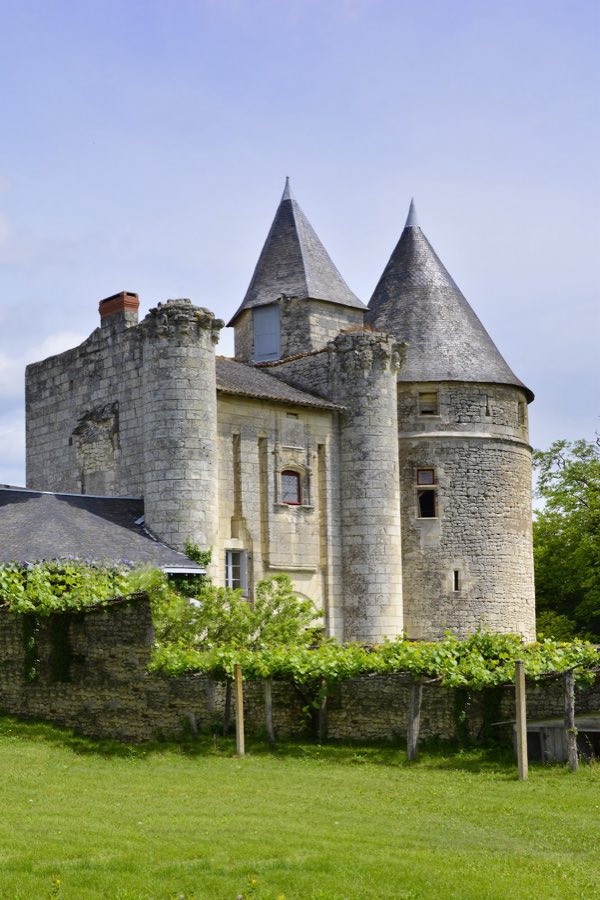
From the thirteenth‑century phase of the site, a cylindrical tower and portions of an enclosing wall remain. The tower dates to the earlier fortress and survives as a distinct medieval element, while the wall fragments mark the former boundary of the fortified enclosure. These components are described as surviving vestiges of the earlier defensive layout and remain part of the estate’s historic fabric.
Buildings added around 1906 for the orphanage form a secondary complex devoted to service functions. Those structures were erected to accommodate a dormitory, a refectory (dining hall), a kitchen, and a classroom, and they served the Work of the Little Gardeners of Brou. Later conservation work undertaken from 1997 involved a full restoration of the principal residence under the direction of a master builder and employed regional stonemasons, painters, a decorator, a successor to the Lobin glazing workshop, and the lighting designer Bidault, returning the château to a restored condition while retaining the appearance shaped by the 1866–1868 campaign.
No. 26624
No. 94784
No. 31060
No. 18706
Comments
Comments for Château de Brou will require a verified account before posting.
We'll send a verification link before your first comment is published.