No. 79044
Château de Tigné
France
ChâteauRestored15th century

No. 14374
Château · France
No. 14374 · 47.213 N, 0.596 W
Quick summary
Château de Gonnord is a château in France with origins associated with the 11th century.
See all castles in FranceChâteau de Gonnord is located in Chemillé-en-Anjou, France; a fortified residence stood on this site from the 11th century, erected in the medieval period.
In the later Middle Ages the place suffered during the warfare of the period and was attacked in the course of the Hundred Years’ War. After that destruction work carried out from the 15th century rebuilt the residence on a roughly square plan and added tall defensive towers.
Religious conflict again affected the château in the 16th century. During the Wars of Religion it suffered destruction, and in 1575 Artus de Cossé-Brissac initiated a program of reconstruction in an Italian Renaissance manner. He reorganized the courtyard with arcades, and one arcade was topped with the Cossé family motto, “Avecque le temps…”. Members of the royal circle lodged at the house on several occasions: Charles IX in October 1565, the Duke of Anjou in 1580, and Henri IV in 1589. Artus de Cossé-Brissac died at the château in 1582.
Ownership passed through several noble families, including du Bellay, the Cossé-Brissac line, and later La Forest d’Armaillé. Administration of the estate was placed under a royal fiscal receiver for generations; by 1704 that office was held by Joseph Dudoyer, then by his son Joseph and by his grandson Étienne Dudoyer, who became the father-in-law of Jean Peltier Dudoyer.
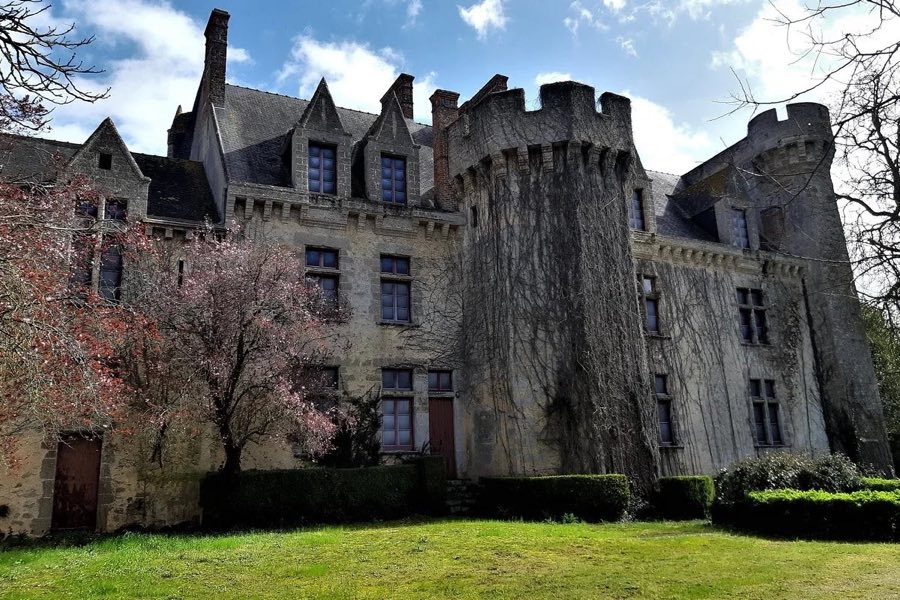
The château was twice set on fire during the Wars of Vendée and was not reconstructed after those burnings. During the 19th century the site remained a ruin, with only the south-facing façade still standing. At the start of the 20th century the roof was rebuilt and a boule de fort playing circle was laid into the ground-floor space. The municipality purchased the property and improved the surroundings of the pond. The château was officially listed as a Monument Historique in 1926.
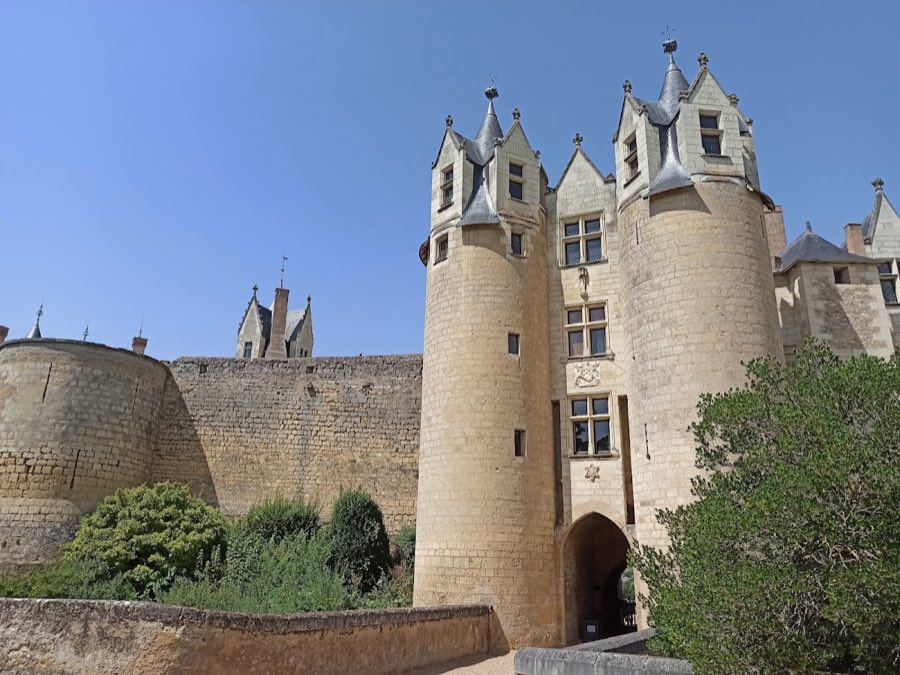
The surviving complex presents a layout that reflects the 15th-century rebuilding, arranged on a square footprint and punctuated by tall towers. This plan describes the principal massing of the building as it was renewed in the late medieval phase; the towers emphasize the vertical profile added during that reconstruction. The towers and square arrangement remain the defining silhouette of the site.
The inner courtyard preserves features from the 1575 Renaissance remaking. Arcaded walkways were introduced at that time, and one arcade bears the family inscription “Avecque le temps…”, an identifiable decorative element from the Cossé-Brissac campaign of works. These arcade forms record the Italian-influenced reconfiguration carried out under Artus de Cossé-Brissac and survive as part of the courtyard ensemble.
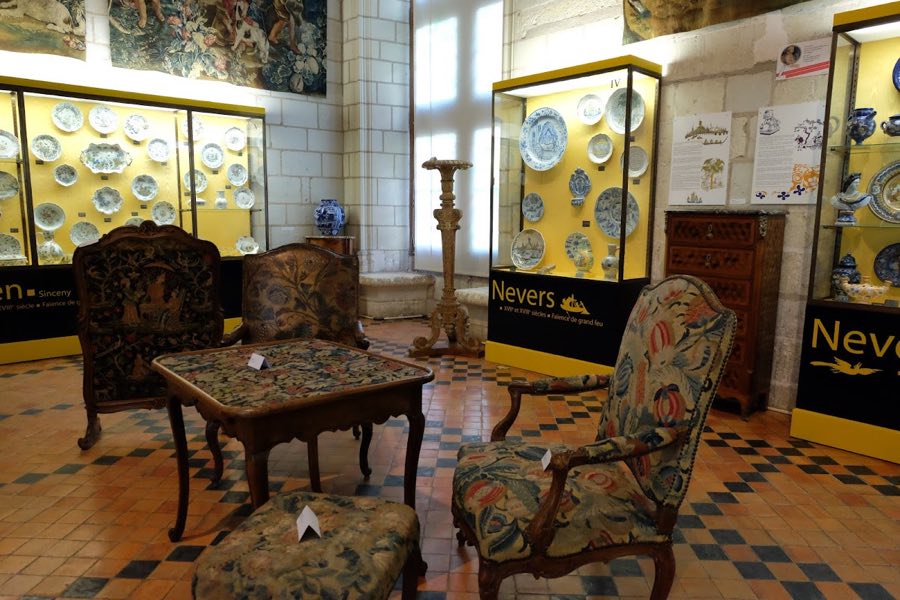
Interior spaces include a theatre hall established within the building and, after work at the start of the 20th century, a jeu de boule de fort playing circle inserted on the ground floor. The boule de fort installation represents a later reuse of lower-level space for a local game; the theatre hall denotes an adaptation of internal rooms for performance.
The site sits within a park that contains a pond, and the commune undertook arrangements of the pond environs in the early 1900s. Condition reflects the tumult of the late 18th-century conflicts: the château was burned twice during the Wars of Vendée and left unrepaired, reducing it to a 19th-century ruin in which primarily the south façade remained. The early 20th-century roof reconstruction stabilized the building and allowed the later interior uses noted above. The château’s status as a listed Monument Historique dates from 1926.
No. 79044
No. 18775
No. 86670
No. 19934
Comments
Comments for Château de Gonnord will require a verified account before posting.
We'll send a verification link before your first comment is published.