
No. 14374
Château de Gonnord
France
ChâteauRuin11th century
No. 79044
No. 79044 · 47.199 N, 0.427 W
Quick summary
Château de Tigné is a château in France with origins associated with the 15th century.
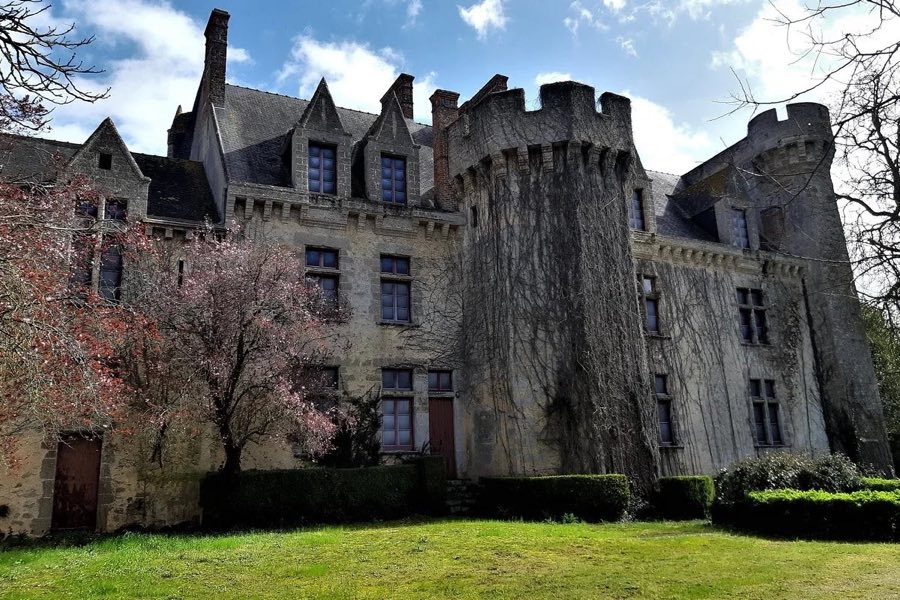
See all castles in FranceThe château de Tigné in Tigné, France, is a medieval castle whose core dates to the 15th century and whose main living block was reshaped in a 19th-century neo-Gothic style, built by the regional lords of medieval Anjou. Its position between Angers and Saumur gave it strategic value on routes into Anjou and Poitou, and for centuries it served as the center of a local castellany with judicial authority over several parishes, making it a notable seat of local power.
In the late Middle Ages the estate lent its name to the family of its seigneurs, and the castle formed the administrative heart of their fief. The castellany exercised high-justice rights over nearby parishes and stood as a fortified place tied to the larger stronghold at Saumur. By the 15th century the present main fortifications were in place, establishing the site as a regional strongpoint.
The château became embroiled in the Wars of Religion in the late 16th century. The owner at that time embraced Protestantism and in October 1595 a captain of the Catholic League captured the fortress, taking the lord prisoner and strengthening its works. Forces loyal to the Protestant governor of Saumur then invested the place, bringing artillery and a large body of arquebusiers who operated in the surrounding countryside. Negotiations allowed the garrison to withdraw with arms in December of that year, and an ordered dismantling of the castle began but did not remove the seigneurial keep. Two years later, in 1598, King Henry IV stayed at the keep after arriving from a nearby estate.
Ownership shifted in the early 17th century when the estate was seized in 1620 and granted to a new proprietor by judicial decision. In January 1632 the château sheltered a band of gentlemen who aided an abduction of a young noblewoman. Royal troops sent to demand her release were fired upon, and the provincial governor laid siege for two months, recovering the captive on 15 March.
The Revolution brought dramatic change. The last seigneur emigrated and in 1794 the castle was set aflame. In the years after the Revolution the property passed first to an Angers banker and later, in 1826, to a local notary; the notary’s family links then tied the estate to the Péton family. In 1830 two of the towers and the entrance portal were demolished.
A comprehensive restoration in 1860 rebuilt the main living block in a neo-Gothic fashion and incorporated surviving medieval towers and a small projecting turret. At the start of the 20th century the estate belonged to Joseph‑Henri Péton, who suffered severe losses when the phylloxera insect devastated vineyards; the property was sold in 1919 to the Lalanne family.
From 1989 the château became part of a commercial wine enterprise operated by the actor Gérard Depardieu in partnership with a colleague. The estate was organized as an agricultural company and saw substantial investment over the following decade, with land purchases that greatly expanded the domain and production that rose into the hundreds of thousands of bottles. A nearby road was given the name Jean‑Carmet in June 1994. In 2011 a short film was made at the château and subsequently received festival awards in 2012.
The site presents a layered architectural record, combining medieval defensive elements with a 19th-century residential rebuilding. The plan originally included five towers arranged around the fortification; today two principal medieval towers survive alongside later work from the neo-Gothic restoration. Remnants of the castle’s double defensive enclosure, that is two concentric lines of fortification, can still be seen in the landscape.
The central fortified tower, the keep (donjon), dates to the medieval period and served as the main stronghold. The keep contains a chapel dedicated to Saint James, showing a religious function within the primary defensive structure. The seigneurial keep endured when other parts of the castle were partially dismantled at the end of the 16th century and remained intact after the destruction of 1794; it also received a royal lodging in 1598.
A second surviving tower is known as the treasure tower. Its original role as a defensive and storage structure belongs to the same late-medieval phase as the keep. Both towers were retained and incorporated into the later 19th-century rebuilding rather than being entirely replaced.
Traces of the double enceinte, the outer defensive rings, are visible as fragmentary walls and earthworks that outline the former fortified compound. These remains reflect the castle’s role as a fortified administrative center and were left in place when the neo-Gothic main living block was attached to the medieval keep during the 1860 rebuilding.
The main living block constructed in 1860 follows neo-Gothic taste and is physically connected to the medieval keep. That restoration reused surviving towers and a small projecting turret, the bartizan (a small projecting turret), which had belonged to the earlier castle. Elements removed in 1830, specifically two towers and the original entrance portal, do not survive, while other parts show the effects of the burning in 1794 and the subsequent reconstruction. Overall, the site presents a mix of intact medieval towers, visible defensive enclosures, and a restored 19th-century residential core.
No. 14374
No. 18775
No. 19934
No. 86670
Comments
Comments for Château de Tigné will require a verified account before posting.
We'll send a verification link before your first comment is published.