
No. 22515
Château de Saint‑Maur, Argent‑sur‑Sauldre
Argent‑sur‑Sauldre, France
ChâteauRestored18th century
No. 69236
Château · France
No. 69236 · 47.690 N, 2.770 E
Quick summary
Château de Pont-Chevron is a château in France with origins associated with the 19th century.
See all castles in FranceChâteau de Pont-Chevron, Ouzouer-sur-Trézée, France, stands on ground that preserves evidence of Roman activity in the second century CE.
In the Roman period, two floor mosaics were laid at the edge of the marshes beside the château’s pond; these panels, dated to the second century, are probably the remains of Roman bathing installations. The mosaics were uncovered in 1962 and became the subject of detailed study, during which specialists questioned the identity of a portrait depicted on one of the panels.
During the medieval era a fortified castle occupied a small island within the large pond of the estate. That medieval stronghold was taken down in the early nineteenth century; the two-arched stone bridge that once connected the island to the shore is the main visible survival from that fortress.
The present château began as a private commission at the end of the nineteenth century. Count Louis d’Harcourt entrusted architects Coulomb and Chauvet with the project in 1896; construction continued for four years and the completed house was inaugurated in July 1900. Ownership of the grounds has been tied to the La Rochefoucauld family since about 1900.
In the twentieth century the property hosted distinguished visitors, including Amélie d’Orléans, Queen of Portugal, in the 1910s, and Valéry Giscard d’Estaing before his presidency. From 1946 until the late 1960s the park was made available each summer to the Scouts de France for national training and summer camps. The two Roman mosaics and the story of the château’s construction became the focus of a museum established at the château in 1983, which was partially remodeled in 2008. Part of the château has been protected as a Monument Historique since 21 May 1987. The site is closely associated with the group of Loire valley châteaux, but it lies just outside the zone inscribed on the UNESCO World Heritage List in 2000 for the valley between Sully-sur-Loire and Chalonnes-sur-Loire.
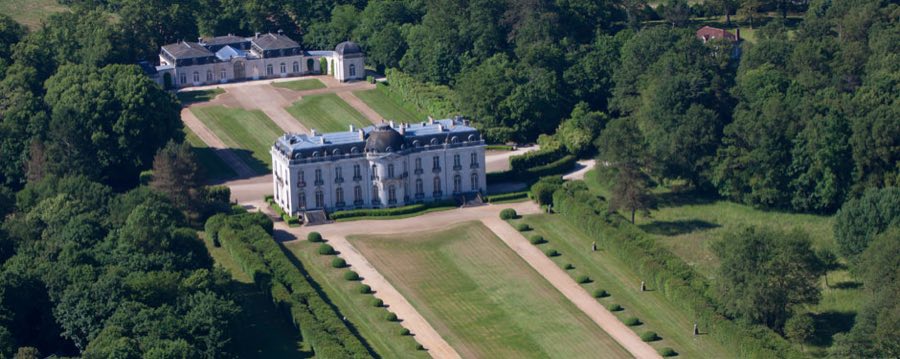
The ensemble comprises a late-nineteenth-century neo-classical country house set within a formal park, an extensive pond with an island, service buildings, and archaeological finds along the marshy edge. The main house is a long, rectangular block whose north side projects as a half-round oval rotunda that forms the central projecting mass; a low balustrade runs along the roofline. Flanking service ranges are rectangular in plan with a central projecting section to the south. Inside those outbuildings a long central nave once contained coach-houses and, later, stables adapted for automobiles.
Two curved wings reach out from the main block and terminate in pavilions; the west pavilion contains a private chapel. The exterior ornament concentrates on the pediments and on sculpted keystones and floral garlands that frame openings, while the dressed masonry of the wall surfaces is set in raised blocks that enliven the panels between windows. Several interior spaces are recorded and afforded protection: the entrance hall carries architectural motifs that echo the outside façades; the dining room retains plasterwork decoration executed and painted to resemble marble; and the ground-floor salon preserves a fireplace and painted canvas panels depicting animals. These interior features are part of the elements protected under the monument designation.
At the edge of the estate’s marshes two Roman-period mosaics came to light in 1962. Dated to the second century, they are interpreted as likely remains of Roman baths. One mosaic includes a portrait whose identity has been openly debated by specialists; the panels were studied intensively and later became central exhibits for a museum opened at the château in 1983 and updated in 2008. The mosaics survive as archaeological finds that were removed from the ground context and conserved for display.
The water landscape dominates the grounds: a pond of approximately twenty-seven hectares supports extensive stands of water lilies and other wetland plants, and botanists have recorded species such as Gentiana pneumonanthe and Gratiola officinalis along its margins. On the pond’s island the earthworks and partial stone remains of the medieval fortified castle are still visible in the landscape, though the fortress itself was dismantled in the early nineteenth century; the surviving two-arched stone bridge that links the island to the shore is the principal structural remnant of that medieval phase. The surrounding park is laid out in the French formal manner, with two tree-lined avenues framing the house, mature stands of lime, oak, hornbeam, beech and plane trees, a formal plot of square flower beds, a kitchen garden and a rose garden. The estate also includes a nine-hectare arboretum, held in private ownership and managed separately from the formal park.
No. 22515
No. 38448
No. 17095
No. 52567
Comments
Comments for Château de Pont-Chevron will require a verified account before posting.
We'll send a verification link before your first comment is published.