No. 36588
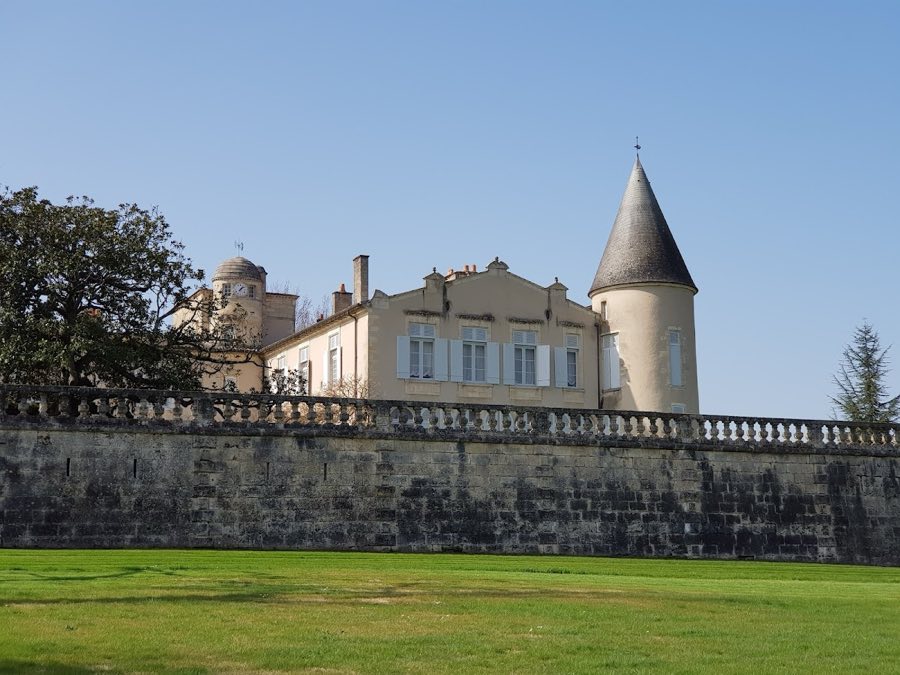
Château Lafite Rothschild
France
ChâteauRestored18th century
No. 59038
No. 59038 · 45.144 N, 0.751 W
Quick summary
Château Gruaud-Larose is a château in France with origins associated with the 18th century.
See all castles in FranceChâteau Gruaud-Larose, Saint-Julien-Beychevelle, France, is a wine estate founded in the early 18th century by Joseph Stanislas Gruaud, a French cleric, and developed as an 18th-century manor embedded in the Bordeaux wine tradition. Its origins reach back to about 1725, with written records appearing in the 1740s, and the estate later became notable across the Bordeaux region when its red wine received the official Second Growth ranking in the 1855 classification. Over more than two centuries the property passed through ecclesiastical beginnings, private ownership, division and reunion, and phases of rebuilding and technological renewal that reflect wider changes in viticulture and commerce.
The estate expanded under its founder, who by 1757 had assembled roughly fifty hectares of land. The property was known then as Fond-Bedeau (also written Fonbedeau), though the founder’s family name, Gruaud, was used alongside that earlier placename. When Joseph Stanislas Gruaud died on 6 September 1771, his heir became Joseph-Sébastien de Larose, an elected official of the presidial court of Bordeaux and lieutenant-general of the sénéchaussée of Guyenne; the Larose name appears in documents by 1791.
A contested inheritance followed the death of the chevalier de Larose, and the Court of Appeals of Bordeaux ordered a sale by licitation (judicial auction). On 21 December 1812 the château was adjudicated to merchants Pierre Balguerie-Stuttenberg and Jean-Auguste Sarget, after which the estate took the combined name Gruaud-Larose. In the later 19th century the property was divided among different owners. After 1846 the vineyard and buildings became partitioned, with the Sarget family holding one portion and other plots associated with families named Bethmann (Metzler de Bethmann) and de Boisgérard. For a time two separate bottlings were marketed, under the names Gruaud-Larose Sarget and Gruaud-Larose Bethmann; an English account records a division described as Gruaud-Larose-Sarget and Gruaud-Larose-Faure.
The château’s vineyard faced a succession of plant diseases during the 19th century. Oidium affected vines between about 1852 and 1860, prompting widespread use of sulfur dusting as protection. Phylloxera first appeared from about 1874, and downy mildew began to affect plantings around 1878. From roughly 1895 owners responded by replacing affected vines with grafts onto American rootstock. The main residence was rebuilt in the late 19th century, a reconstruction date of 1879 being inscribed on the rear façade.
Economic difficulties set in by the late 19th century and persisted into the early 20th, and by the 1910s the two halves of the former estate had again come under separate control: the Sarget portion was in independent hands in 1916 and the Bethmann portion in 1919. Désiré Cordier acquired the Sarget share in 1917 and later purchased the Bethmann or Faure portion in the mid-1930s, reuniting the original holdings. Désiré Cordier died in 1940; his grandson Jean Cordier took charge of the property in 1947 and carried out vineyard renewal and modernization of management.
In the late 20th century the estate attracted corporate investment. Compagnie de Suez took a stake in the Cordier company in 1983. Alcatel-Alsthom purchased the château in 1993 and carried out comprehensive restoration work, enlargement of the cellars and partial reconstruction of wooden vats, and redesign of the grounds. The Merlaut (Taillan) group acquired the property in 1997 and the estate has remained in the Merlaut family since that date. On 22 February 2012 the château ensemble, including its tower and an agricultural shed, was officially listed as a historic monument.
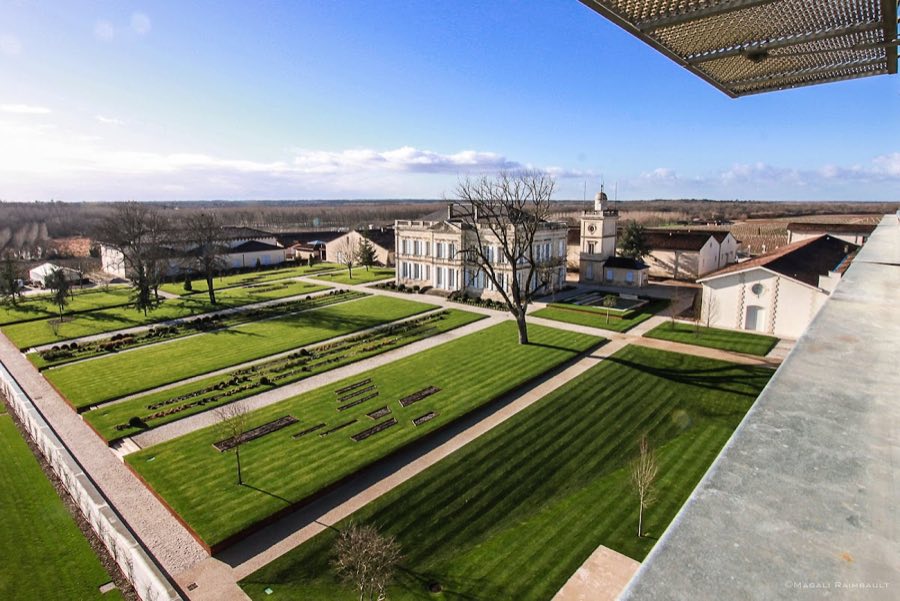
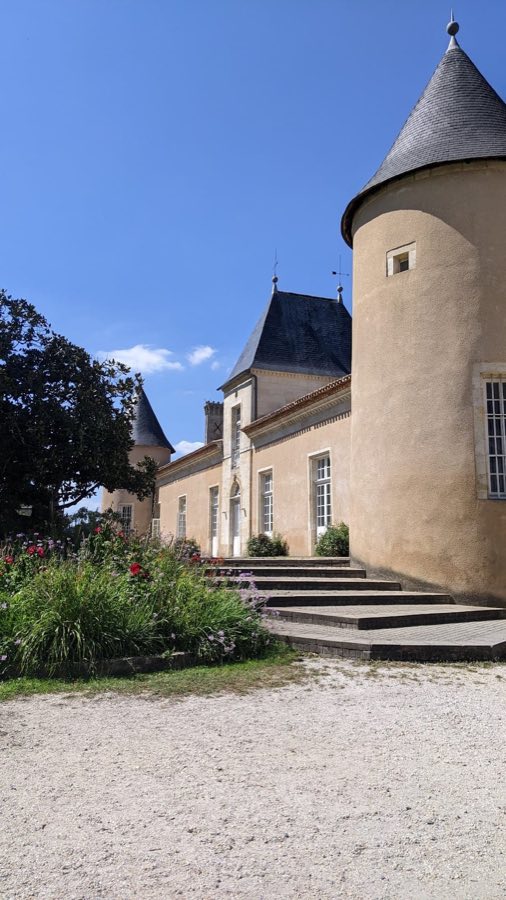
The site consists of a two-storey, multi-winged manor house set within a cultivated estate that includes extensive vineyards covering about eighty-two hectares. The house sits amid well-kept grounds featuring an English-style lawn, planted flower beds and paths surfaced in white gravel. The rear façade of the main building bears the date 1879, marking the late 19th-century rebuilding phase that shaped the present composition.
The château ensemble explicitly comprises a tower and an agricultural hangar, both incorporated into the 2012 historic-monument listing. The hangar functions as an agricultural building associated with estate operations. Wooden vats survive on the property, partly reconstructed during late 20th-century works, and the cellars were enlarged as part of those interventions; the expanded underground spaces serve wine storage and maturation.
Modern technical installations are present alongside older structures. The estate contains an oenological laboratory, computerized systems for monitoring harvest reception and vats, a weather station to track growing conditions, and a sewage-treatment station. Restoration and landscape redesign carried out in the 1990s repaired the château fabric and reshaped the green spaces while adapting the winery to contemporary production methods.
Vine plantings are recorded with slightly different compositions in various accounts. One set of figures gives roughly sixty percent Cabernet Sauvignon, thirty percent Merlot, seven percent Cabernet Franc and three percent Petit Verdot. Another account lists about fifty-seven percent Cabernet Sauvignon, thirty percent Merlot, eight percent Cabernet Franc, three percent Petit Verdot and two percent Malbec. A third report indicates fifty-five percent Cabernet Sauvignon, thirty-one percent Merlot, ten percent Cabernet Franc, two percent Petit Verdot and two percent Malbec. The estate’s principal wine is matured for eighteen months in French oak barrels, with new oak used at an average rate close to ninety percent.
No. 36588
No. 56884
No. 15458
No. 36402
Comments
Comments for Château Gruaud-Larose will require a verified account before posting.
We'll send a verification link before your first comment is published.