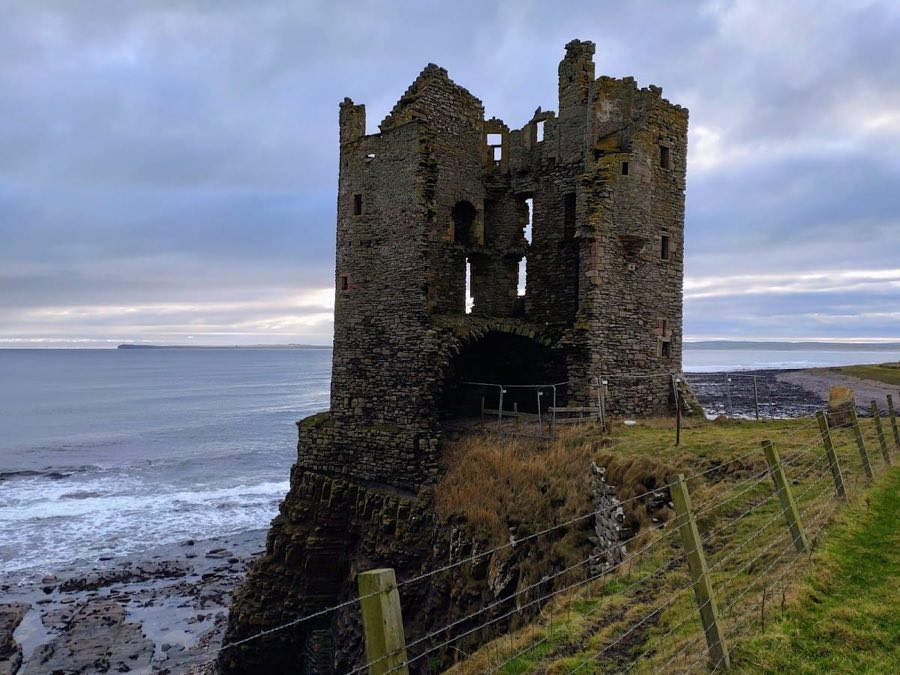
No. 13672
Keiss Castle
United Kingdom
Tower houseRuin17th century
No. 31692
Tower house · United Kingdom
No. 31692 · 58.235 N, 3.436 W
Quick summary
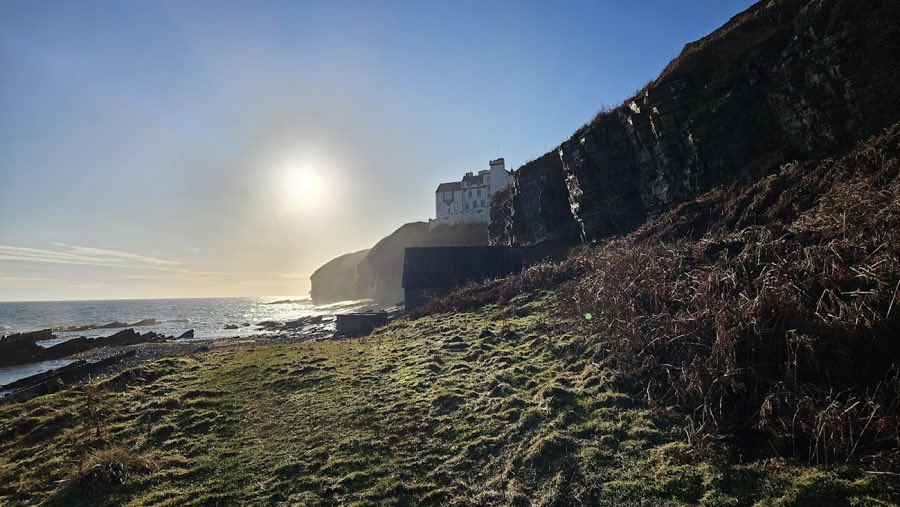
Dunbeath Castle is a tower house in United Kingdom with origins associated with the 17th century.
See all castles in United KingdomDunbeath Castle stands on a rocky promontory on the east coast of Caithness, about two kilometres south of the village of Dunbeath, and originated within the framework of medieval Scottish lordship. The site is first recorded in 1428 when the lands were held by the Earl of Caithness and the first named laird was Alexander Sutherland. The estate passed into the Sinclair family when Alexander Sutherland’s daughter married William Sinclair, who lived from 1410 to 1484. In 1620 the earlier building on the peninsula was replaced by a substantial tower house rising four storeys. Around 1624 the property returned to John Sinclair, who is associated with extensive remodelling in the 1630s that added upper storeys to the earlier fabric.
In March 1650 Royalist forces under James Graham, 1st Marquess of Montrose, attacked the castle. Sir John Sinclair left for Edinburgh and his wife, Catherine Fraser, remained to defend the house against an assault led by Sir John Hurry; she surrendered and a Royalist garrison occupied the castle. After Montrose’s defeat at the Battle of Carbisdale the following month, forces under David Leslie recovered the stronghold.
The castle underwent further alteration across later centuries. Sir William Sinclair carried out substantial 17th-century work, and later changes were made in 1853 and 1881, with the architect David Bryce engaged for the latter project. In the late 1800s the northern elevation was regularised into a symmetrical front and a long, straight tree-lined approach of about three quarters of a mile was laid out. From 1894 until 1945 the house was owned by Vice-Admiral Sir Edwyn Alexander-Sinclair. Subsequent owners included Bertram Currie, who bought it in 1945, Harry Blythe and Helen (Sinclair) Blythe in 1967, Ray Stanton Avery in 1976, and Stuart Wyndham Murray-Threipland in 1997. In 2024 the property changed hands for £25,000,000 to Dunbeath Estates Limited, whose sole director is Don Macleod; the ultimate purchaser was obscured by trusts and company filings.
The castle has remained a private residence. It is a Category A listed building and its designed grounds are included in the national Inventory of Gardens and Designed Landscapes, the grounds’ inclusion being recorded in 2003. At the time of a 2023 listing the house itself was closed to the public and the gardens were available only by appointment.
The present ensemble is principally a 17th-century building with substantial 19th-century enlargement that seeks visual continuity with the older core. The oldest surviving fabric is concentrated at the south-west corner and dates mainly to the 1600s. A major building campaign in 1620 produced a multi-storey tower that established the castle’s dominant form, and further vertical work in the 1630s produced the higher upper levels now evident in the silhouette. Later nineteenth-century additions were built on the north and east sides in a Scots Baronial manner intended to harmonise with the historic block.
Interiors show extensive alteration, so the internal arrangement and finishes differ markedly between the older fabric and the later work. The recorded internal floor area for the assembled building is 19,669 square feet, reflecting the combination of the original tower and its subsequent extensions. The site’s landward defence is strengthened by a dry ditch cut across the narrow promontory, taking advantage of the rocky peninsula on which the castle stands. The late nineteenth-century landscape additions include the straight three-quarter-mile approach lined with trees. The protected designation recorded for the property covers the principal building together with associated features on the estate, including walled gardens and a garden pavilion, all recognised as part of the historic designed landscape.
No. 13672
No. 91752
No. 78845
No. 38318
Comments
Comments for Dunbeath Castle will require a verified account before posting.
We'll send a verification link before your first comment is published.