No. 17449
Corvin Castle
Romania
CastleRestored14th century
No. 85075
No. 85075 · 45.889 N, 22.897 E
Quick summary
Fortress of Deva is a castle in Romania with origins associated with the 13th century.
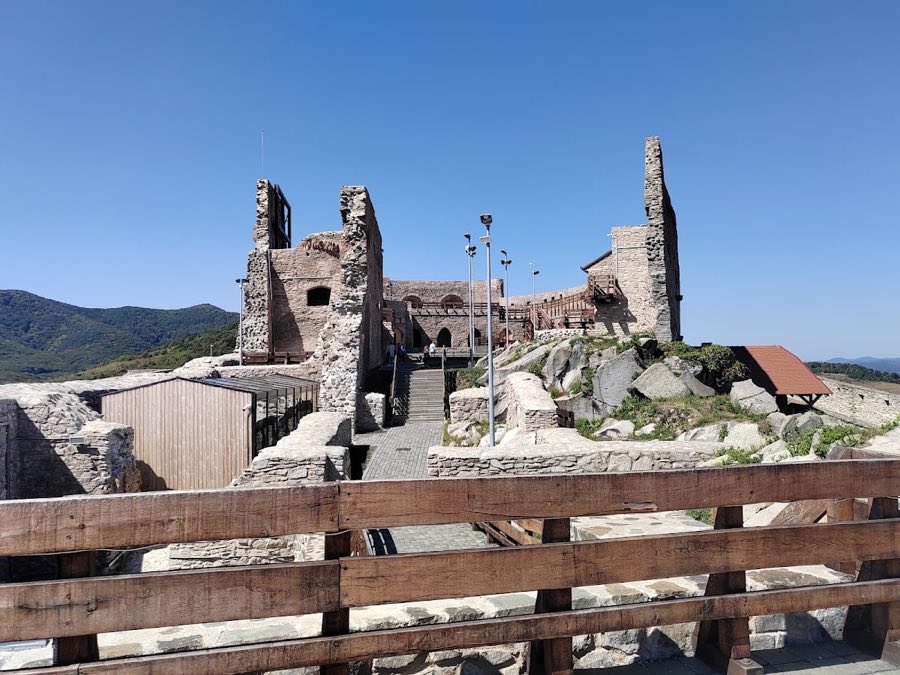
See all castles in RomaniaThe Fortress of Deva stands on a volcanic cone hill above the city of Deva in Romania. Its location has been fortified since ancient times by various civilizations, beginning with the Dacians and later strengthened by the Romans, reflecting the site’s long military importance.
In the mid-13th century, following the devastation caused by the Mongol invasion, King Béla IV of Hungary ordered the construction or reconstruction of the current medieval fortress, which first appears in written records dated between 1264 and 1269. This fortress was established on a strategic vantage point overlooking the Mureș River valley, a vital corridor into Transylvania. Over the centuries, it became the seat of regional military governors known as voivodes and served as the residence for several important rulers, including John Hunyadi, John Zápolya, Stephen Bocskai, and Gabriel Bethlen.
The fortress witnessed various conflicts throughout its history. In 1273, it resisted attacks by the Cumans, a nomadic group from the Eurasian steppes. During the 16th century, it endured Ottoman sieges as Hungary and Transylvania were caught in the struggle against Ottoman expansion. Later, in the early 18th century, it was involved in the Rákóczi War of Independence, a fight against Habsburg rule.
During the 17th century, the fortress also served as a prison. Among its notable prisoners were Francis David, the first Unitarian bishop of Transylvania who died in captivity in 1579, and István Dobó, known for his defense of Eger. The fortress was heavily fortified in the late 1600s and early 1700s, with military engineers enhancing its defenses using Vauban-style bastions, a design innovated by the French military architect Sébastien Le Prestre de Vauban. These updates were completed under the supervision of General Steinville between 1717 and 1719.
By the late 18th century, the fortress had lost much of its military significance. It was sold to a private owner who removed movable assets, leading to rapid decay. Emperor Francis I later ordered restoration efforts beginning in 1817, spanning twelve years to preserve the fortress’s remains.
During the Hungarian Revolution of 1848–1849, the fortress was controlled by Austrian troops until it was captured by Hungarian forces after an arduous siege, making it one of the few strongholds to fall to the revolutionaries alongside Buda and Arad. Tragically, on August 13, 1849, an explosion in the fortress’s powder magazine destroyed much of the structure, killing over a hundred soldiers. Just days later, on August 18, General Józef Bem surrendered to the Austrian forces at the fortress, marking a significant moment in the conflict.
In modern times, the Fortress of Deva has been officially recognized as a historical monument. From 2008 onward, extensive restoration work has been carried out to stabilize and partially rebuild the fortress, culminating in its reopening to the public in 2016. The name “Deva” is thought to originate either from the Dacian word “dava,” meaning fortress or settlement, or from the Roman legion II Augusta, which was relocated from the British city of Deva (now Chester), suggesting a continuity of military presence across centuries.
The fortress crowns a volcanic cone rising between 250 and 378 meters above the city of Deva. Its medieval layout consists of three distinct enclosures arranged along the hill’s slopes and summit, each featuring a different shape: the lowest is ovoidal, the middle takes an irregular ovoid form, and the highest enclosure, positioned at the summit and extending onto the northern slope, is roughly semicircular. This tiered design reflects the strategic adaptation to the hill’s topography.
Early construction materials include stone blocks with dovetail cuts, a technique linked to the earlier Dacian fortifications on the site, indicating a deliberate reuse of ancient masonry. The fortress’s walls retain these characteristics, offering a tangible connection between prehistoric and medieval defensive architecture.
Within the complex, a Renaissance-style palace called Magna Curia was built in the 17th century by Gabriel Bethlen at the fortress base, serving as a more comfortable residence in contrast to the austere defenses above. Additionally, a southern round bastion was added during the reign of George I Rákóczi, enhancing the fortress’s artillery defenses to meet the evolving demands of warfare.
Iron security features included a prison and torture chambers, actively used during the 17th century. These spaces played a critical role in the political and religious struggles of Transylvania, as evidenced by the incarceration of figures such as Francis David.
The fortress endured significant destruction from the explosion of the powder magazine in 1849, which obliterated the entire eastern wing. Today, only the walls and ruins located on the hill’s summit remain standing, bearing witness to the site’s tumultuous history.
Restoration efforts initiated in 2008, driven by the Hunedoara County Council, focused on structural reinforcement and careful preservation. These works required partial closures lasting almost eight years. A notable addition to the site’s infrastructure is a funicular, or inclined lift, which was installed on the hill’s steepest slope to facilitate access.
The Fortress of Deva is formally listed in the Romanian register of historic monuments under the code HD-II-a-A-03216, recognizing its cultural and historical value as a landmark that spans Dacian, Roman, medieval, and modern periods.
No. 17449
No. 14908
No. 80736
No. 71514
Comments
Comments for Fortress of Deva will require a verified account before posting.
We'll send a verification link before your first comment is published.