No. 96037
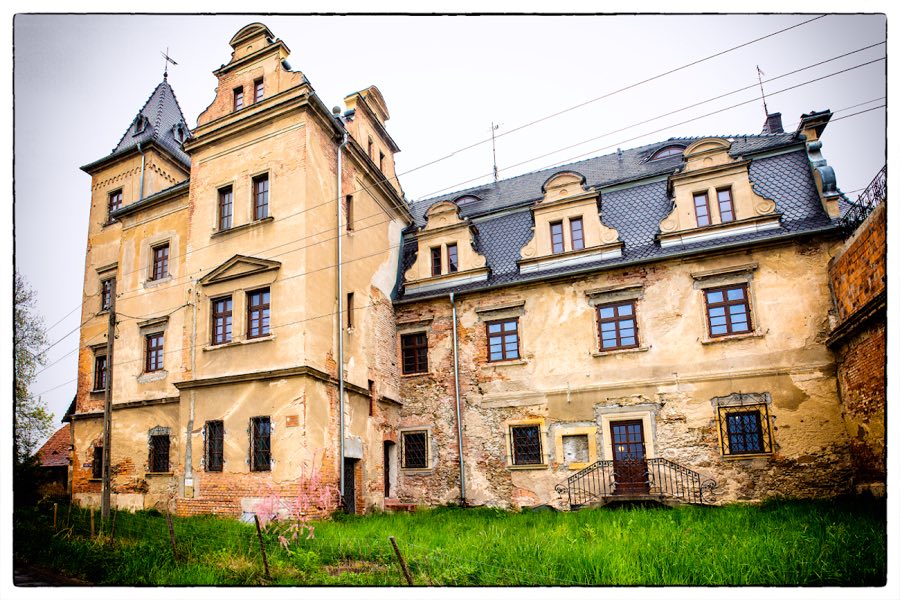
Palace in Nowizna
Poland
CastleRestored16th century
No. 37859
Castle · Poland
No. 37859 · 50.736 N, 16.790 E
For rent
Gola Dzierżoniowska Castle is marked for bookable castle accommodation. Nightly pricing, sleeps count, stay rules, and amenities are displayed only when public operator data is available.
Rental type: Hotel / bookable stay, Short-stay rental
Short-term availability: Bookable accommodation signal
Quick summary
Gola Dzierżoniowska Castle is a castle in Poland with origins associated with the 10th century.
See all castles in PolandGola Dzierżoniowska Castle stands in the municipality of Gola Dzierżoniowska, Poland; its permanent construction dates to the Renaissance and was begun under Leonard von Rohnau.
A settled community occupied the site around the year 1000, and the Renaissance building was most likely raised on the footprint of an earlier medieval stronghold. Evidence linked to that medieval phase includes a steep escarpment on the western side, a wet moat to the east, and two concentric stone walls that once enclosed the place, all of which testify to a defensive origin.
Work on the present masonry began in the late 1500s. An inscription above the main entrance records that construction started in February 1580 under Leonard von Rohnau. The structure was enlarged between about 1600 and 1610, and at the start of the seventeenth century an additional tower was built at the eastern corner; since that tower’s erection the castle’s basic silhouette has remained the same.
At the beginning of the eighteenth century the building underwent further alterations, and it received a restoration around the turn of the twentieth century. During fighting in 1945 the castle suffered partial destruction from bombardment. Its last private owners, the von Prittwitz und Gaffron family, were expelled or compelled to leave, and the property subsequently fell into ruin.
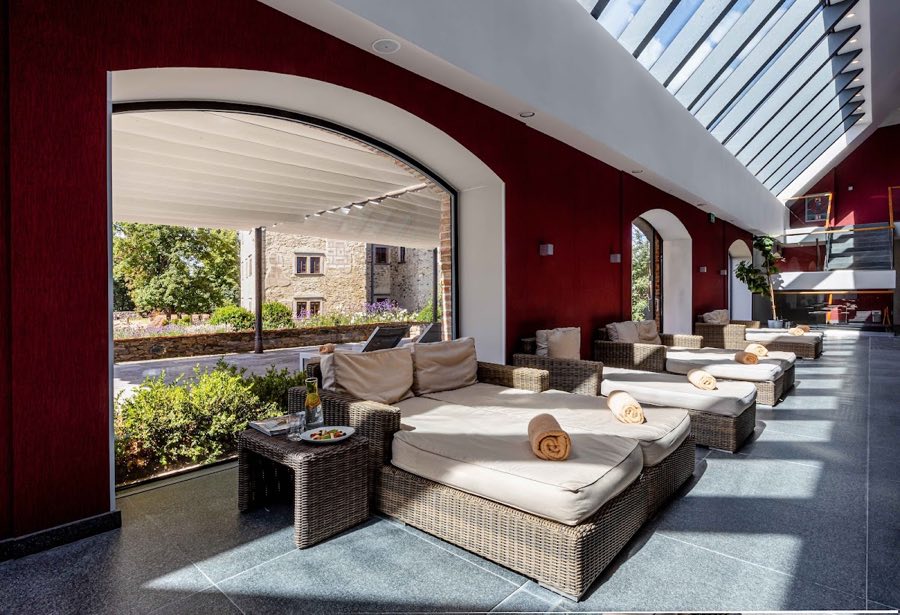
The site and its surrounding park are protected by the national cultural authority under a strict conservation regime. Major reconstruction work has taken place since 2000, with grant support in 2007–2008 from the Ministry of Culture and National Heritage cultural program. After restoration and redevelopment, the property reopened in the summer of 2013 as a luxury hotel, spa and restaurant named Uroczysko 7 Stawów, owned by Marek Gendaj. The castle is described in documents as among the oldest and largest Renaissance castles in the region.
The complex follows a quadrilateral plan arranged around an internal courtyard, set on a granite escarpment. Builders founded the walls directly on the exposed granite rock and used granite as a primary construction material. The overall plan and the masonry reflect the Renaissance phase that defined the present castle, while earlier defensive layout elements remain visible in the site’s topography.
Archaeologically confirmed traces linked to the medieval occupation include the steep slope to the west, an eastern wet moat, and double stone curtain walls surrounding the site. These features record the castle’s original defensive character and were incorporated into later building phases rather than being completely removed or replaced.
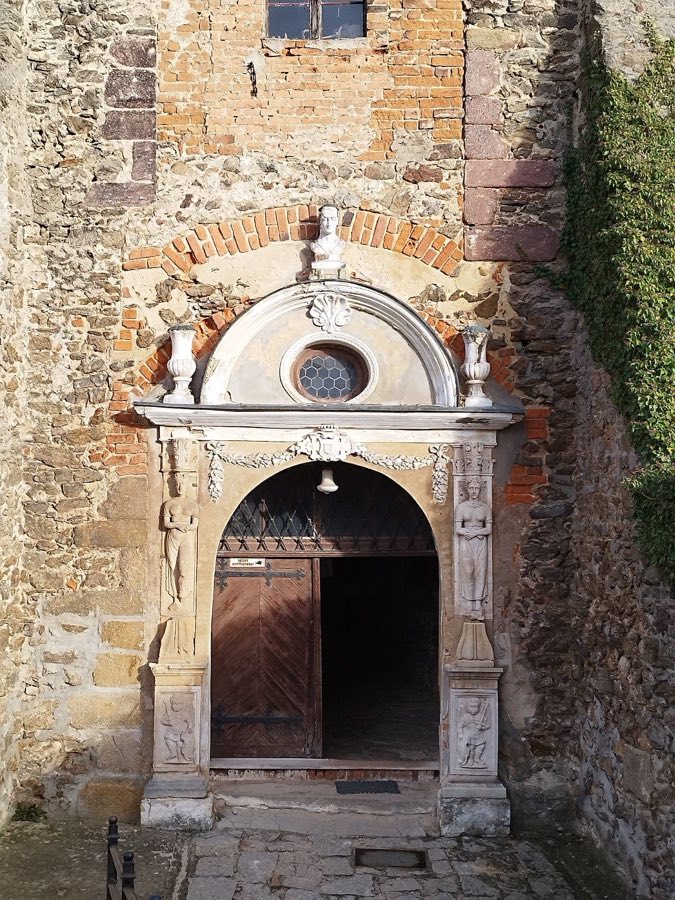
A tower added at the eastern corner in the early 1600s survives as part of the castle’s historic form; sources indicate the building’s general shape has not changed since that addition. The main entrance has been reconstructed and the exterior walls display sgraffito decoration, a layered plaster technique characteristic of the Renaissance period. Above the principal doorway a German-language inscription is preserved on the portal, and the portal’s frieze bears a series of heraldic shields. The shields are set in two rows; the upper row, from left, shows Rohnau, Nassau, Reibnitz, Nimptsch, Senitz auf Rudelsdorf, Reibnitz, Pfeil and Pogrell, while the lower row, from left, shows Gfug, Borwitz, Reibnitz, Brauchitsch, Eichholz, Wiese u. Kaiserswaldau, Reibnitz and Tunckel.
Within the courtyard stands a linden tree estimated at roughly three centuries old. Below the castle the landscaped park extends across thirteen hectares and was inventoried in autumn 2001, recording 1,619 trees belonging to 36 species (inventory compiled by Ewa Domaszewska, Artur Barcki and Cedric Gendaj). The park is served by a substantial water-irrigation system and is crossed by the Gola river, which feeds seven ponds, several of which have become overgrown. A principal avenue through the grounds remains lined with mature beech trees that have passed a century of growth.
Today the site exhibits a mixture of preserved, restored and reconstructed elements. The castle still bears damage from the 1945 bombardment but has benefited from conservation at the turn of the twentieth century and intensive rebuilding since 2000, including the rebuilt portal and decorative wall treatments. The property and its park are under formal cultural protection while restoration and adaptive reuse have altered parts of the complex for contemporary functions.
No. 96037
No. 81393
No. 69107

No. 11635
Comments
Comments for Gola Dzierżoniowska Castle will require a verified account before posting.
We'll send a verification link before your first comment is published.