No. 37859
Gola Dzierżoniowska Castle
Poland
CastleRuinFor rent10th century
No. 96037
Castle · Poland
No. 96037 · 50.758 N, 16.609 E
Quick summary
Palace in Nowizna is a castle in Poland with origins associated with the 16th century.
See all castles in PolandThe Palace in Nowizna in Nowizna, Poland began as a fortress-like residence erected in 1565 by the von Schellendorf family, originating in the 16th century and later extended with neo-Gothic additions; it is entered on the Lower Silesian register of immovable monuments and has played a visible role in the region’s landed‑estate history. From its start as a family stronghold the site remained a centre of aristocratic ownership and adaptation for several centuries.
The initial phase of construction and occupancy belongs to the von Schellendorf line. Bernhard von Schellendorff, who died in 1593, is recorded among the early owners and a replica of his epitaph is preserved inside the palace. During the 17th and 18th centuries the estate passed through other noble houses, including the von Czettritz and von Gellhorn families, and later the Stolberg‑Wernigerode family, each of which held the property in turn and contributed to its succession of ownership.
In the 19th century the manor came under the Perponcher‑Sedlnitzky family. Count Friedrich Wilhelm von Perponcher‑Sedlnitzky, after whom the house became known as Wilhelmsburg, served as marshal of the royal court in Berlin and acted at times as envoy to The Hague. During his tenure new economic buildings in a neo‑Gothic manner were added to the estate. His son Alexander von Perponcher‑Sedlnitzky pursued further enlargement and modernization of the complex into the early decades of the 20th century.
At the close of the Second World War the palace was used to shelter library holdings removed from Breslau, now Wrocław; those collections were destroyed when the Red Army occupied the site. After wartime looting the complex was converted to residential use and went into a long period of decline. Custodial records list the Perponcher‑Sedlnitzky family in 1945, Red Army occupation in 1945–46, and later use by local municipal and cooperative bodies, including the village mayor’s office and the cooperative Gminna Spółdzielnia “Samopomoc Chłopska.” By 2007 the estate had passed into private hands. In recent years the palace has been restored and renovation work has taken place under new ownership.
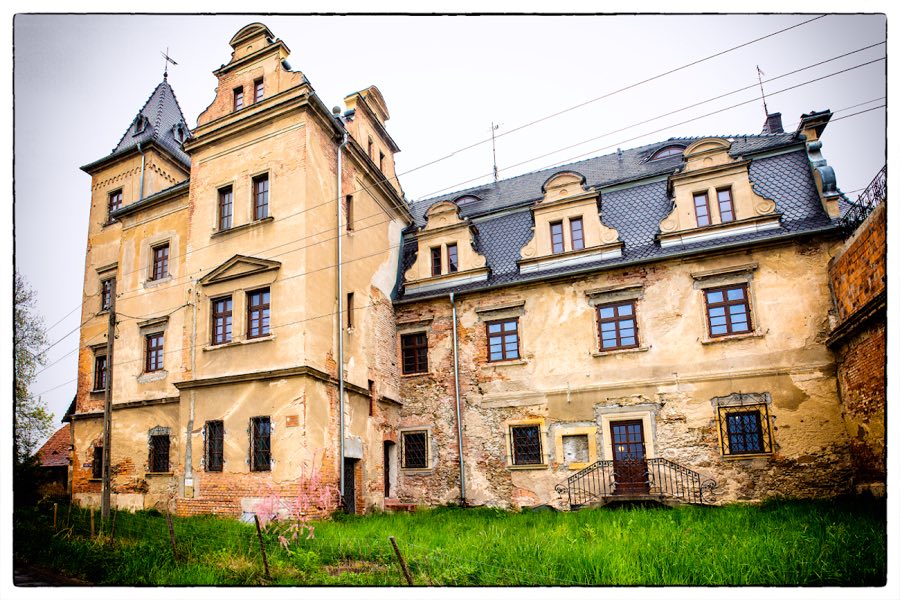
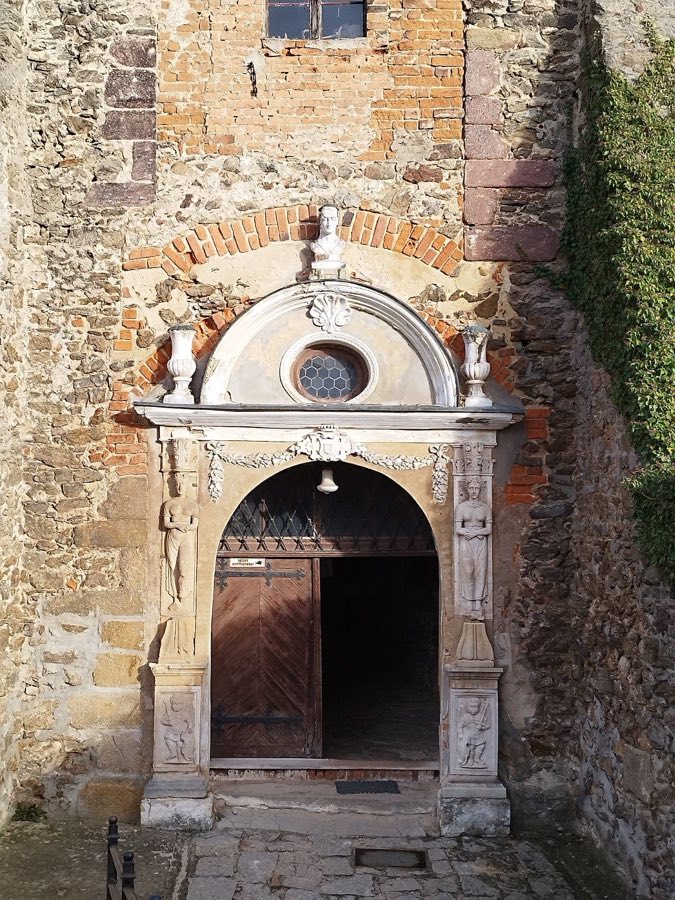
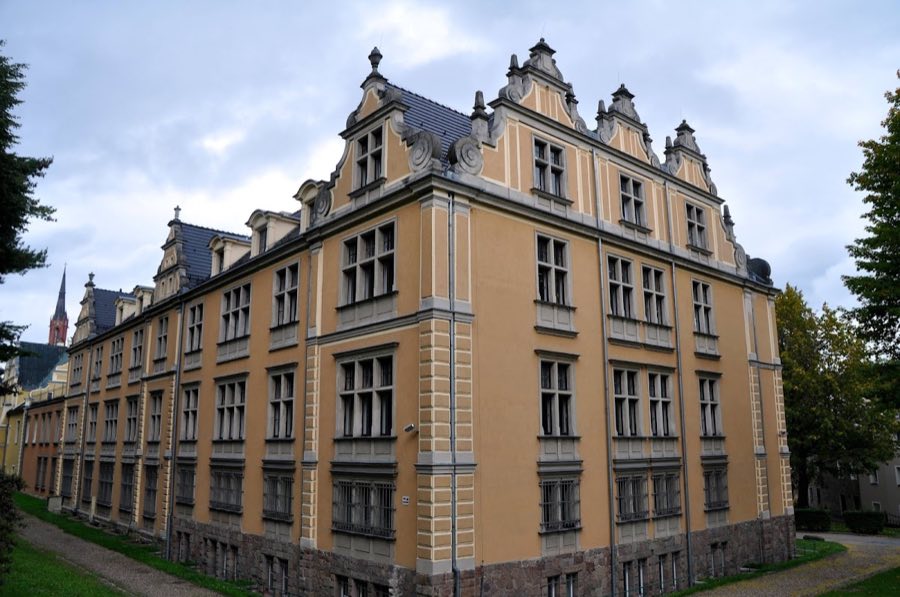
The ensemble centres on a two‑storey main building that preserves a complex, accretive plan. The roof is a mansard roof (a two‑slope roof with a steep lower slope) pierced by dormer windows, and the principal facade is anchored by two projecting bays set forward from the central block. The left projecting bay is finished with a tower‑type roof, while the right displays a Renaissance gable and a double‑pitched roof. The main entrance sits beneath a central porch and a pediment that carries a shield bearing the Perponcher‑Sedlnitzky coat of arms, with two decorative vases on pedestals beside it.
Heraldic panels and memorial elements remain integrated into the walls. The front wall of the left projecting bay carries the von Gellhorn coat of arms and the right bay displays the coat of arms of Barbara von Nostitz, who was the wife of an early owner. Inside the palace a replica of Bernhard von Schellendorff’s epitaph, dated to 1593, has been preserved. The granary’s gable bears the Perponcher‑Sedlnitzky and Ciołek coats of arms, signaling the agricultural and estate functions attached to the site.
Later additions reflect the 19th and early 20th century phases of enlargement. Three small towers and a tower‑like projecting bay were attached around the original core, and a low, flat‑roofed side annex was appended to the main block. Economic outbuildings executed in a neo‑Gothic mode survive from the late 19th century and speak to the estate’s program of modernization. Vaulted rooms (arched ceilings) that date back to the 16th century have been retained in the interior, offering direct physical testimony to the earliest building phase.
The palace stands within a larger ensemble that includes a park laid out around 1820. The complex suffered looting and decay after the Second World War and was later adapted for housing and local administrative uses, but in the present period the buildings are privately owned and have been the subject of restoration and renovation, with the principal structures and many of the later additions surviving in repaired or renewed condition.
No. 37859
No. 69107
No. 22810
No. 51048
Comments
Comments for Palace in Nowizna will require a verified account before posting.
We'll send a verification link before your first comment is published.