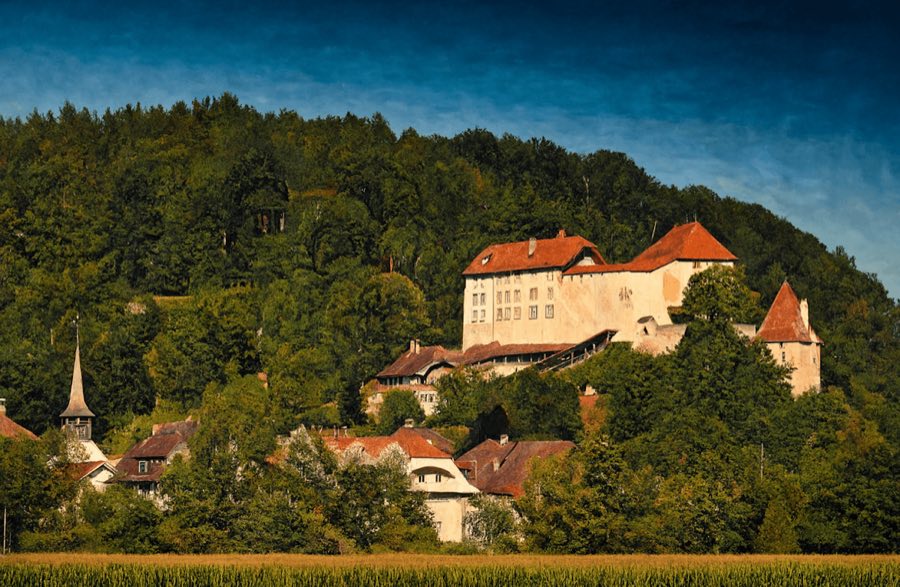
No. 86946
Laupen Castle
Switzerland
CastleRestored12th century
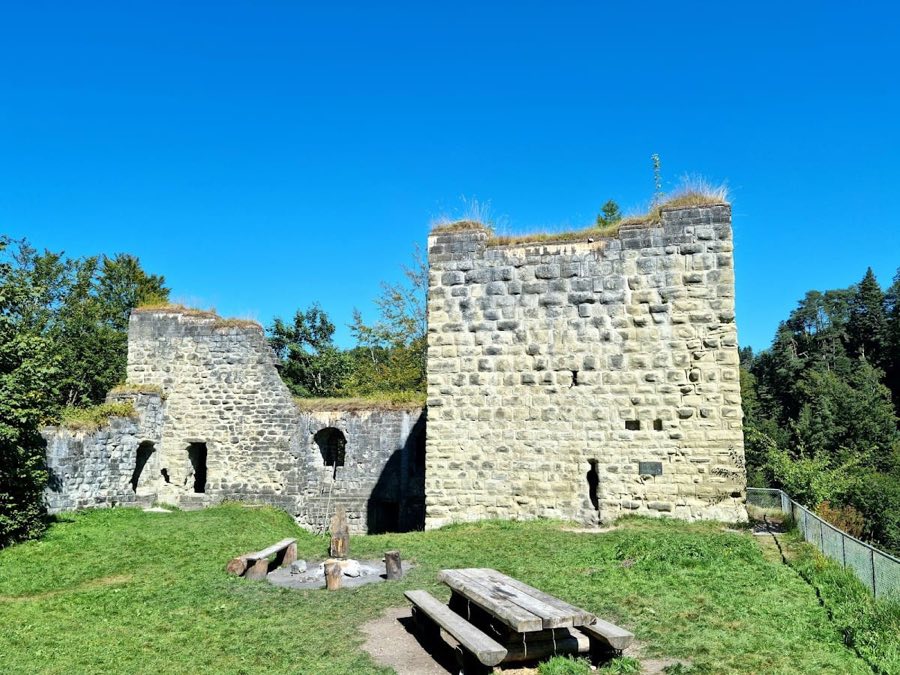
No. 15380
Castle · Switzerland
No. 15380 · 46.834 N, 7.331 E
Quick summary
Grasburg Castle is a castle in Switzerland with origins associated with the 13th century.
See all castles in SwitzerlandGrasburg Castle is located near the municipality of Schwarzenburg in Switzerland. It was built in the early 13th century by the Staufer dynasty, a German royal family that governed parts of the regions now known as Bern and Fribourg. The castle’s construction is closely tied to this period of Staufer expansion and control.
The first documentary reference to the site dates back to 1223 under the name “Grasburc.” During the first half of the 13th century, knights Otto and Kuno von Grasburg are recorded as occupants, highlighting the castle’s role as a fortified residence linked to the Staufer imperial domain. A local administrative figure, Jakob Schultheiss von Grassburg, is mentioned in records from 1239, further indicating the castle’s significance as an administrative center. Subsequently, during the period known as the Interregnum, when imperial authority weakened, control of Grasburg shifted to the Kyburg family.
Following the decline of the Staufer dynasty around 1250, Grasburg Castle changed hands multiple times. It came under the dominion of the Kyburgs, briefly passed to the House of Savoy in 1263 or 1264, and then was granted as a fief to Rudolf of Habsburg. Rudolf restored its status as an imperial stronghold, appointing local bailiffs, known as vogts, from prominent families including von Maggenberg, de Corbières, and de Vuippens to oversee the castle and its surrounding lands.
In 1310, King Henry VII pledged Grasburg to Amadeus V of Savoy. The Savoy family and their heirs held possession for more than a century. By the early 15th century, due to the castle’s remote location and a state of disrepair, it was sold in 1423 to the neighboring cities of Bern and Fribourg. These cities established a condominium rule over the castle, administering it jointly and appointing alternating vogts to manage its affairs.
By 1575, Grasburg Castle was abandoned as a seat of administration, which was transferred to Schwarzenburg Castle. Ownership later passed to the Canton of Bern in 1803, and then to the city of Bern in 1894. The city undertook various restoration projects to stabilize and preserve the site, with significant repair work conducted in the early 20th century and further conservation efforts continuing into the 21st century.
Grasburg Castle occupies a sandstone rocky promontory above the Sense Gorge near Schwarzenburg. The site stretches over an uneven plateau roughly 150 meters long and 50 meters wide, making it the largest castle ruin in the canton of Bern. Its natural position on a steep rock formation provided strong defensive advantages, with sheer slopes protecting it on nearly all sides except the southeast, where a natural rock saddle connects the site to the surrounding land.
The castle’s layout encompasses the main castle area, an outer bailey, and a central courtyard, all of which survive today mainly as ruins. The core of the castle was originally built on the elevated western tip of the promontory, separated from the rest of the site by a broad neck ditch about 16 meters wide. A subsequent construction phase added a bergfried—a tall, main tower typical of medieval castles—at the eastern end. This tower served as the last line of defense and a lookout point.
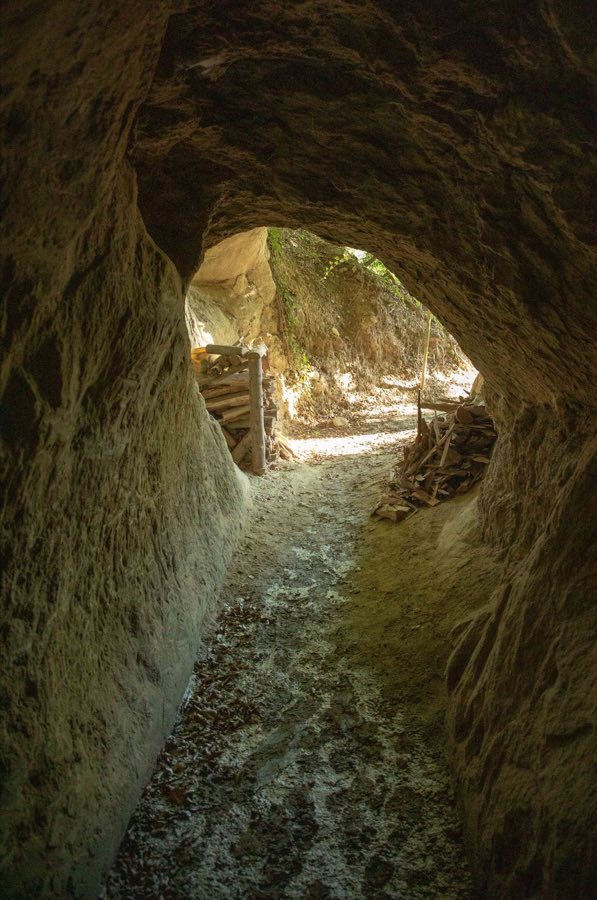
Construction materials were sourced locally, with sandstone carved directly from the rock formation forming the primary building stone. Gothic architectural details found within the ruins align with the early 13th-century dating of the castle’s construction. Over the centuries, various restoring and safety efforts have preserved key sections of the site, allowing visitors to explore the remains securely.
Strategically positioned, the castle oversaw a medieval road that connected the former Kyburg cities of Thun and Fribourg and controlled a river crossing on the Sense located about 600 meters to the south. Although the castle is now roofless and fragmentary, its substantial walls, ditch, and tower foundations provide insight into its military and administrative purpose during the Middle Ages. Today, the surviving structures stand as testimony to its original function as a formidable stronghold in the region.
No. 86946
No. 31159
No. 36387
No. 18416
Comments
Comments for Grasburg Castle will require a verified account before posting.
We'll send a verification link before your first comment is published.