No. 20251
Burg Berge
Germany
CastleRuin11th century
No. 57401
No. 57401 · 50.994 N, 7.042 E
Quick summary
Haus Haan is a manor house in Germany with origins associated with the 12th century.
See all castles in GermanyHaus Haan stands in Dünnwald, Cologne, Germany, and was established by members of the medieval German knightly class. Before 1200 the knight Seybold von Blech built the first defensive earthwork, a motte, on a cleared area at the site, and the place is first documented in a charter dated 1203. By 1230 the estate belonged to the knight Konstantin von Haane, whose sons Nikolaus and Jakob von Haane took part in a recorded dispute in 1264 with the nearby Dünnwald convent over use of the Mutzbach stream to fill the castle’s moat.
A longer legal settlement followed earlier grants of water use by Count Adolf, nicknamed “Adolf with the beard.” Arbitration appointed by Countess Margarete von Berg and her son Adolf awarded the convent exclusive rights to the stream while granting the knights limited access for two days and nights each week, specifying the times of use at nine o’clock on those days. The decision required that any water taken be directed only into the castle’s moat, that a relative of the knights be admitted into the convent, and that the knights pay twenty Cologne marks in compensation.
In 1355 the knight Wilhelm von Haane established a mill at the point where the Mutzbach descends from the lower heath terrace into the Rhine valley, roughly at today’s Dünnwalder Mauspfad. The mill functioned as a fulling mill and later became known as the lower fulling mill; its operation was leased to tenants. The estate passed by inheritance to the von Lülsdorf family, who made Haus Haan their seat and lived there from 1373 until 1710.
During the Thirty Years’ War the castle suffered damage and in 1628 imperial troops burned it down. A new manor house was erected in 1730 and received a further renovation in 1786. Ownership later moved to the Droste zu Vischering family. In 1812 the property was sold to a Mr. Brügelmann of Ratingen, who appointed Friedrich Wilhelm Brügelmann as manager; this family founded the firm Brügelmann in 1822. The estate changed hands again in 1818 to the Freiherr von Fürstenberg zu Neheim, a line that later became Counts of Fürstenberg-Stammheim. The counts sold Haus Haan to the city of Cologne in 1828.
Under municipal ownership the complex lacked a continuing use and parts of the estate fell into decay, with some economic buildings used as a riding stable. The city sold the property in 1986 and it was converted into an owner-occupied residential complex. Local tradition preserves a legend that an underground passage once linked Haus Haan with the Dünnwald convent, through which nuns could escape if the site came under attack.
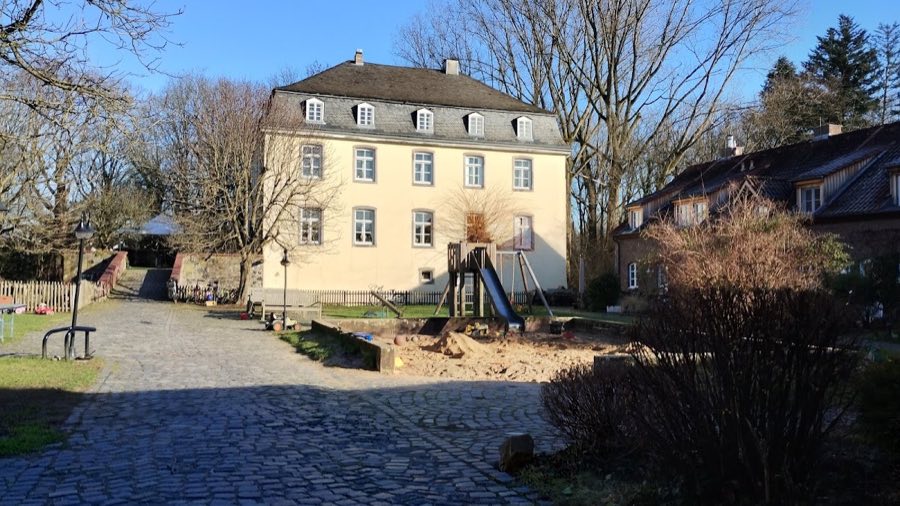
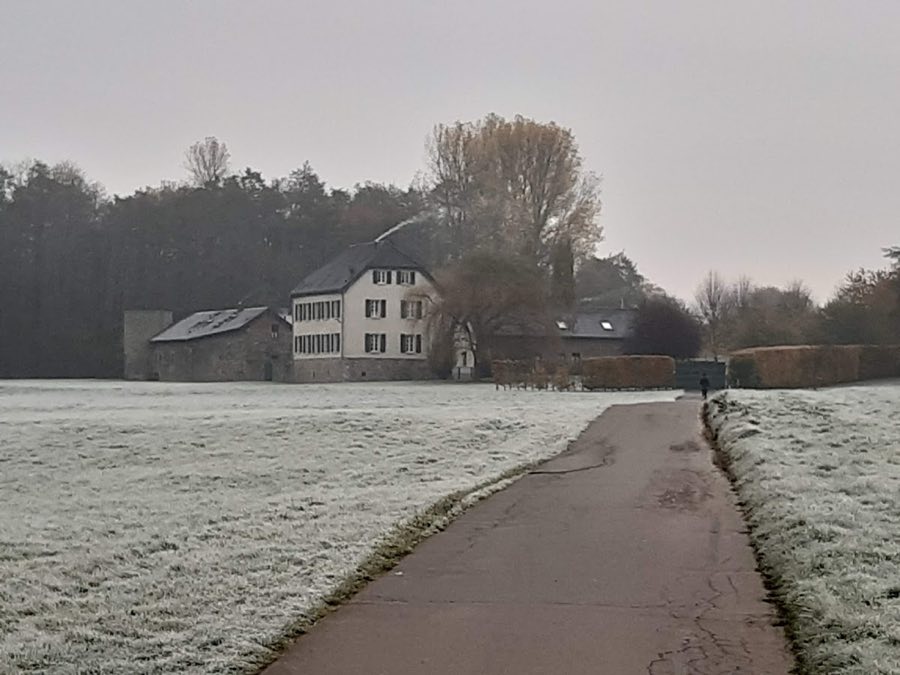
The ensemble is laid out as a roughly square grouping with the main house set at the centre, not completely ringed by other structures. The manor stands on a highly raised masonry island that is entirely encircled by a water-filled moat. A steep stone arched bridge rises from the inner courtyard to provide the principal approach onto the island. The manor itself is a plain, rectangular two-storey building with a high mansard roof and regular window placement on each side.
Buildings that once served economic functions rise from the level of the moat on three sides of the main house; these are of more recent date than the central dwelling and were later adapted for varied uses. Directly opposite the island entrance a gate passage opens toward the modern street Zeisbuschweg, marking the historic access axis. Water for the moat is supplied by a small channel that branches from the Mutzbach at the Dünnwalder Mauspfad, and the flow into the moat can be controlled by a weir.
The 1355 fulling mill occupies the historic spot where the Mutzbach drops from the lower heath terrace into the Rhine valley, approximately at the present Dünnwalder Mauspfad; it was worked as a fulling mill and later referred to as the lower fulling mill, with its operation let to tenants. The site shows evidence of successive reuse and adaptation, and a local legend records a subterranean passage said to have connected the manor and the Dünnwald convent. The principal masonry island, the stone bridge, the moat fed from the diverted stream, the surrounding service buildings, and the mill location remain recognizable elements of the historic complex.
No. 20251
No. 84472
No. 22537
No. 79556
Comments
Comments for Haus Haan will require a verified account before posting.
We'll send a verification link before your first comment is published.