No. 98198
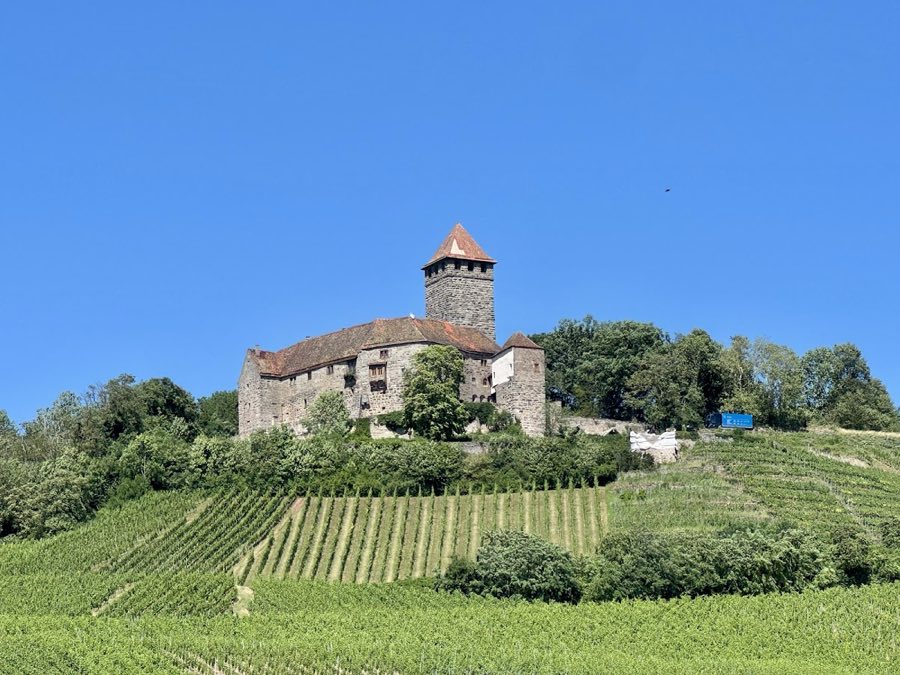
Burg Lichtenberg
Germany
CastleRestored12th century
No. 97215
No. 97215 · 48.980 N, 9.242 E
Quick summary
Höpfigheim Castle is a castle in Germany with origins associated with the 14th century.
See all castles in GermanyHöpfigheim Castle in Steinheim an der Murr, Germany, began as a medieval fortified site first established in the High Middle Ages and was transformed into a schloss during the 1500s. Its long-lived role shifted from a feudal holding to an aristocratic residence and later to municipal and civic functions, reflecting local shifts in ownership and administration across several centuries.
The place is first recorded in the early 14th century, and by the mid-1300s it was held as a fief by Walter von Ebersbach under the Counts of Vaihingen. Over the following centuries the property passed among regional noble families, including the lords of Mönsheim, Urach and Bernhausen, before the von Speth family acquired it in 1486.
In 1587 the complex was sold into ducal hands and granted as a fief to a privy councillor, who commissioned a comprehensive remodeling in the late 1500s that reshaped the building into its schloss form. Major works at that time included reworking the main house and adding defensive towers; these late-16th-century alterations define much of the ensemble seen today.
At the end of the 17th century the fief returned to ducal control and was earmarked for enlargement as living quarters for the crown prince, Friedrich Ludwig. After the prince’s death the site served as the office seat for the Stabsamtmann and for the cameral official of the Oberamt Marbach, the district administration of Marbach. In the mid-18th century the wooden bridge giving access was replaced with a stone bridge.
In the 19th century the municipality of Höpfigheim bought the property and adapted it for public use; it accommodated a school and housed the town hall. During the period of National Socialism the gate tower was used by the local Hitler Youth. The main building continued as a school until 1965 and served as town hall until 1973. Renovations took place in 1981 and again in 2005 to repair decayed wooden elements and rebuild the filling masonry. Until his death in 2020 the district administrator Ulrich Hartmann resided in the castle.
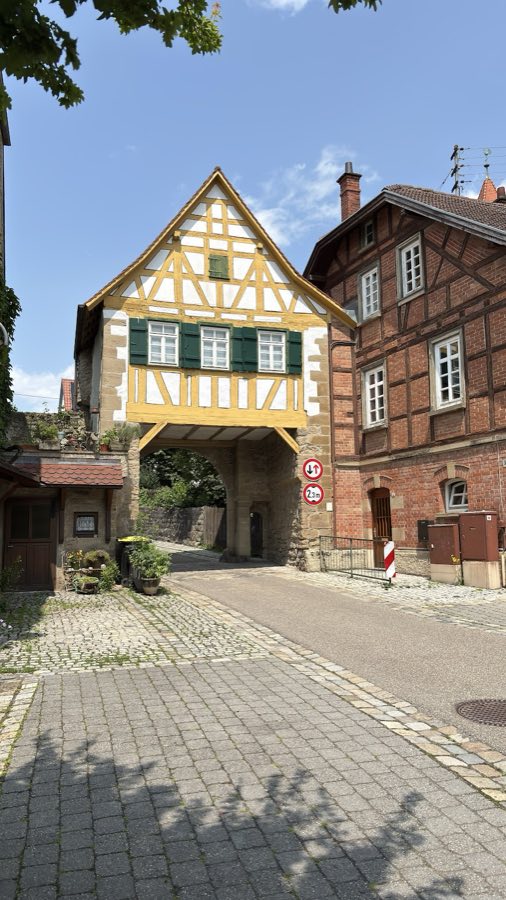
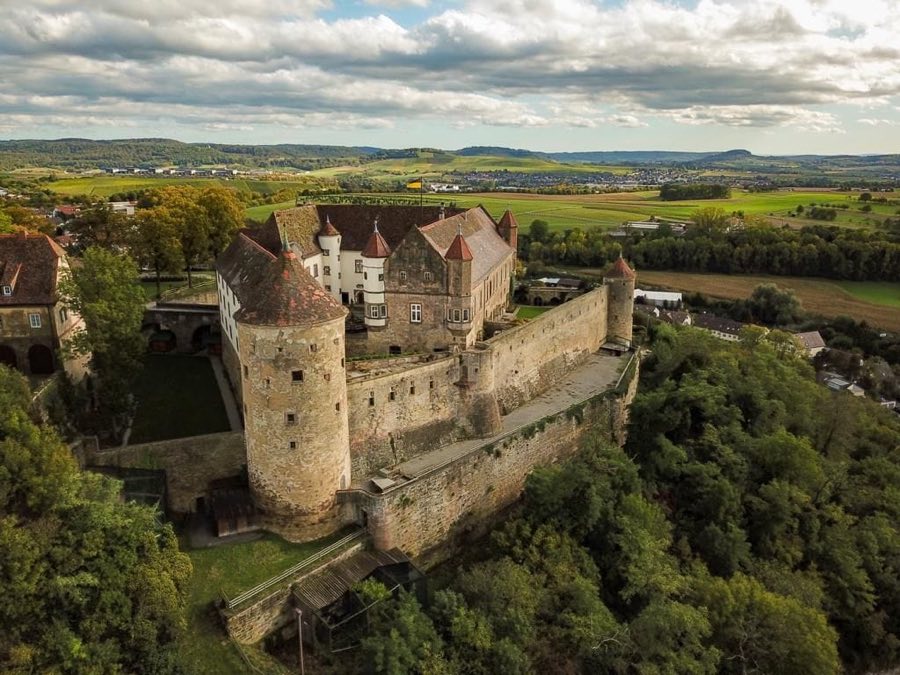
The castle stands as a compact, formerly fortified farmyard surrounded by multiple moated enclosures. A forecourt, entered from the north through a gatehouse, opens onto a principal square enclosure that is itself ringed by a wall and moat. Within that main enclosure a central courtyard is bounded on the south and west by the two-winged principal building, while the east and north sides are formed by a masonry wall with a battlemented walkway, a defensive wall-walk that runs behind crenellations. Access to this inner space is through a northeast gatehouse.
Fragments of the original moat and curtain works remain around the farmyard and main enclosure, preserving the sense of the site’s defensive layout. A surviving round tower, pierced with shooting slits, stands as a remnant of those fortifications. Both gate towers and the round tower date to the late-16th-century remodeling, and the defensive works were probably renewed during that expansion.
The main house originally featured an open upper loggia that was enclosed during the late-1500s alterations; its columns were finished with stucco at that time. Structural timber-frame elements survive in parts of the ensemble; timber-frame (wooden beam construction with infill) members that had suffered water or rot damage were replaced in 2005 and the infill masonry was rebuilt. The wooden drawbridge was removed and a stone bridge installed in 1754, and that permanent stone access remains part of the compound’s approach.
Buildings of the former economic court, the working farm buildings that served the estate, are still standing and are now privately owned. Today the ground floor of the main building serves a bank branch, while upper rooms and the outlying farmyard structures are in private hands, with past restorations having stabilized much of the visible fabric.
No. 98198
No. 56433
No. 99334
No. 11063
Comments
Comments for Höpfigheim Castle will require a verified account before posting.
We'll send a verification link before your first comment is published.