No. 37993
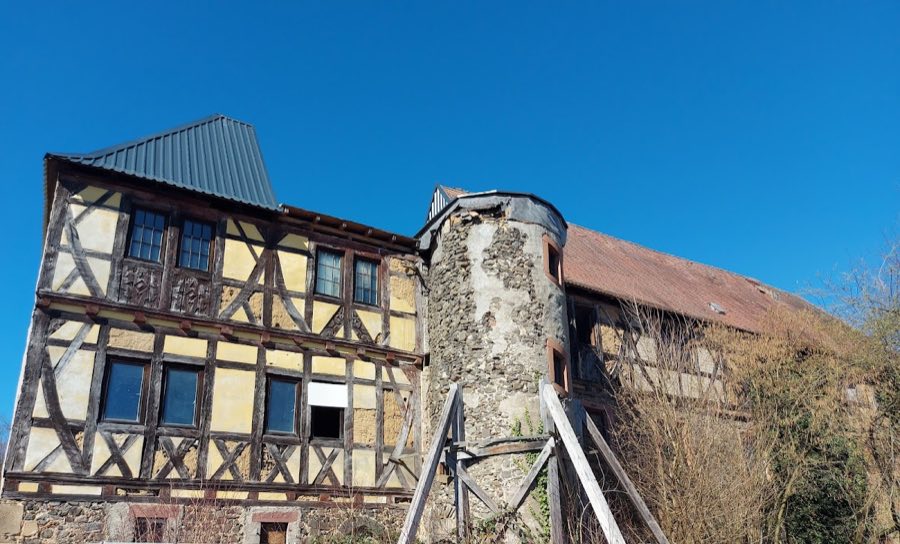
Burg Södel
Germany
PalaceIntact15th century
No. 46719
Castle · Germany
No. 46719 · 50.345 N, 8.590 E
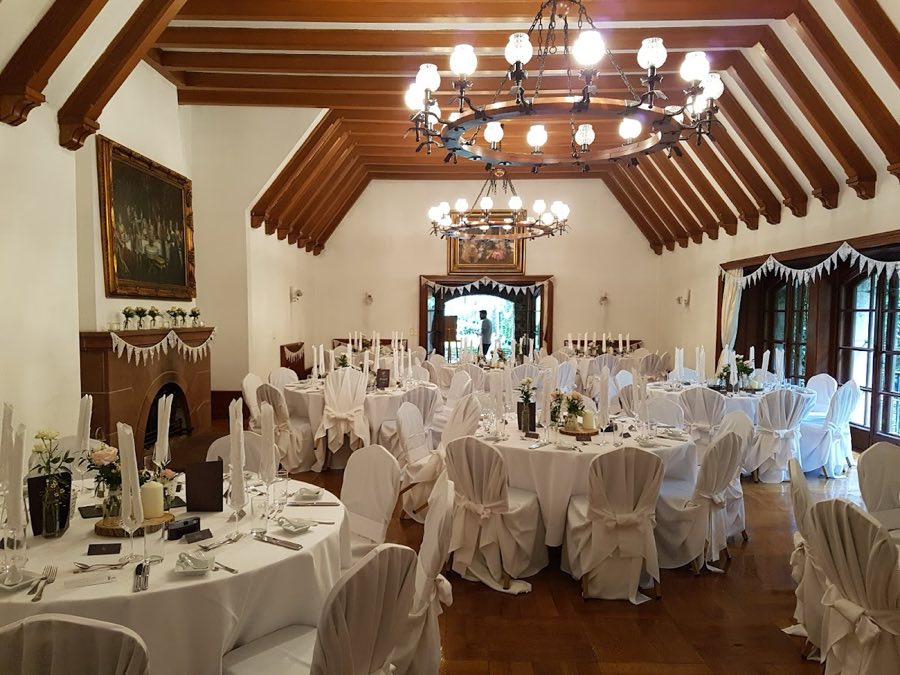
For events
Kransberg Castle is marked as a château or castle venue lead. Capacity, indoor/outdoor spaces, catering rules, and accommodation options are published only after public verification.
Event types: Weddings, Private events, Cultural gatherings, Filming and photography
Ceremony spaces: Ceremony setting to verify
Quick summary
Kransberg Castle is a castle in Germany with origins associated with the 11th century.
See all castles in GermanyKransberg Castle in Usingen, Germany, is a medieval hilltop stronghold first erected around 1170 by medieval builders, likely replacing earlier fortifications that may reach back to the 11th century and, according to one account, possibly to the 7th century. The complex acquired much of its visible shape after a neo‑Gothic rebuilding in the late 19th century. Over time the site played locally important roles in noble administration and, in the 20th century, became a focus of military command and intelligence activity during World War II and the Cold War.
The castle appears in surviving records in the 13th century, when Erwinus de Cranichesberc is named as owner in 1250. Ownership passed through several noble hands: it was sold to Duke Philipp IV von Falkenstein in 1310, came under the Eppstein family in 1419 and the Königstein line after 1433, transferred to the County of Stolberg in 1535, to the Archbishopric of Mainz in 1581, and was acquired by the Waldbott von Bassenheim family in 1654. From the late 18th century the complex fell into neglect.
In the mid‑19th century the Duchy of Nassau took possession, and after 1866 the site came under Prussian administration. A baronial owner in the 1870s carried out large‑scale neo‑Gothic rebuilding that reshaped the castle’s appearance; despite these works, parts of the outer defenses and the central tower remained largely as they had been.
Private ownership continued into the 20th century until 1939, when the Nazi state took control. Between 1939 and 1941 Albert Speer carried out extensive adaptations, renaming the complex Adlerhorst, meaning “Eagle’s Nest,” and adding reinforced concrete, air‑raid standard bunkers that were disguised as seven small cottages and linked to the castle by a network of underground passages. After Adolf Hitler rejected Adlerhorst as his principal headquarters in February 1940, the complex was repurposed as Luftwaffe headquarters for Operation Sea Lion, the planned invasion of Britain. When invasion plans were dropped, the site served as a rehabilitation center for soldiers and as Hermann Göring’s personal retreat. From October 1944 the castle and its associated bunker works housed OB West, the German high command for the Western Front, under Gerd von Rundstedt. Adolf Hitler lived at the castle from 11 December 1944 until 16 January 1945.
On 19 March 1945 P‑51 Mustang fighters carried out a forty‑five minute air raid that damaged or destroyed the castle and nearby buildings and caused civilian casualties. German forces, including those under Kesselring, abandoned the site on 28 March 1945, and a U.S. Army unit occupied the castle on 30 March 1945. In the months that followed the complex became an Anglo‑American detention and interrogation center, known from June 1945 as Camp Dustbin, where high‑profile industrial, technical, and financial figures were held and questioned; Camp Dustbin remained active through 1946.
During the Cold War the Organisation Gehlen, the U.S.–German intelligence formation that later evolved into the Federal Intelligence Service, moved into the complex in 1956. The site subsequently hosted the 5th U.S. Army Corps, which ran a non‑commissioned officer academy, and housed U.S. intelligence units that operated parts of an espionage network aimed at East Germany. U.S. forces departed in 1990. The German government sold the property to a private owner in 1993. Further changes of ownership followed: parts were converted to a business park for information‑technology firms around 2000, that activity ended by 2008, and in late 2012 a Turkish investor group acquired the castle with plans for educational use. Deferred maintenance left sections of wall and a balcony endangered, prompting closure of the road below, and a fire on 28 March 2014 damaged several ceiling beams. By 2023 the owner was living on site and gradually restoring rooms; the castle also functions as a venue for civil weddings, with a registry office, and has hosted classical music concerts.
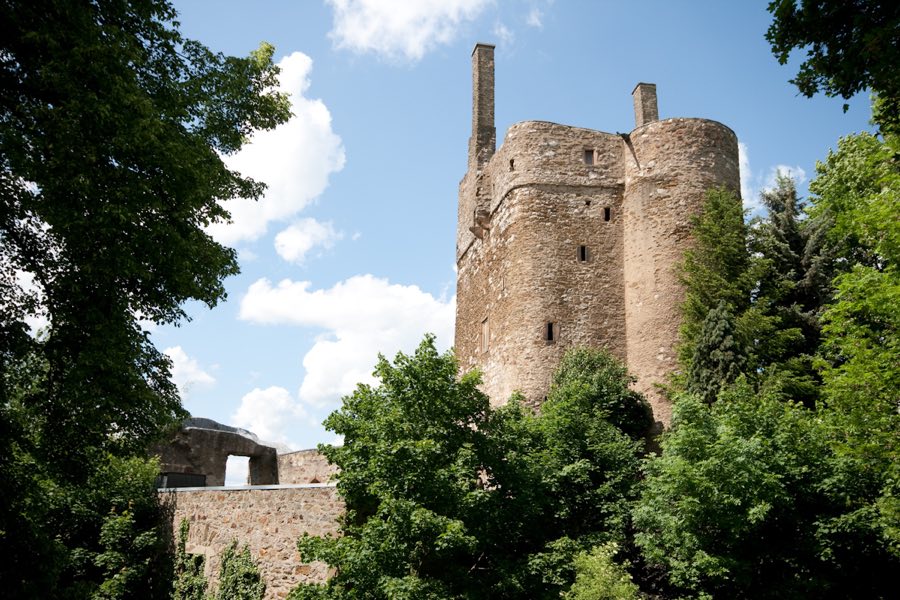
Sitting on a steep rock above the village of Kransberg in the Taunus hills, the castle presents a layered layout of early stone fabric beneath later stylistic additions. The earliest surviving masonry includes fragments of defensive wall and the bergfried (main tower), which date to the early medieval period, including the 12th century. These stone elements are among the oldest parts of the complex and form the core around which later buildings cluster. A palatial residence block and several towers that were part of the medieval phase remain incorporated into the main structure, where they can be seen as older masonry amid later work.
The late 19th‑century rebuilding added neo‑Gothic extensions and dressing that substantially changed the castle’s external appearance. Those interventions used dressed stone and ornamental detailing typical of Gothic revival work, applied over the medieval fabric. Despite this transformation, sections of the outer defensive works and the central tower were left largely as they had been, so the castle today shows a mix of medieval stonework and 19th‑century stylistic surface treatments.
Twentieth‑century military construction altered the site more radically. Reinforced concrete bunkers, built to air‑raid standards, were concealed as seven small cottages and connected to the castle by an extensive underground bunker complex. The wartime ensemble also included at least one large underground shelter, a spacious ceremonial hall, and vehicle garages. The modern bunkers are of mass concrete and were deliberately camouflaged to resemble vernacular buildings. Wartime bombing and later firefighting operations damaged parts of the complex in March 1945, and a 2014 fire harmed several ceiling beams; by the 2010s some of the 20th‑century architectural traces were still visible. Repair work has been carried out room by room in recent years to stabilise and restore damaged structures.
No. 37993
No. 36806
No. 57446
No. 79217
Comments
Comments for Kransberg Castle will require a verified account before posting.
We'll send a verification link before your first comment is published.