No. 19529
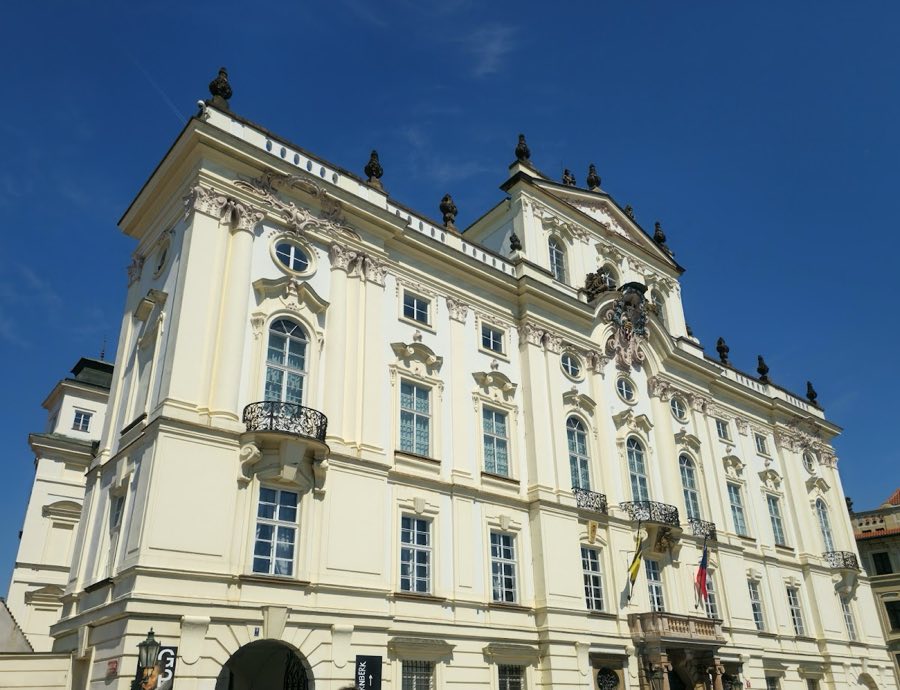
Archbishop's Palace, Prague
Prague, Czechia
PalaceRestored14th century

No. 27779
Palace · Czechia
No. 27779 · 50.087 N, 14.398 E
Quick summary
Lobkowitz Palace is a palace in Czechia with origins associated with the 18th century.
See all castles in CzechiaLobkowitz Palace in Prague, Czechia, is a Baroque city palace built in the early 18th century by Bohemian noble patrons, completed around 1703–1707. Erected in the Baroque period, the house became an important urban residence for high-ranking noble families, a site for notable musical performances, and in the 20th century a diplomatic building whose role reached an international turning point in 1989.
Construction and early ownership began when a Bohemian count commissioned the city residence, laid out its gardens, and then, because of debts, sold the property soon after completion. Ownership transferred in 1717 to another noble household, and in 1753 the palace passed by marriage into the Lobkowitz family. It then remained the Prague seat of the Hořín–Mělník branch of that family until 1927.
During the period of private ownership the palace served cultural as well as residential functions. The principal domed salon hosted concerts by Ludwig van Beethoven and by Carl Maria von Weber. The original formal gardens were later redesigned in 1790 as an English-style park, reflecting changing tastes in landscape design.
In 1927 the state acquired the property for the Ministry of National Education. Over the following decades the building housed a series of public institutions, including the monuments office, the Slavonic Institute, the Institute of Archaeology, the Oriental Institute and the Masaryk Academy of Labour. After the 1948 communist takeover the palace was used for some years as the Embassy of the People’s Republic of China.
Following the establishment of diplomatic relations with West Germany in 1973, the palace became the Federal Republic of Germany’s embassy in Prague in 1974, and later the representation of reunited Germany. In late summer 1989 thousands of citizens of the German Democratic Republic sought sanctuary at the embassy and occupied the palace and gardens for several weeks, a final count of 4,500 people. On 30 September 1989 Federal Foreign Minister Hans‑Dietrich Genscher announced from the palace’s first-floor balcony that those refugees would be permitted to emigrate to the Federal Republic of Germany; a plaque now marks that balcony. That announcement has been described as opening the way to the fall of the Berlin Wall on 9 November 1989. The palace grounds were renovated after the occupation ended.
Plans in the mid-1990s foresaw transferring the property into German federal ownership in exchange for the former United States embassy building in Berlin. Negotiations intensified in 2009 but by 2014 an outright sale had not been completed; instead a 50-year lease arrangement was concluded. The palace and its garden remain protected as a cultural monument of the Czech Republic.
The palace stands as a compact Baroque ensemble dating to the early 1700s, combining a long, straight-facing street front with a more animated garden side. Along the street the building presents an extended, almost rectilinear façade that follows the line of Vlašská Street. Facing the garden, the composition shifts to sweeping curves with a central projecting bay flanked by two inward-curving wings, and the house is separated from its planted grounds by an ornate metal grille adorned with sculptural work.
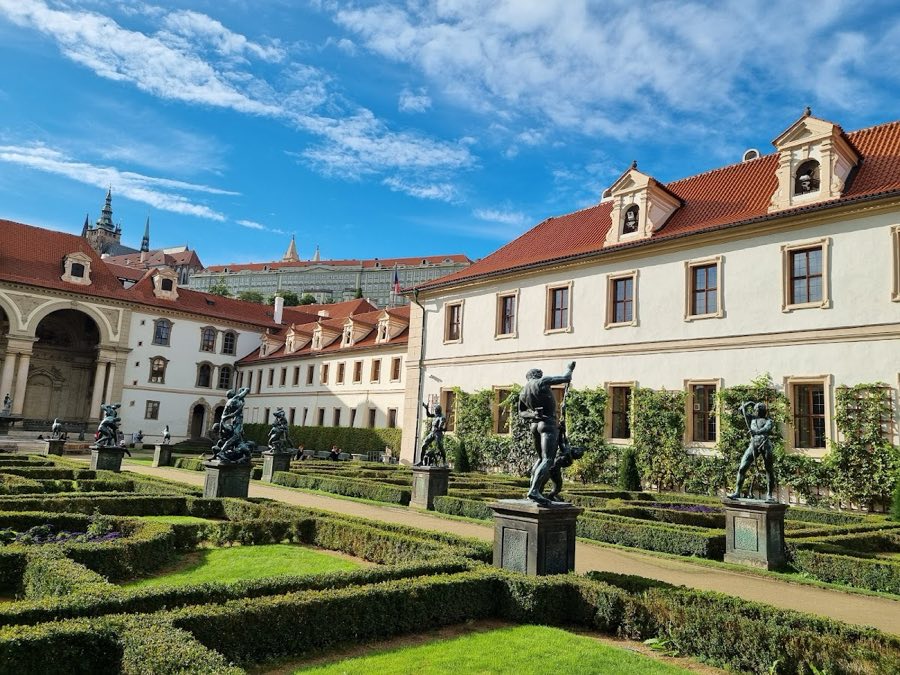
The gardens themselves began as a formal Baroque layout created with the palace but were reshaped into an English-style park in 1790, reflecting a move toward more naturalistic planting and paths. The garden continues to form part of the palace ensemble and is protected as part of the cultural monument.
Interior and ornamental elements of the complex remain visible. A domed hall (a room covered by a dome) survives and is recorded as the space in which Ludwig van Beethoven and Carl Maria von Weber performed. A first-floor balcony on the garden side, the place from which the 1989 announcement was made, carries a commemorative plaque. Above an entrance the triangular pediment (triangular gable above an entrance) displays the Lobkowicz family coat of arms.
A later sculptural addition on the garden side is the Trabant sculpture titled “Quo Vadis” by David Černý; the original of that work is held in the collection of the Forum of Contemporary History in Leipzig. The palace and its gardens were renovated after the 1989 occupation and continue in active use as the German embassy under a fifty-year lease, while the whole ensemble remains legally protected as a cultural monument of the Czech Republic.
No. 19529
No. 76144
No. 25500
No. 56491
Comments
Comments for Lobkowitz Palace will require a verified account before posting.
We'll send a verification link before your first comment is published.