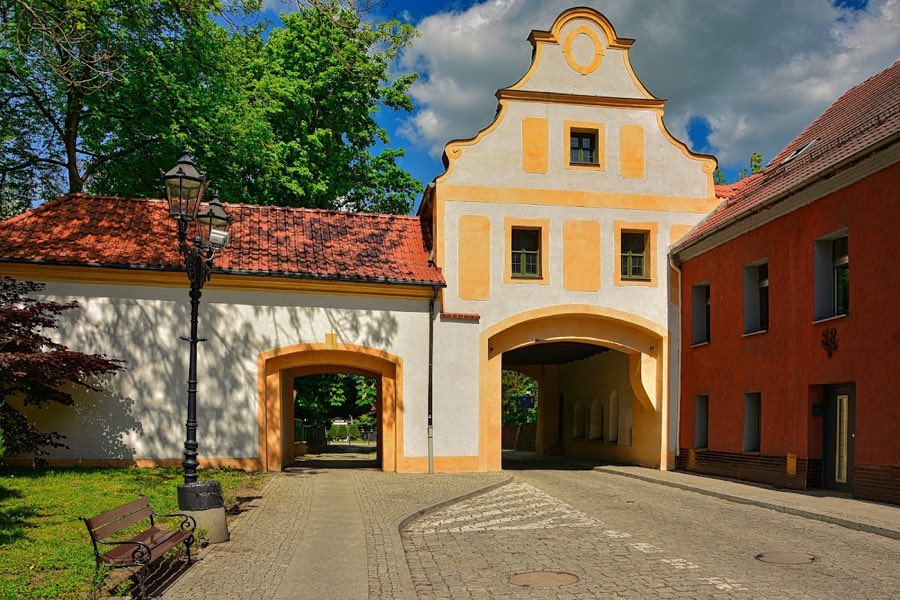
No. 26166
Głogówek Castle
Poland
CastleRuin8th century
No. 53906
No. 53906 · 50.441 N, 17.769 E
For events
Moszna Castle is marked as a château or castle venue lead. Capacity, indoor/outdoor spaces, catering rules, and accommodation options are published only after public verification.
Event types: Private events, Cultural gatherings, Filming and photography
Quick summary
Moszna Castle is a castle in Poland with origins associated with the 18th century.
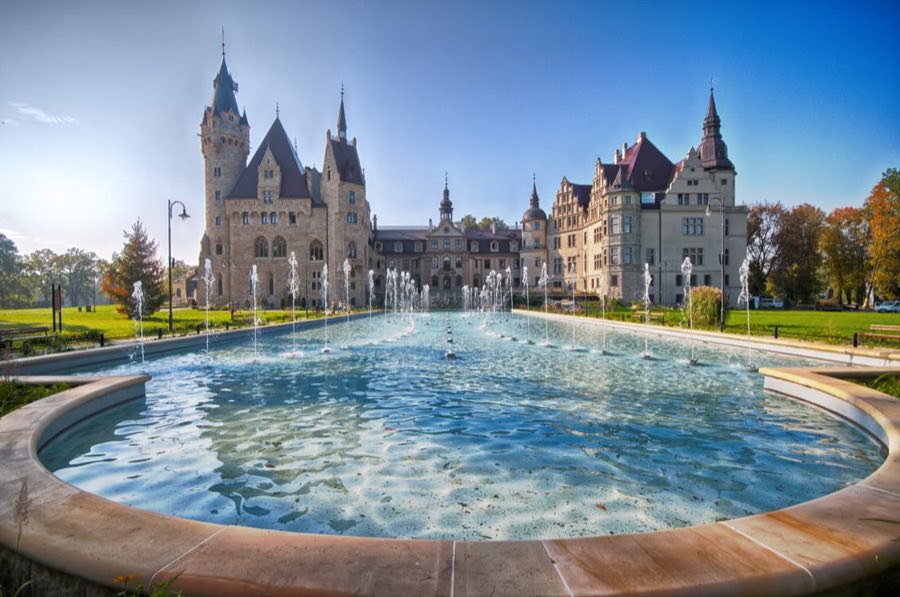
See all castles in PolandMoszna Castle is located in the municipality of Moszna in present-day Poland. It was originally constructed as a baroque palace in the mid-18th century under the ownership of Georg Wilhelm von Reisewitz, marking its origins in the European noble tradition of that era. The site has belonged to several prominent families and has experienced notable historical developments over the centuries.
The earliest recorded documentation of the palace dates to 1845, when it was still owned by the Seherr-Thoss family. Ownership changed hands in 1853 to Heinrich von Erdmannsdorf, and from 1866 the estate became the principal residence of the Tiele-Winckler family, who were influential industrialists. This period initiated significant social and architectural changes at the site, aligning the palace more closely with the rising industrial wealth in the region.
A pivotal moment in the castle’s history occurred on the night of June 2-3, 1896, when a devastating fire severely damaged the original baroque palace. Reconstruction followed in two major stages. Between 1896 and 1900, the central section was restored, and a new eastern wing was constructed in the neo-Gothic style, including an orangery. Later, from 1912 to 1914, a western wing was added in neo-Renaissance style, characterized by ornate pilasters, semi-columns, and an octagonal tower associated with hunting traditions. These expansions transformed the palace into a sprawling and stylistically diverse complex.
The Tiele-Winckler family planned to establish a burial crypt beneath the palace chapel but found the humidity unsuitable, resulting in the relocation of their family cemetery to a dedicated site within the palace park. This cemetery remains accessible and stands as a testament to the family’s lasting connection to the estate.
Emperor Wilhelm II visited Moszna Castle on several occasions related to hunting events in 1904, 1911, and 1912, hosted by Franz Hubert von Tiele-Winckler, demonstrating the palace’s role as a center of aristocratic social life in the early 20th century.
During World War II, Moszna Castle was repurposed as a branch of a military hospital. Although the building itself avoided damage from combat, the aftermath of the war saw Soviet troops quartered there in 1945, leading to extensive looting and destruction of the palace’s interior furnishings and art collections.
Following the war, the palace served various institutional functions before becoming a sanatorium in 1972. Later, it was converted into the Center for Neurosis Therapy, operating from 1996 to 2013. After medical services were moved nearby, the palace transitioned into its current role, partly opening to suit different functions and cultural activities.
Excavations conducted at the site uncovered remains of medieval wooden structures beneath the palace, as well as cellar fragments initially suspected to be connected with a Templar castle and underground passages to a nearby castle in Chrzelice. These connections are now considered unlikely but enrich the historical narrative of the location. Postwar construction revealed traces of medieval palisades, highlighting an earlier fortified presence on the site.
Since 1984, Moszna Castle and its surrounding park have been venues for various cultural events including chamber music performances, art exhibitions, and the annual Music Festival of Blooming Azaleas, reflecting its evolving role in the cultural life of the region.
The Moszna Castle complex encompasses about 8,000 square meters and contains 365 rooms alongside 99 towers and turrets, creating an extraordinary combination of architectural styles. Architecturally, it is composed of three main parts, each representing a different historical period and design influence. The oldest section is the central baroque wing from the 18th century, restored after the 1896 fire. The eastern wing, erected between 1896 and 1900, displays neo-Gothic characteristics and includes an orangery, which served as a greenhouse for exotic plants. The western wing, added from 1912 to 1914, expresses neo-Renaissance elements, featuring decorative pilasters, semi-columns, and a prominent octagonal hunting tower.
The palace is arranged in an irregular U-shape, with the central wing positioned perpendicular to the main axis of the surrounding park. A coat of arms belonging to Franz Hubert von Tiele-Winckler, who managed the palace’s restoration and expansion after the fire, is visible on the southern facade, providing a visual acknowledgment of the family’s influence.
Surrounding the palace is an extensive landscaped park, varying in size between 100 and 200 hectares according to different sources. The park’s central axis is highlighted by a linden tree-lined alley flanked on both sides by 19th-century water canals, designed in Dutch and French styles, which contribute to a formal, geometric layout. Ornamental ponds punctuate the grounds, one of which is adorned with a Chinese-style bridge leading to an island whimsically named Easter Island. This setting includes natural highlights such as centuries-old oak trees, some surpassing 300 years in age, and dense clusters of rhododendrons, lending the park an atmosphere of mature woodland interspersed with cultivated beauty.
Within the park lies the family cemetery of the Tiele-Winckler lineage, situated at the end of the main alley. This site serves as the final resting place for family members, having been relocated from a chapel crypt due to unsuitable humidity conditions.
Archaeological exploration beneath the palace has uncovered remnants of medieval wooden structures, revealing earlier occupation layers predating the current building. Fragments of cellars discovered underground were once thought to be linked to a Knights Templar castle, with oral traditions suggesting possible hidden tunnels connecting to a nearby castle in Chrzelice. However, later assessments have cast doubt on these interpretations, indicating that the Templar association is unlikely.
Further evidence of medieval fortifications came to light through postwar construction activities that exposed vestiges of a palisade—a defensive wooden fence typical of earlier periods. These findings illuminate the site’s long history as a fortified location evolving into the grand palace complex visible today.
While parts of the Moszna Castle interiors remain intact and support cultural gatherings, much of the original furniture and artwork were lost after 1945 during the Soviet occupation. Nevertheless, the surviving spaces capture the romantic, fairy-tale quality for which the castle has become renowned, reflecting its intricate blend of baroque, neo-Gothic, and neo-Renaissance elements.
No. 26166
No. 32886
No. 49026

No. 25234
Comments
Comments for Moszna Castle will require a verified account before posting.
We'll send a verification link before your first comment is published.