No. 44729
Eynard Palace
Switzerland
PalaceRestoredFor events5th century
No. 61718
Palace · Switzerland
No. 61718 · 46.199 N, 6.148 E
Quick summary
Musée de l'Athénée, Geneva is a palace in Geneva, Switzerland with origins associated with the 19th century.
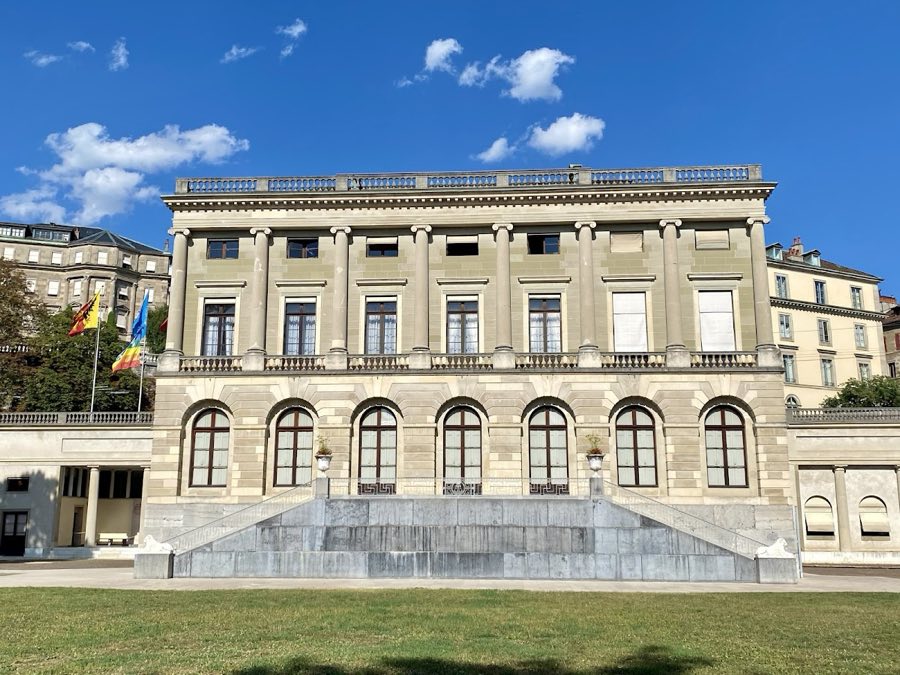
See all castles in SwitzerlandThe Musée de l’Athénée in Geneva, Switzerland, is a mid-19th-century civic palace built for the Geneva Society of Arts. Constructed between 1860 and 1864, its design draws on classical forms and an exedra-like arrangement that reflects a 19th-century taste for monumental public architecture. The building became historically important as the meeting place where the International Committee of the Red Cross was founded in 1863, and it quickly took on a central role in Geneva’s cultural and international institutional life.
The idea for a public assembly building on this site reaches back to 1821, when Jean-Gabriel Eynard proposed a program of five civic buildings and set aside money toward a meeting place. Work on the palace was carried out decades later to house the long-established Geneva Society of Arts, an organization created in 1776 by Horace-Bénédict de Saussure. The society formally began using the new rooms in 1864, with a ceremonial opening held on 5 January of that year.
Even before the society’s full occupation the building served a pivotal international function. In 1863 Henri Dunant brought together the founding group of what became the International Committee of the Red Cross in the palace’s large lounge. That event is commemorated on the southeast façade, where an inscription marks the Red Cross’s establishment at the initiative of Dunant. The same principal reception space later hosted the International Committee for Historical Sciences and the International Association for Aid to Children, confirming the site’s continuing use for international committees and assemblies.
The palace occupies a narrow, elongated plot that had once formed part of Geneva’s old fortifications, and its overall massing was designed to harmonize with neighboring buildings of the period. The building has been maintained and renewed over time: the main structure saw renovation work in 1983 and again between 2006 and 2012, and the decorative Salle des Abeilles underwent refurbishment in 1985. Since 1989 the white-stone wing facing Rue Saint-Léger has been adapted to house the Barar Foundation collection, created by Pierre Braier and built largely from the paintings collected by his father, Maurice Braier.
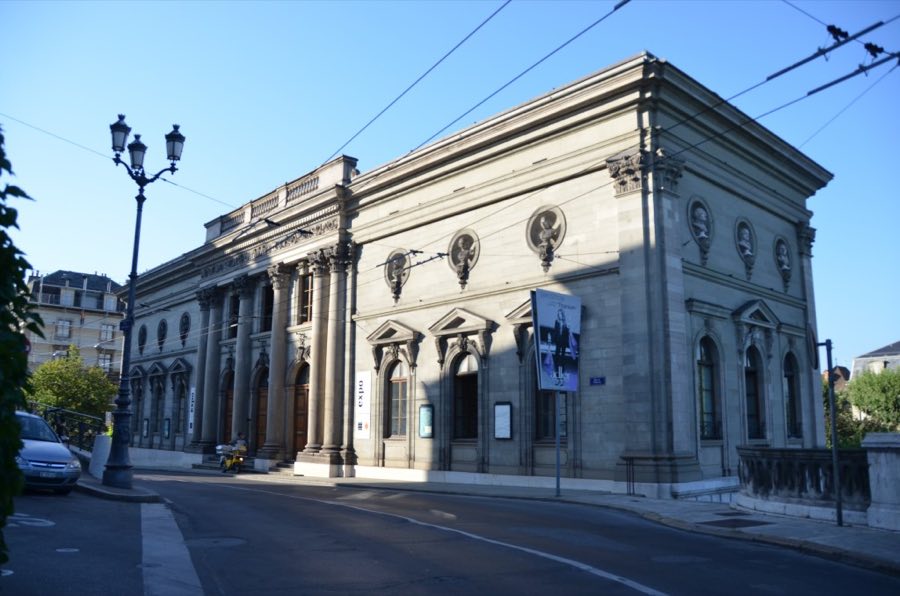
The palace stands on an elongated urban plot and presents a single principal storey on its main frontage, giving it a horizontal, temple-like composition. Three semicircular entrance openings form the centre of the façade, flanked by six very large Corinthian columns (Corinthian columns are classical columns with ornate acanthus-leaf capitals). A horizontal band above the columns (entablature, a horizontal band above columns) carries a strong projecting cornice, producing an overall effect that recalls an exedra, a curved architectural recess, completed by a crowned railing along the roofline.
Along the main and western elevations there are nine decorative niches and window arrangements that show an influence from late Renaissance mannerism associated with Michelangelo, and several sculpted portrait busts are set into the façade. Among these are representations of notable local figures, including Bishop Adémar Fabry. The busts on the exterior and within the interior were executed by Charles Man, Louis Dorsier, and Frédéric Dufour; a portrait of Jean-Gabriel Eynard by Frédéric Dufour stands in the principal stairwell.
Interior ground-floor planning groups formal reception salons around a principal large lounge. One named reception room, called the Hall of the Bees, features decoration executed to imitate marble and a molded ceiling with medallions realized in plaster imitation by Jean-Jacques Driaz, François Fuji, and Pietro Tadaouli. The great salon houses the Geneva Society of Arts’ collection, and the central blind window on the southeast elevation bears the inscription recording the Red Cross’s 1863 founding. The first floor contains a series of salons lit from above and is used for temporary exhibitions, while the basement holds the society’s library. A 1926 painting by Émile Chambon, showing Athena and the Muses extending their patronage over the society, is installed within the building.
The building’s fabric has been conserved through several campaigns: a general renovation in the early 1980s, a dedicated refurbishment of the Hall of the Bees in 1985, and a later program of works from 2006 to 2012. The white-stone wing that faces Rue Saint-Léger has been repurposed since 1989 to display the Barar Foundation collection, altering that portion of the palace for museum use while retaining the building’s historic decorative schemes.
No. 44729
No. 97358
No. 22467
No. 13864
Comments
Comments for Musée de l'Athénée, Geneva will require a verified account before posting.
We'll send a verification link before your first comment is published.