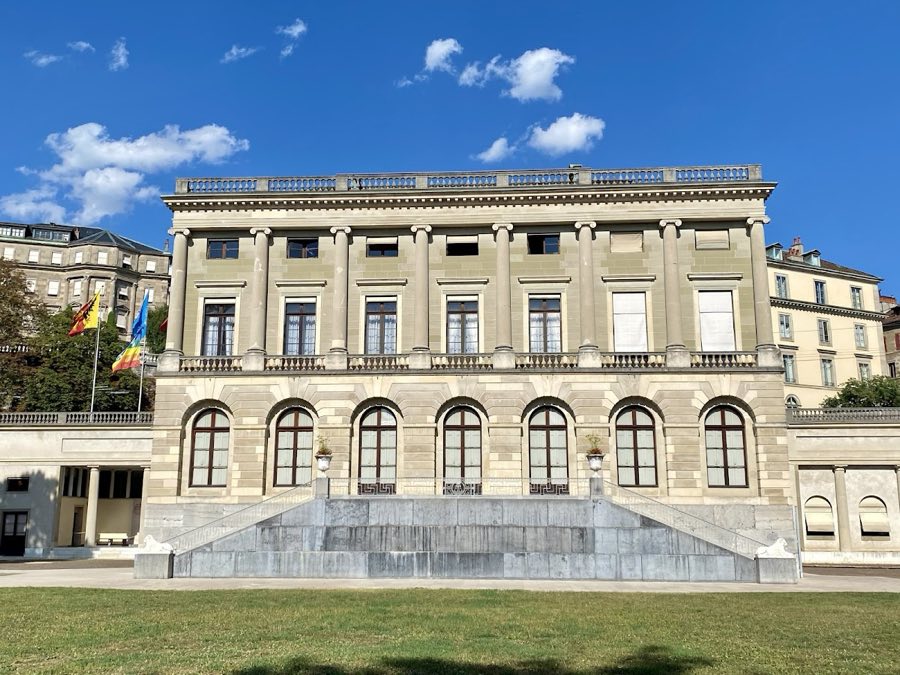
No. 44729
Eynard Palace
Switzerland
PalaceRestoredFor events5th century
No. 97358
Palace · Switzerland
No. 97358 · 46.215 N, 6.151 E
For rent
Palais Wilson is marked for bookable castle accommodation. Nightly pricing, sleeps count, stay rules, and amenities are displayed only when public operator data is available.
Rental type: Hotel / bookable stay, Short-stay rental
Short-term availability: Bookable accommodation signal
For events
Palais Wilson is marked as a château or castle venue lead. Capacity, indoor/outdoor spaces, catering rules, and accommodation options are published only after public verification.
Event types: Private events, Cultural gatherings, Filming and photography
Accommodation: Accommodation signal present
Quick summary
Palais Wilson is a palace in Switzerland with origins associated with the 19th century.
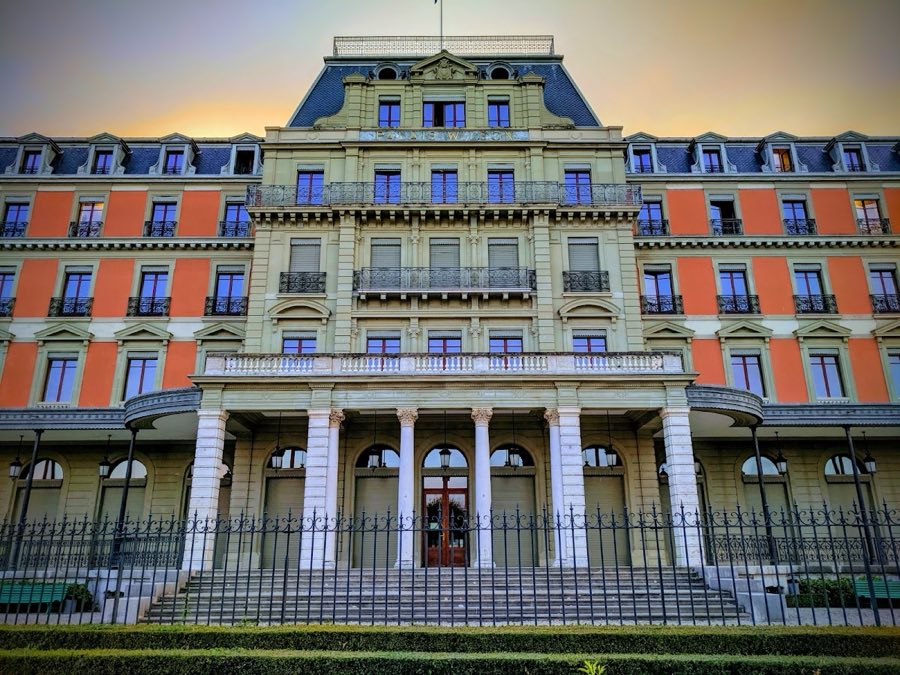
See all castles in SwitzerlandPalais Wilson in Geneva, Switzerland, is a late 19th-century, five-storey building completed between 1873 and 1875 and originally opened as a luxury hotel. Built in the 1870s, the structure quickly became part of Geneva’s lakeside urban fabric and later gained international significance when it served as headquarters for emerging global institutions in the 20th century.
The building began life as the Hôtel National, a grand city hotel with more than two hundred guest rooms and public meeting spaces. During the early decades of the 20th century its interiors were modernized to meet contemporary standards of comfort, a process carried out between 1905 and 1920 that included the fitting of private bathrooms in many guest rooms.
In September 1920 the property was acquired to house the newly formed League of Nations. The League’s secretariat departed London at the end of October 1920 and staff moved into the premises on the morning of 28 October; the building functioned officially as the League’s headquarters from 1 November 1920 until the secretariat relocated to the Palais des Nations on 17 February 1936. In 1924 the building received the name Palais Wilson in honour of U.S. President Woodrow Wilson and his role in establishing the League.
To host the 1932 Conference on Disarmament a purpose-built glass annex, known as the Disarmament Pavilion, was erected in 1931–1932. After the League moved out, ownership and use shifted: from 1937 the Swiss federal government and the Canton of Geneva took co-ownership and the building accommodated federal and cantonal offices. From 1937 until 1984 the Secretariat of the International Bureau of Education was based there.
In the 1960s ownership passed hands within Swiss public authorities: the Confederation gave the palace to the Canton in 1966, and the Canton transferred it to the City of Geneva in 1967. During this municipal period the building housed a variety of public functions, including an auditorium where the psychologist Jean Piaget taught his new educational ideas.
The palace suffered two serious fires, on 2 June 1985 and again on 2 August 1987. The second conflagration began in the glass annex, which was destroyed in 1987. Following these events the building fell into progressive disuse until civic decisions in the 1990s set it on a path of rehabilitation. A 1990 popular vote authorized a conversion plan; in 1992 national authorities decided to adapt the site for a House of the Environment, work began in 1993, and in June 1994 the federal parliament approved 75 million Swiss francs to finance the restoration. In 1997 the Secretary-General of the United Nations requested permission to place the Office of the United Nations High Commissioner for Human Rights at Palais Wilson; the Swiss government granted approval on 25 June 1997 and the office was officially inaugurated and leased in June 1998. Palais Wilson is the current headquarters of the Office of the United Nations High Commissioner for Human Rights.
The palace occupies a prominent position along the Lake Geneva waterfront on Quai Wilson, the quay named for the same American president after whom the building was renamed. The main block rises five storeys and was laid out originally to provide 225 rooms and multiple meeting areas when it opened in the 1870s. Its plan and scale reflect its origin as a large urban hotel intended to accommodate guests and official gatherings.
Known changes to the fabric of the building record the evolution of use across the 20th century. Between 1905 and 1920 substantial interior work adapted room accommodation to modern conveniences, explicitly including the installation of private bathrooms in guest rooms. In 1931–1932 a separate glass pavilion was added to the site to serve as the Disarmament Pavilion for the 1932 Conference on Disarmament; this annex functioned as a dedicated conference volume until it was consumed by fire in August 1987.
The later history of the site is visible in its conservation record. The main structure suffered partial destruction in fires on 2 June 1985 and 2 August 1987 and was progressively abandoned afterward. A programme of restoration and reuse was launched in the 1990s, funded in part by a 1994 federal allocation, and the restored palace now serves as the headquarters of the Office of the United Nations High Commissioner for Human Rights. The annex that once hosted disarmament negotiations no longer survives, while the principal five-storey building was rehabilitated and returned to active institutional use by 1998.
No. 44729
No. 61718
No. 22467
No. 13864
Comments
Comments for Palais Wilson will require a verified account before posting.
We'll send a verification link before your first comment is published.