No. 71313
Château de Montfort
France
ChâteauRestoredFor events20th century
No. 61757
Palace · France
No. 61757 · 43.698 N, 7.277 E
Quick summary
Palais Lascaris is a palace in France with origins associated with the 17th century.
See all castles in FrancePalais Lascaris in Nice, France, is a 17th-century Genoese Baroque town palace erected in the first half of the 1600s by the Lascaris de Vintimille family. Built within the dense fabric of Nice’s old quarter, the house served as a grand urban residence for that noble lineage and later acquired municipal and cultural importance when it became a public museum and the home of an extensive collection of historical musical instruments.
Construction and alteration of the residence began in the early 1600s and continued into the 1700s, when the building received a program of 18th-century remodelling that introduced sculptural work and rocaille (shell-like rococo) ornament. The names of the original designers are not recorded in surviving documents, and the overall decorative language is described by historians as Genoese Baroque. The family retained ownership of the palace until 1802.
By the opening decades of the 20th century the palace had fallen into poor repair. The city of Nice acquired the property in 1942 in order to install a museum devoted to regional arts and traditions. The carved and painted ornaments of the house received legal protection as a French Historic Monument on 15 February 1946. A program of rehabilitation began in 1963 and concluded in 1970, the year the restored palace opened definitively to the public as a municipal museum.
The musical-instrument collections now central to the palace’s purpose have older origins. The core came from the legacy of Antoine Gautier (1825–1904); his bequest took effect in 1904 and the city council formally accepted it on 19 September 1904. Gautier left more than 225 instruments and a music library, together with 60,000 francs and a stipulation that 600 francs per year be paid to a luthier for instrument upkeep. Over the 20th century the city conserved and moved the group through several institutions before transferring the holdings to Palais Lascaris in 2001 with the plan to create a museum of historical instruments. A permanent display opened in 2011. Additional deposits have enlarged the collection, including the Gaveau-Érard-Pleyel archives placed by the AXA group in 2009 and shown in 2011–2012, and the Tissier-Grandpierre gift deposited by the Institut de France on 31 January 2013, a group of 66 instruments that includes 18 historic harps. Today the instrument collection numbers about 500 items and is included in the international MIMO (Musical Instrument Museums Online) catalogue with records accessible through Europeana.
The palace occupies a narrow urban plot and displays the ornamental exuberance of Genoese Baroque adapted to a town house. The principal façade faces a medieval street and presents an ornate composition that emphasizes windows and projecting balconies set with white marble balustrades. The exterior reads as an urban front designed to register wealth and taste within the compact streetscape of Nice’s old town.
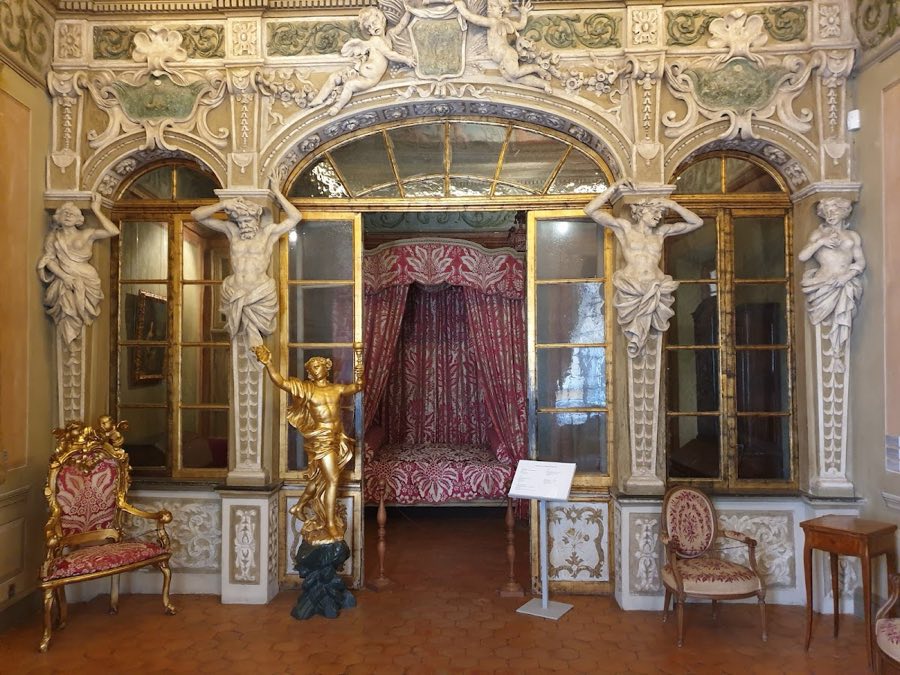
Visitors enter through a broad vestibule covered by a vaulted ceiling formed by intersecting barrel vaults (groin vault), a type of vault created where two barrel vaults cross. That entry hall is painted with strong-toned decorative motifs and leads directly toward the house’s main stair. A monumental staircase, surrounded by arcaded galleries and fitted with sculpted figure groups, rises to the upper levels and provides access to the first-floor rooms now used for temporary exhibitions.
The principal ceremonial level, the noble floor (the main reception floor), preserves ceiling frescoes dating to the mid-17th century. Sequences of sculpted statues and later rocaille decoration were applied during the 18th-century alterations, creating a layered interior where seventeenth-century painting and eighteenth-century stuccowork coexist. Walls throughout the reception apartments are hung with Flemish and Aubusson tapestries, and furnishings date to the 1600s and 1700s, forming a period domestic ensemble.
Religious imagery and movable devotional objects remain part of the palace’s contents. Numerous devotional paintings testify to the influence of the Order of Saint John of Jerusalem, and the house retains reliquaries and other devotional items that were part of the Lascaris–Vintimille inheritance. The layout also includes a private chapel alongside ordinary domestic chambers, and these rooms are incorporated into the museum presentation. The palace’s carved and painted ornaments were formally recognised as part of France’s national heritage on 15 February 1946, and a comprehensive restoration carried out from 1963 to 1970 returned much of the fabric to use as a museum setting that today also accommodates the city’s historic musical-instrument collection.
No. 71313
No. 34802
No. 56101

No. 29487
Comments
Comments for Palais Lascaris will require a verified account before posting.
We'll send a verification link before your first comment is published.