No. 18871
Krzysztofory Palace
Poland
PalaceRestoredFor events17th century
No. 56464
Palace · Poland
No. 56464 · 50.062 N, 19.935 E
Quick summary
Pod Baranami Palace is a palace in Poland with origins associated with the 16th century.
See all castles in PolandPod Baranami Palace in Kraków, Poland, is a Renaissance-period urban palace created in the 16th century during the Polish Renaissance by combining older Gothic townhouses, and it became an important site in the city’s social and political life. Local tradition links the place name, which translates as “Where the Rams,” to an earlier inn and a sheep enclosure on the site and to a ram emblem used on the building. The property appears in records after 1346, when it belonged to Paulina Cavallo, an official connected with the saltworks at Bochnia, and later passed through several private owners in the 15th century.
In the 15th and 16th centuries the site hosted a prominent inn that attracted leading Polish writers and poets, including Jan Kochanowski, Mikołaj Rej, and Łukasz Górnicki. In the latter half of the 16th century the two adjoining Gothic houses were united into a single Renaissance palace under Justus Ludwik Decjusz, the royal secretary to King Sigismund I the Old. In 1577 the king bought the property and two years later presented it to Kasper Bekiesz, the starost of Lanckorona; the Hungarian poet Bálint Balassi is reported to have lived there during that period.
Ownership passed through several noble families over the next centuries. The palace belonged to Katarzyna Lubomirska-Ostrogska, then in the 17th century to members of the Radziwiłł family, who expanded the complex by adding an adjoining house. By 1709 the estate came into the Sanguszko family through Marianna Lubomirska; Janusz Aleksander Sanguszko inherited it in 1738. Poor management led to its sale in the mid-18th century, and in 1753 Hieronim Wielopolski acquired the property and rebuilt it in a Baroque form known from a contemporary city view. Wielopolski held the palace until 1772.
Artur Potocki purchased the palace in 1822 and it remained in the Potocki family until World War II, serving in the late 19th and early 20th centuries as a gathering place for conservative political circles and Kraków’s cultural life, and housing an extensive collection of art, furniture, porcelain, and traditional Polish kontusz sashes. During the Kraków uprising in April 1846 the building accommodated the headquarters of the insurgent National Guard. The Potockis carried out a major rebuilding in 1860 that raised the roofline by one storey, and three sculpted ram heads were placed above the main gate in 1853–1854.
In the 20th century the palace was used for military medical purposes during World War I, and in the summer of 1920 Krystyna Potocka made it available for a military hospital during the Polish–Soviet War. Under German occupation in World War II the building housed the governor of the Kraków district. After the Red Army entered Kraków in January 1945 the palace served as the Soviet military commandant’s office and contained premises used by SMERSH and the NKVD. The state nationalized the property in 1947 and transferred it to the Kraków House of Culture, which used the building until 1990. The basement cabaret Piwnica pod Baranami opened there in 1956 and in 1969 the palace began to house a small studio cinema known as Kino Pod Baranami, later recognized in 2009 by Europa Cinemas for its programme. The building was returned to its prewar owners in August 1990; the following day a large fire damaged part of the palace and repairs continued for several years. Notable recorded visitors over the centuries include the Russian tsarevich Alexei in 1709, Prince Józef Poniatowski in 1809, King Frederick Augustus of Saxony (Duke of Warsaw) in 1810, and Emperor Franz Joseph I in 1880.
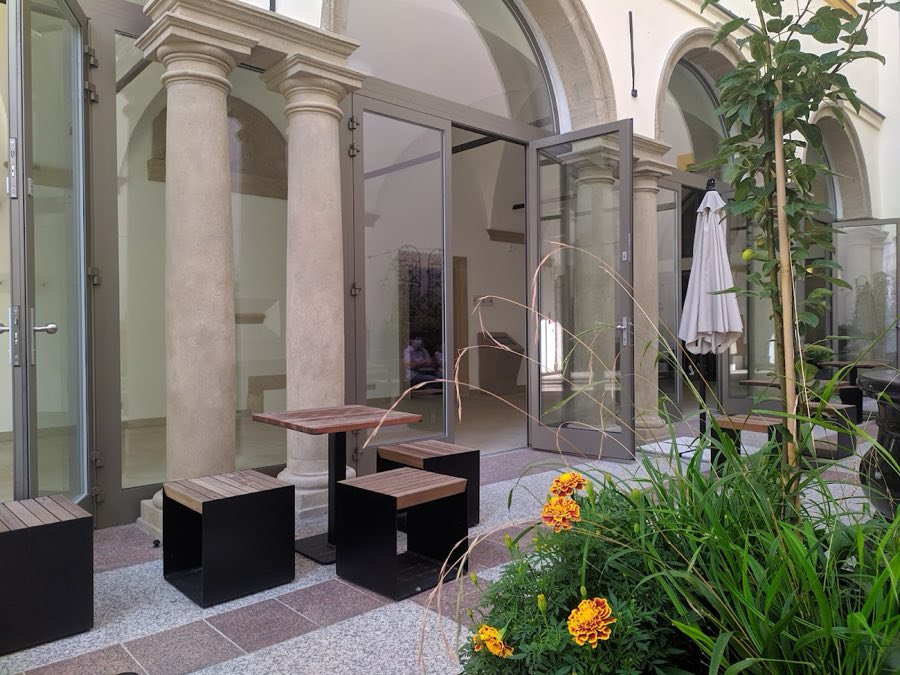
The palace presents as an urban block formed from two medieval townhouses joined in the 16th century, arranged around an internal courtyard. The lower-level façades that face the courtyard preserve Gothic structural elements, while the outer façades show Baroque decorative work added in the 18th century. The building retains a stacked plan typical of town palaces, with notable survival of earlier fabric beneath later layers.
Medieval cellars survive below ground and remain a major feature of the site, providing a continuous link to the townhouses that predated the Renaissance remodelling. A ground-floor room on the right side of the entrance contains a nine-bay ribbed vault (a vaulted ceiling supported by intersecting arches), dated to the first half of the 16th century. The vestibule (entrance hall) and this vaulted room form a coherent early-16th-century sequence that survives in situ in the building’s ground level.
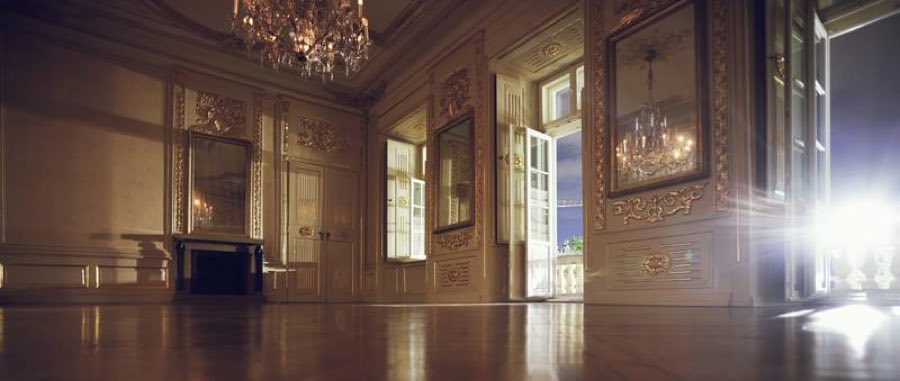
The internal courtyard retains lower-storey Gothic masonry and openings, while interiors through the upper levels display decorative elements from the 17th, 18th, and 19th centuries, reflecting successive refits and tastes. Above the main gate that opens onto the principal square three sculpted rams were added in 1853–1854 and remain a defining external emblem. The palace complex includes the main entrance from the square, the vestibule, the courtyard, the access to the basement where the cabaret is located, and the medieval cellars, all of which show phases of reuse and repair.
Later structural changes included the mid-19th-century raising of one additional storey, which altered rooflines and interior proportions. A major fire in August 1990 damaged parts of the palace; those sections were repaired in subsequent years so that the medieval cellars, the vaulted ground-floor chamber, the courtyard elevations, and the ram sculptures survive today in restored or conserved condition. Oral tradition links the name “Where the Rams” to the earlier inn and sheep enclosure once on the site, a local explanation for the ram motif visible above the gate.
No. 18871
No. 12432
No. 96487
No. 33328
Comments
Comments for Pod Baranami Palace will require a verified account before posting.
We'll send a verification link before your first comment is published.