
No. 82359
Śmiełów Palace
Poland
Manor houseIntact18th century
No. 94633
Castle · Poland
No. 94633 · 51.976 N, 17.503 E
Quick summary
Radoliński Palace, Jarocin is a castle in Jarocin, Poland with origins associated with the 19th century.
See all castles in PolandRadoliński Palace in Jarocin, Poland, was the principal family seat of the Radoliński line of Greater Poland, a Polish noble family bearing the Leszczyc coat of arms, and it was rebuilt in the mid-19th century in the English neo-Gothic style. The site grew from a medieval manorial holding first recorded in 1258, and in the 1800s the estate became notable for its elaborate residence, extensive collections, and its role within the shifting political landscape when the region belonged to the Kingdom of Prussia.
The estate traces its origins to the medieval manor of Jarocin, granted in 1258 to Janko of Jarocin by Duke Boleslas, with the holding expanded in the fifteenth century. By 1662 the property belonged to Count Andreas Leszczyc of Radolin-Radoliński, who served as a senator of the Holy Roman Empire. For generations the Radoliński family retained ownership and used an older fortified residence, later called the Skarbczyk, as a family treasury and archive.
In the nineteenth century a member of the Radoliński family replaced the uncomfortable fortified house with a purpose-built country residence. Władysław Radoliński commissioned a new palace designed by the Prussian royal architect Friedrich August Stüler and construction took place in the mid-1800s, with dates in accounts ranging from the late 1840s through 1865; furnishing of the great hall was completed in 1865. The palace served as the family home and storehouse for large collections of books, arms, coins, and works of art.
Władysław’s son Hugo von Radolin, a Prussian diplomat born in 1840, directed significant remodelling and enlargements in the 1880s and again in the years before the First World War, when an eastern wing was added. Hugo died in the palace on 20 July 1917. On 4 December 1917 a major fire consumed a large portion of the library, furniture, artworks, and weapons. The building was rebuilt over subsequent years, but the interiors never returned to their former brilliance.
Between the world wars and during the Second World War, restoration efforts were not carried out. Hugo’s grandson Wilhelm left Jarocin on 24 January 1945 as the Red Army approached. With the arrival of Soviet troops and the new communist authorities in 1945 the Radoliński family was expelled. After the war the palace suffered theft and vandalism, although it was not completely stripped or destroyed by the occupying forces. Local officials undertook efforts to secure valuables with mixed results.
In the decades after 1945 the palace accommodated a range of public institutions, including a state centre for librarian education, a primary school, a state music school, the local branch of a historical society, and the town and commune public library. In 2022 a permanent exhibition of the regional museum opened inside the building. The estate’s English-style park no longer survives in its original form and the château stands in a condition that requires restoration.
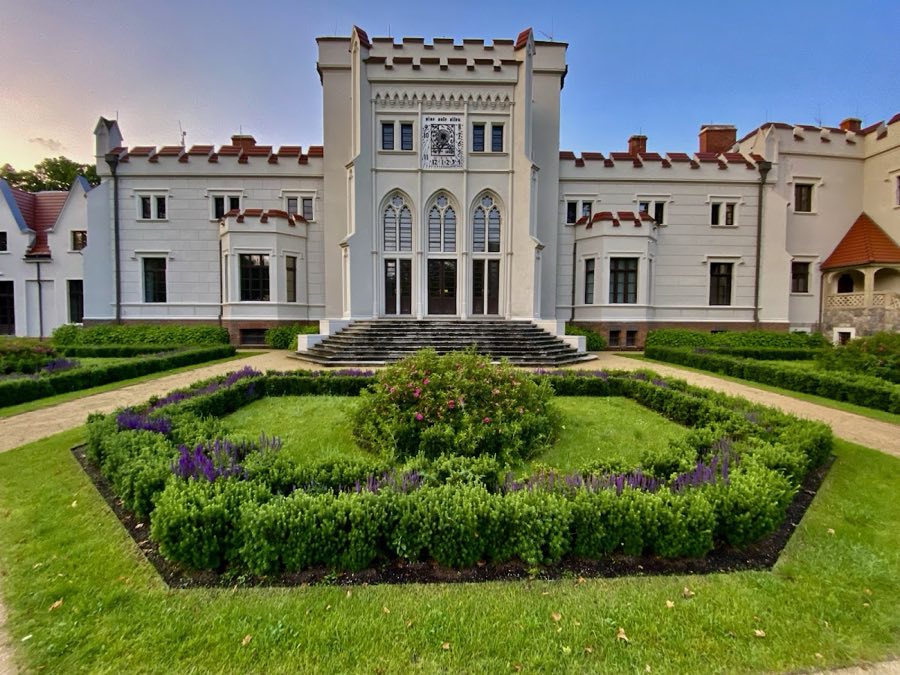
The palace is a three-storey, mid-19th-century house executed in the English neo-Gothic manner, set within what was once a private English-style park. The exterior presents a principal façade facing the park and a rear façade turned toward the town, linked to a formal garden and an extensive terrace. A projecting risalit (a projecting section of a façade) marks the main entrance and is finished with crenellation (a battlemented top), and the Leszczyc coat of arms is displayed on the façade.
Internally the layout combined family apartments, guest rooms, and large public rooms. At completion the plan included numerous bedrooms, a library, a boudoir, halls and a salon, an orangery that housed some 600 potted plants, a great hall, bathrooms, kitchens, servants’ rooms, a wardrobe, study, dining room, and a terrace. Many principal finishes were wooden floors and the main hall contained tall, narrow stained-glass windows. Furnishings recorded at the site included marble-topped tables and carved fireplace surrounds, and several movable objects such as a mahogany piano, an ancient vase from Pompeii, and Italian damask curtains.
The palace held extensive collections. By the late nineteenth century the library numbered about ten thousand volumes, including a 1563 Brest Bible and a manuscript of The Manuscript Found in Saragossa. A numismatic collection contained coins and medals from antiquity and later periods, for example a 1623 medal bearing the portrait of King Sigismund III Vasa. The arms collection comprised swords and firearms by named makers. A Renaissance wardrobe stored 137 pieces of Chinese porcelain. In the main hall glazed display cabinets exhibited the family’s arms collection, described as the largest such collection in the region.
Several later additions and fittings survive in record. An orangery was converted to a library in 1907–1908, running water was introduced in 1906 and gas lighting in 1908, a gardener’s house was built in 1898 near the main entrance, and a sundial by Richard Munzky was placed on the rear elevation in 1910. Around 1911–1914 an east wing was added and other outbuildings were constructed in the park. Decorative fittings included historic wooden panelling brought from an Austrian monastery installed in the dining room, a marble fireplace presented by Sultan Abdul Hamid II with bronze wolf figures once owned by Stanisław August Poniatowski, a fireplace in the wardrobe bearing the Sforza arms, a sixteenth-century marble lavabo, and a silver crucifix given by Pope Pius IX.
The 1917 fire destroyed a substantial portion of the library, furniture, works of art, and weapons; rebuilding took place, but interiors never regained their prior splendour. In the years after 1945 the building suffered vandalism and theft. The park laid out with input from the landscape designer Peter Joseph Lenné and Władysław Radoliński no longer exists in its original form, and the palace stands in a condition that calls for restoration.
No. 82359
No. 66375
No. 57731
No. 78819
Comments
Comments for Radoliński Palace, Jarocin will require a verified account before posting.
We'll send a verification link before your first comment is published.