No. 94633
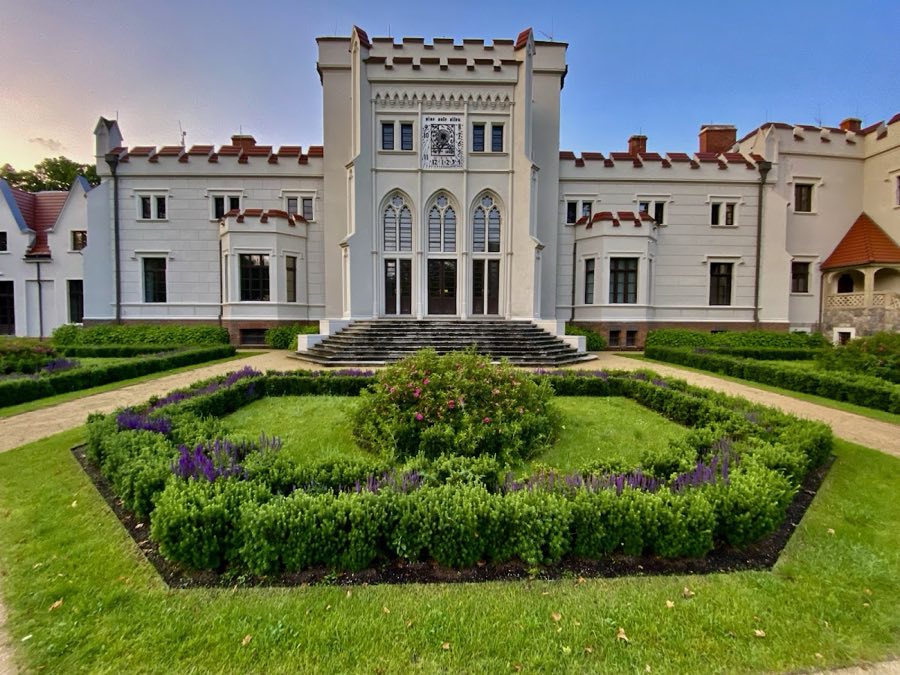
Radoliński Palace, Jarocin
Jarocin, Poland
CastleRestored19th century

No. 82359
Manor house · Poland
No. 82359 · 52.106 N, 17.571 E
Quick summary
Śmiełów Palace is a manor house in Poland with origins associated with the 18th century.
See all castles in PolandŚmiełów Palace in Śmiełów, Poland, is a Classicist country house erected in 1797 for the Polish noble Gorzeński family. Built at the end of the 18th century in the Classical style, the house became a notable local center because of its association with Polish patriotic activity and later with the poet Adam Mickiewicz.
The palace was commissioned by Andrzej Gorzeński at the close of the 1790s. His son Hieronim returned from service as an adjutant to Marshal Louis Davout during Napoleon’s Russian campaign and took charge of the estate, expanding its agricultural programme with horse breeding and taking part in patriotic organisations. Located close to the border that divided partitioned Poland, the property became a practical transfer point for people and printed material used in independence work, a role that grew stronger after the November Uprising, the 1830–31 Polish armed revolt against Russian rule. Adam Mickiewicz spent several weeks at the house in August 1831.
When the Gorzeński line ended in 1887 the heavily indebted estate was bought by Franciszek Chełkowski. The Chełkowski family modernised the farm operations, assembled a collection of Mickiewicz-related objects in the residence, and ran the palace as an informal cultural salon that attracted leading figures of Polish letters and public life, including Henryk Sienkiewicz and Ignacy Paderewski. Following the German invasion of Greater Poland in 1939, Józef and Maria Chełkowski were interned and occupying authorities took control of the property. After 1945 the palace was looted and divided into separate apartments, and later used as a school.
In 1970 the National Museum in Poznań assumed responsibility for the building, carried out restoration work, and in 1975 reopened the house as a museum dedicated to Adam Mickiewicz under the National Museum in Poznań. The palace is recorded in the register of immovable monuments for the region.
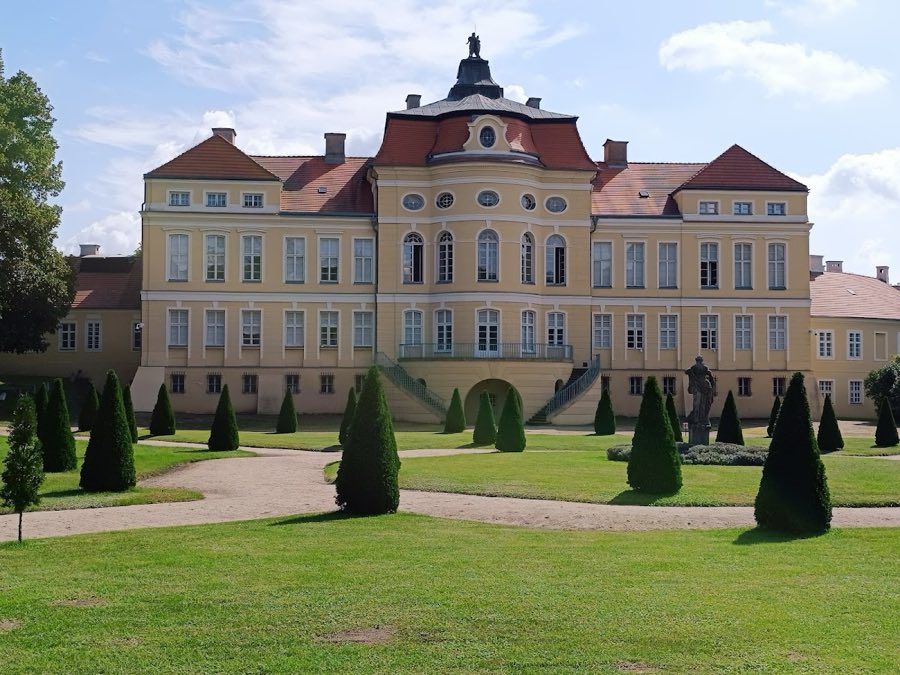
The palace occupies a horseshoe-shaped plan, its two wings spreading roughly forty-three metres apart and linked to a central, two-storey main block by semicircular galleries. The principal façade is marked by a four-column portico using oversized columns in the giant order, a composition that follows a Palladian villa model. At least some of the service buildings around the yard, including the stable, coach house and granary, belong to the same original design campaign.
The two wings are covered with a Kraków roof (a regional pitched roof with a steeper lower slope and a shallower upper slope). The western wing contained guest accommodation, while the eastern wing had a separate entrance from the garden and housed the kitchen, establishing a clear separation between public rooms and service areas.
Inside, the plan is irregular. An octagonal salon projects into the garden façade and does not open directly onto the main stair, while the ground and first floors are almost the same height, producing a strong horizontal rhythm between storeys. The layout includes many niches and small rooms that break the larger spaces into a sequence of more intimate interiors.
Beneath the projecting octagonal salon lies an eight-sided hall covered by a barrel vault with lunettes, which was used as the meeting room for a Masonic lodge; a so-called Masonic altar is located in the stairwell. Decorative painting by the Smuglewicz brothers appears in the principal reception rooms: the oval salon contains an iconographic program drawing on episodes from Homer’s Iliad, and the blue salon held a cycle of rustic frescoes modelled on Pompeian wall-painting. Those mural schemes survive today only in two rooms on the ground floor.
The palace stands within a managed landscape park that reaches the forests along the Warta River. From the house there are views across meadows in the wide valley and toward a ridge whose outline is punctuated by the church at Brzostkowo. The museum preserves the historic grounds, including the small commemorative “Zosia’s Garden” and a monument dedicated to Adam Mickiewicz.
No. 94633
No. 57731
No. 66375
No. 45835
Comments
Comments for Śmiełów Palace will require a verified account before posting.
We'll send a verification link before your first comment is published.