No. 76027
Donamon Castle
Ireland
CastleRestoredFor events12th century
No. 62449
No. 62449 · 53.635 N, 8.193 W
For events
Roscommon Castle is marked as a château or castle venue lead. Capacity, indoor/outdoor spaces, catering rules, and accommodation options are published only after public verification.
Event types: Private events, Cultural gatherings, Filming and photography
Quick summary
Roscommon Castle is a castle in Ireland with origins associated with the 12th century.
See all castles in IrelandRoscommon Castle is located in the town of Roscommon, Ireland. It was originally built by the Anglo-Normans, a medieval European group that established control over parts of Ireland following the 12th century invasion. The nobleman responsible for its construction was Robert de Ufford, who began work on the castle in 1269 after acquiring the land from an Augustinian monastery founded centuries earlier by Saint Coman mac Faelchon in the 5th century.
Shortly after its construction, the castle became the focus of conflict in the region. In 1272, it was seized by Aodh Ó Conchobhair, the regional king of Connacht, representing native Irish resistance to Anglo-Norman rule. English forces later regained control in 1280 and undertook repairs and expansions to strengthen the fortress. By the mid-14th century, control shifted once again when the Irish O’Connor family retook the site in 1340. The O’Connors maintained ownership for more than two hundred years, successfully defending the castle against several English attempts to reclaim it.
In 1569, during a period of intensified English consolidation of power in Ireland, Henry Sidney, the Lord Deputy appointed by the English crown, captured Roscommon Castle. It was subsequently granted to Sir Nicholas Malbie, who served as governor of Connacht under Queen Elizabeth I. Malbie initiated remodeling in 1578, notably enlarging window openings to alter the castle’s interior character. The 17th century brought further turbulence, with the castle changing hands multiple times amid the Irish Rebellion of 1641 and ensuing conflicts. It suffered damage from artillery during the siege led by Oliver Cromwell in 1652. Finally, a destructive fire in 1690 caused the castle’s complete ruin, after which it was abandoned.
Roscommon Castle holds a place in Irish historical records, being mentioned in medieval annals such as the Annals of Inisfallen and the Annals of the Four Masters. These sources help confirm key events in the castle’s complex history of construction, conquest, and decline.
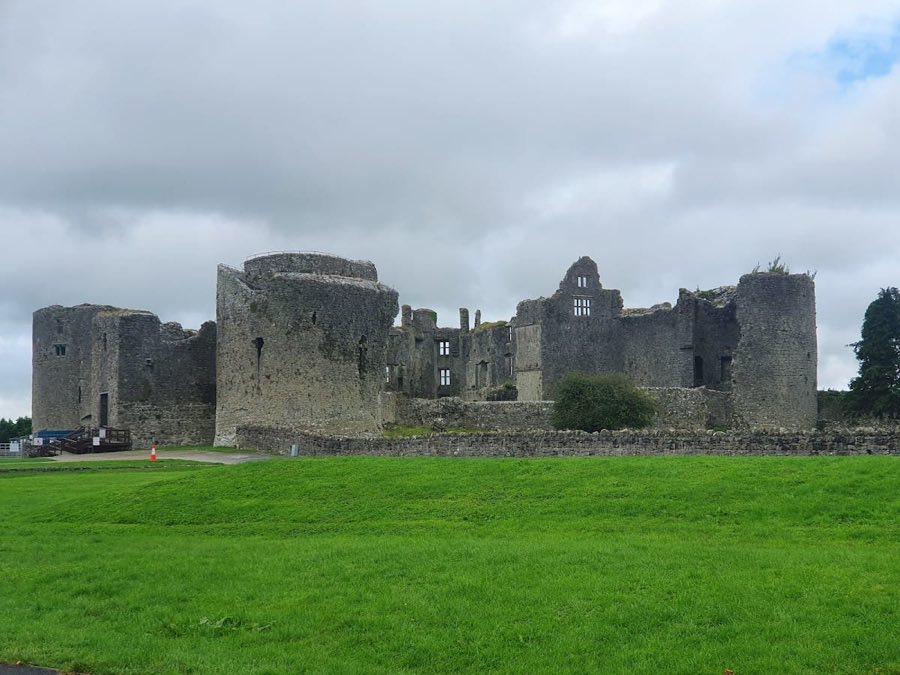
Roscommon Castle occupies a rectangular site on a hillside near the town, showcasing the design typical of fortified Anglo-Norman strongholds in Ireland. The structure is defined by four D-shaped towers, each rising to three stories. Two of these towers stand as twin gatehouses, forming the castle’s main entrance, with one of the entrance towers preserving its robust vaulted stone roof. Vaulted roofs involve arched stone ceilings designed to support substantial weight, an architectural feature associated with durability and defensive strength.
Originally, the castle was enclosed by a tall curtain wall, a type of defensive barrier connecting the towers and protecting those inside. Surrounding the castle at some distance was a symmetrical ditch, a trench dug to impede attackers. This ditch would have served as part of the overall defensive system by making it harder for enemies to reach the walls.
During the remodeling carried out in 1578, large paired windows were inserted into both the towers and curtain wall. These windows, more expansive than earlier arrow slits or narrow openings, reflected changes in military technology and lifestyle, allowing more light into the castle’s interior spaces while somewhat reducing defensibility.
Today, the castle stands in a ruined condition but continues to dominate its surroundings as a significant historical site. Many architectural features remain visible, such as the towers and some sections of the curtain wall. The vaulted roof of one entrance tower endures as a particularly notable remnant of the original construction. The overall layout and surviving features provide a tangible connection to the castle’s turbulent history and the evolution of medieval fortifications in Ireland.
No. 76027
No. 30903
No. 18339
No. 45642
Comments
Comments for Roscommon Castle will require a verified account before posting.
We'll send a verification link before your first comment is published.