No. 37797
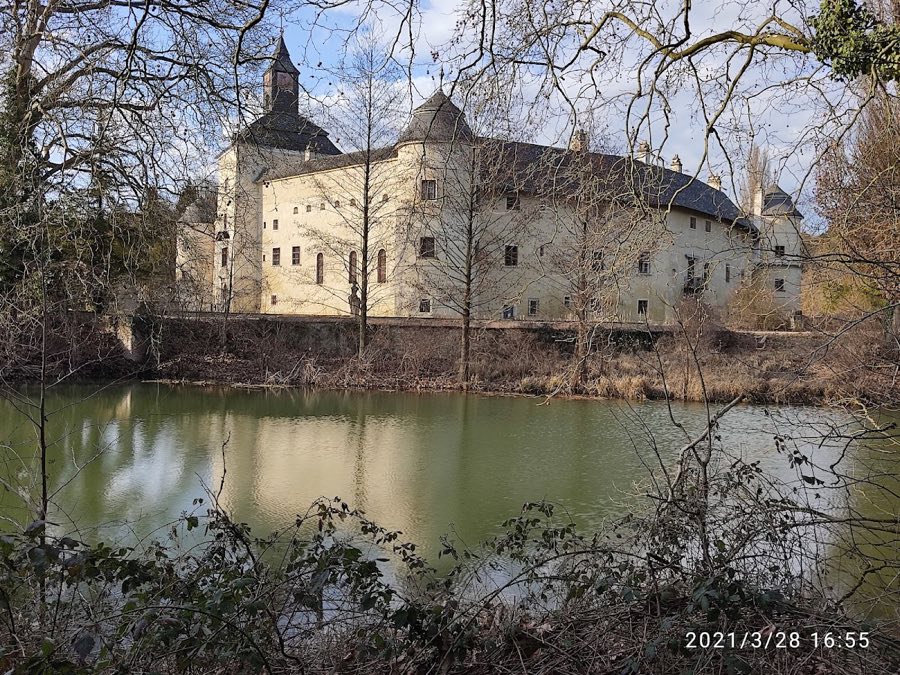
Schloss Niederleis
Austria
CastleIntact14th century
No. 81766
Castle · Austria
No. 81766 · 48.540 N, 16.348 E
For events
Schloss Ernstbrunn is marked as a château or castle venue lead. Capacity, indoor/outdoor spaces, catering rules, and accommodation options are published only after public verification.
Event types: Private events, Cultural gatherings, Filming and photography
Quick summary
Schloss Ernstbrunn is a castle in Austria with origins associated with the 17th century.
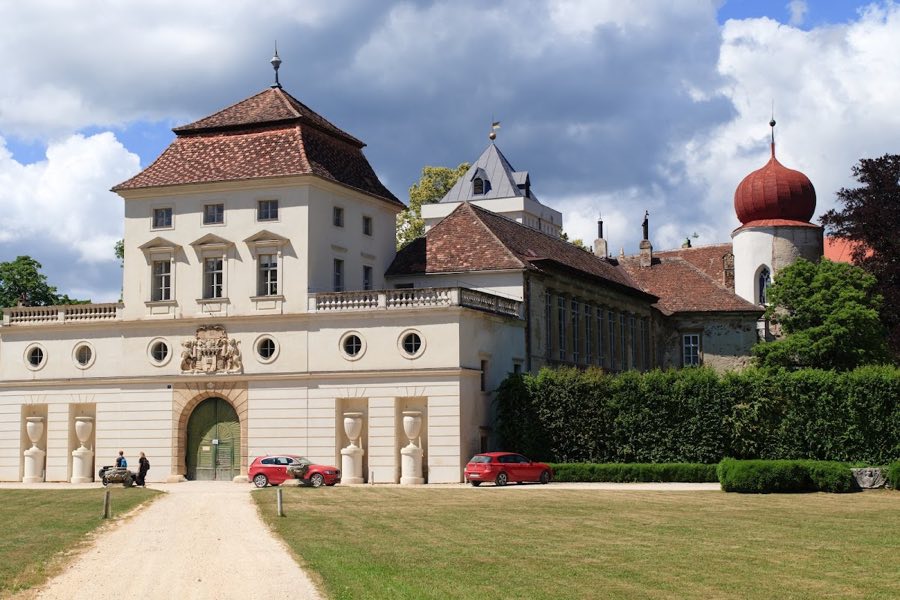
See all castles in AustriaSchloss Ernstbrunn in Dörfles, Austria, is a medieval castle complex whose inner core dates to the 12th and 13th centuries and that later acquired Late Renaissance, Baroque and Classicist layers. Erected and expanded by local medieval lords within the landscape of the Holy Roman Empire, the site grew from a fortified noble residence into a palace-like estate and remained a regional seat of noble families for centuries.
The earliest personal names connected with the place appear around 1180, when a Heinrich de Ernstbrunne served as witness in local affairs. In 1254 a violent episode is recorded: Ebran von Ernstbrunn was executed after a dispute with Bertold von Ernstbrunn that also involved opposition to King Ottokar. By 1313 the lordship passed by inheritance to Ulrich von Maissau; at the same time feudal tenants named Gneusen held rights on parts of the land.
Ownership continued to shift over the late Middle Ages and the early modern period. In 1430 the territorial prince took the lordship and pledged it to the Doss family until 1480. In 1499 the estate passed by exchange to the Lords of Ebersdorf, who retained it until their line ended in 1556. In 1592 Leonhard von Harrach sold the property to Joachim von Sinzendorf. Joachim served as a special ambassador at the Ottoman court in Istanbul and fathered thirteen children; his son Lorenz established the Ernstbrunn branch of the Sinzendorf family.
From the mid-17th century the Sinzendorfs transformed the site into a Baroque residence. After 1654 Rudolf Graf von Sinzendorf carried out substantial Baroque rebuilding, and in the late 18th century Reichsfürst Prosper von Sinzendorf enlarged the older fortress into a more palatial complex, creating the ensemble that survives in modified form. The male Sinzendorf line ended in 1822. Following a prolonged inheritance dispute, Prince Heinrich LXIV of Reuss-Köstritz assumed the lordship in 1828. The estate later came into the possession of Heinrich IV of Reuss-Köstritz, who established it as a family fideicommiss, or entailed estate, and lived at the castle.
In the 20th century the castle accumulated a large private library between 1910 and 1945 that numbered over 40,000 volumes by the end of the Second World War; the collection was largely lost during the fighting and the decade of Soviet occupation that followed. During the post-war period the property was placed under the Soviet occupational administration known as USIA, during which the complex suffered heavy devastation and much of its inventory was removed. After the Austrian State Treaty the property was returned to the family and restoration work has continued. In the later 20th and early 21st centuries the estate has remained a private residence for the owning family, hosted cultural events such as the CON ANIMA chamber music festival and occasional filming, and retained parkland that was partly converted to a wildlife park in 1975. Since 2001 the Wolf Science Center has been established within the park. The grounds are recognised among Austria’s important garden‑architectural monuments and form part of the Leiserberge Nature Park and its associated landscape protection area.
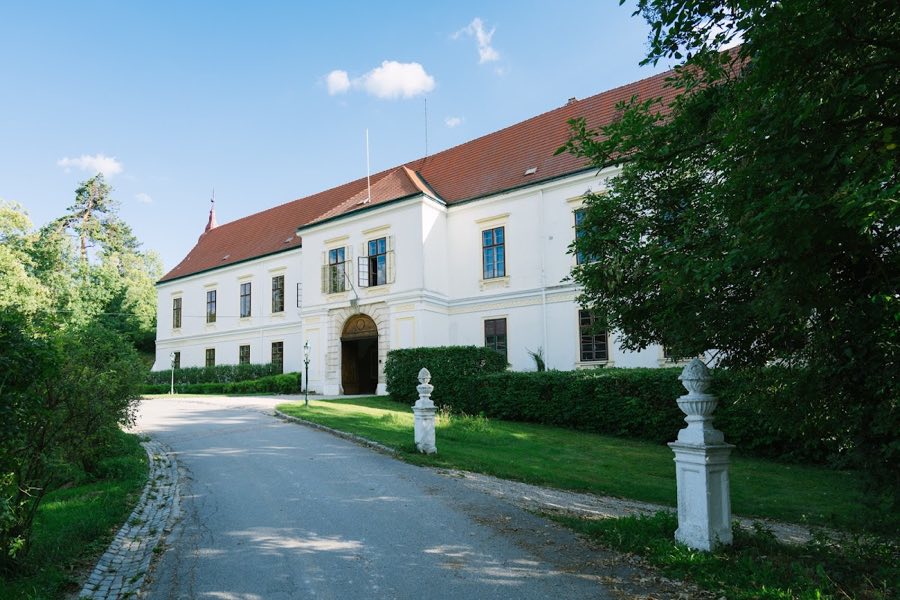
The castle occupies a northward slope above the village and presents an elongated plan of successive courtyards rising one behind the other. A medieval core from the 12th–13th centuries sits on a limestone rock spur that is exposed on three sides and surrounds the innermost courtyard; this core is laid out as a stretched octagon. Successive building campaigns in the Late Renaissance, Baroque and Classicist periods were grafted onto that medieval nucleus, producing a complex of discrete building groups arranged around four courtyards.
A robust outer curtain wall reaches up to three metres in thickness and in the southeast is strengthened by a square keep (tall defensive tower). The keep originally rose three storeys and received an additional storey during work in the 16th or 17th century. The principal outer front is a sixteen‑axis south façade that closes the outer ward; the outer ward was remodelled in a Baroque manner between 1672 and 1677, a fact proclaimed by the Sinzendorf coat of arms set above the round‑arched gate.
The courts contain distinct functional groups. The second court includes a clock tower and a Protestant chapel dated to about 1863. The third court contains the upper palace, known as the Hochschloss (upper palace). The fourth court houses a Catholic chapel, a knights’ hall and the keep. Above the main outer portal a compound coat of arms displays the Sinzendorf shield bearing a chief that signifies the hereditary office of cupbearer for lands north of the Enns, the cup device appearing between the helmet’s horns. That central shield is flanked by two smaller escutcheons, the right showing the Burgraviate of Rheineck (sometimes mislabelled as County Rieneck) and the left representing von Lappitz, reflecting a 1648-approved union of arms.
In front of the gate stands an early Baroque fountain in stone with a hexagonal basin and a central shaft that bears heraldic decoration. Sixteen coats of arms decorate the fountain: four shields on the shaft below the basin and twelve pairs set around the rim. These arms form a genealogical presentation for Rudolf Graf von Sinzendorf and his wife Eva Susanna Gräfin von Zinzendorf and Pottendorf. The shaft shows the shields of their direct great‑grandparents: Leonhard von Sinzendorf; Anna von Harrach; Alexander von Zinzendorf and Pottendorf; and Susanna von Volkra. The basin carries the six remaining great‑grandparent pairs, among them Hans Rueber Freiherr zu Pichsendorf with Maria Anna Freiin von Welsperg, and David von Trauttmansdorff with Amalie Kuzal von Lappitz, as well as other named noble couples.
Surrounding the main buildings are service ranges and farm structures, including a substantial three‑storey granary (Schüttkasten). The castle garden was laid out in the second half of the 17th century under the Sinzendorf patronage and was reshaped in 1775 into a Baroque‑classical ensemble. Surviving garden pieces include a temple fountain called Neubrunn, a Victory or Peace column nicknamed “Black Gretl”, an obelisk commemorating Field Marshal Gideon von Loudon and a monument to Chancellor Franz Josef von Saurau; these historic elements remain on the grounds, though their positions have varied over time.
During earthworks near the granary in 1984–85 roughly one hundred full‑size Baroque stone figures, likely dating to about 1700, were uncovered. The figures are original stone sculpture from the Baroque period; their original arrangement around the site has not been re-established. The complex was heavily damaged and partly stripped during the USIA period after the Second World War, and following restitution the buildings and park have been the subject of ongoing repair and conservation.
No. 37797
No. 67086
No. 14220
No. 36289
Comments
Comments for Schloss Ernstbrunn will require a verified account before posting.
We'll send a verification link before your first comment is published.