No. 76041
Horneck Castle
Germany
CastleRestoredFor rent13th century
No. 32111
No. 32111 · 49.218 N, 9.277 E
Quick summary
Schloss Lautenbach is a manor house in Germany with origins associated with the 19th century.
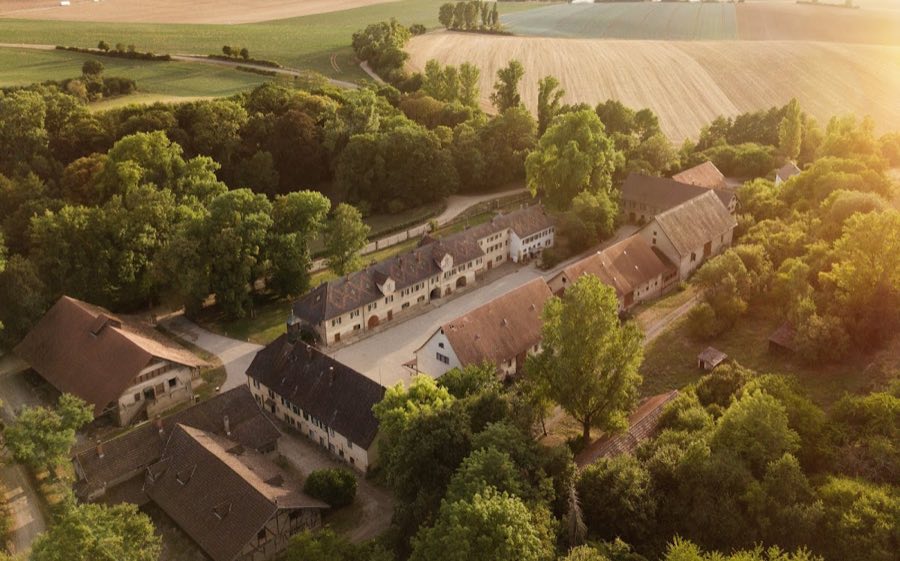
See all castles in GermanySchloss Lautenbach in Oedheim, Germany, is a country manor whose present appearance dates from a late 19th-century Neo-Renaissance remodelling built upon an older 17th- and 18th-century core. The place sits on ground with human activity reaching back to the Middle and New Stone Ages, and over the centuries it served as a local manorial centre under monastic institutions, knightly families, and religious orders, making it a focal point for rural landholding and legal contest in the region.
Human use of the site begins in prehistory. Evidence from the Middle Stone Age includes pottery fragments, a flint knife, and a burial, while a New Stone Age settlement north of the later farmstead produced pottery, stone tools, and burial mounds. These early traces mark the location as a long-lived place of settlement and ritual.
The name Lautenbach appears in 1254 in connection with Lichtenstern Monastery, and the place first appears as a village in a 1335 transaction when Engelhard VII of Weinsberg sold the lordship of Scheuerberg, including Lautenbach, to the Archbishopric of Mainz. In 1419 the Mönchhof (later called the Helmstadter Hof) was granted to Philipp von Wittstatt. Ownership and control shifted repeatedly in the late medieval period: in 1467 Lautenbach passed with surrounding lands to Hans von Sickingen, and in 1484 the property changed hands to the Teutonic Order. After 1484 the village was destroyed and its inhabitants were moved to Oedheim and Dahenfeld; this destruction may have occurred during the Peasants’ War.
Following the village’s ruin the place survives in records as two agricultural units, the Lautenbacher Hof and the Mönchhof. The Mönchhof was sold to the Carmelites of Heilbronn in 1490, who repaired it and later let it to officials of the Teutonic Order. The Carmelites sold the property in 1537 to Eberhard von Gemmingen, beginning a period of lay ownership that intersected repeatedly with the claims of religious orders.
During the Thirty Years’ War the Teutonic Order moved back into the farmstead after 1631 when the estate’s obligations were not met. Members of the Gemmingen and Helmstatt families sought to recover the property: Karl Friedrich von Helmstatt petitioned in 1643, and Weiprecht von Gemmingen brought further claims after the Peace of Westphalia, but those efforts did not restore control. Around 1664 the Teutonic Order repaired the site and reunited the two farms. On 18 August 1687 the Order sold the entire mark to Johann Esaias von Rühle because the land was yielding poorly.
In 1726 the estate passed by inheritance to Johanna Elisabeth von Rühle and then to her son Johann Friedrich von Frederking, under whose family the holding enlarged and was described as a model agricultural enterprise. The Teutonic Order renewed a challenge to the 1687 sale beginning in 1747, producing a long legal contest that culminated with the Imperial Chamber Court deciding in favor of the von Frederking family on 9 June 1777. Before that judgment the city of Heilbronn had already become owner on 14 January 1772 under Georg Heinrich von Roßkampff, and from 1772 until 1823 the city leased the farms. In 1780 the mark of Lautenbach comprised 926 Morgen of land.
On 1 August 1823 Legation Councillor August Heinrich Christoph von Wächter bought Lautenbach for 75,000 Gulden. His son, Johann August Freiherr von Wächter, applied in 1855 to have Lautenbach incorporated into the municipality of Oedheim; in 1860 Lautenbach became a subordinate municipality with its own mark, a status that lasted until 1936. Under the von Wächter family the estate saw social and economic initiatives and the family secured hunting rights on the marks of Lautenbach, Willenbach, and Oedheim. In 1856 the track to Oedheim was upgraded to a permanent road, and the von Wächter household carried out a comprehensive renovation in the later 19th century that gave the main house its Neo-Renaissance appearance and laid out the surrounding grounds as a park with a pavilion and tree-lined avenues.
In 1869 the house and lands were leased to Heinrich Landes, a Mennonite, whose family operated the farm for four successive generations. Mechanization arrived in the early 20th century with the first tractor in 1923 and a steam plough in 1925. In later years the Lautenbacher Hof reached roughly 240 hectares of arable land and kept about 300 fattening pigs. Blanche von Wächter-Palm, the last family representative to use the estate, died on 15 November 1941; thereafter the property passed to an heirs’ community, the Freiherr von Palm’sche Erbengemeinschaft in Künzelsau. The estate is currently no longer farmed.
The site presents two broad layers of remains: prehistoric deposits associated with early settlement and burial, and the standing estate buildings and landscape shaped from the 17th century onward and refashioned in the 19th century. The layout combines the older agricultural complex at the heart of the property with a later park-like setting that includes a small pavilion and avenues of planted trees.
Prehistoric features lie north of the historic farmstead and include the remains of a New Stone Age settlement with pottery fragments, worked stone tools, and burial mounds. From the Middle Stone Age there are pottery fragments, a flint cutting implement, and a single burial, indicating recurrent use of the location from early times. These finds represent discrete activity areas and funerary places associated with successive prehistoric communities.
The built complex of Schloss Lautenbach centers on a group of buildings whose oldest fabric dates to the 17th or 18th century; these structures form the core around which later 19th-century changes were carried out. In the late 1800s the main house received a Neo-Renaissance appearance and the ancillary residences and agricultural buildings were improved and given a more unified aesthetic. The grounds were arranged as a park and include a pavilion and avenues of trees, reflecting the 19th-century transformation from purely agricultural site to a landscaped estate.
Infrastructure linked to the estate survives as part of the site’s historic setting. The former field track to Oedheim was upgraded to a permanent roadway in 1856, a change that altered access and circulation around the mark. Today the buildings retain their historic sequence from early modern cores to later decorative treatment, and the property is no longer worked as a farm.
No. 76041
No. 56435
No. 99334
No. 56433
Comments
Comments for Schloss Lautenbach will require a verified account before posting.
We'll send a verification link before your first comment is published.