
No. 56435
Burg Guttenberg
Germany
CastleRestored14th century
No. 76041
Castle · Germany
No. 76041 · 49.287 N, 9.156 E
For rent
Horneck Castle is marked for bookable castle accommodation. Nightly pricing, sleeps count, stay rules, and amenities are displayed only when public operator data is available.
Rental type: Hotel / bookable stay, Short-stay rental
Short-term availability: Bookable accommodation signal
For events
Horneck Castle is marked as a château or castle venue lead. Capacity, indoor/outdoor spaces, catering rules, and accommodation options are published only after public verification.
Event types: Private events, Cultural gatherings, Filming and photography
Accommodation: Accommodation signal present
Quick summary
Horneck Castle is a castle in Germany with origins associated with the 13th century.
See all castles in GermanyHorneck Castle in Gundelsheim, Germany, originated in the high medieval period with a local noble family, the Herren von Horneck, and later became a commandery of the Teutonic Order. A Ludovicus de Horneck appears in records of 1238 and the family is commonly linked to a foundation around 1200, though construction phases have been variously dated into the later Middle Ages.
In the mid-13th century Konrad von Horneck conveyed the castle and his share of Gundelsheim to the Teutonic Order, entered the Order with his sons and became commander of the new commandery; alternative accounts place this transfer in the 15th century. Over generations the Order enlarged the site. By 1294 the Order held the remainder of Gundelsheim and a riverside settlement was abandoned as a new town grew below the castle, receiving town rights in the later 14th century. From the early 15th century the castle served as one of the German Masters’ principal residences alongside Marienburg and Riga; Eberhard von Seinsheim used it as a preferred residence and burial place and founded a prayer brotherhood and an Order hospital in the 1420s and 1440s.
In 1525 insurgent peasants seized Horneck during the German Peasants’ War, destroying domestic buildings and the castle archive; the German Master Dietrich von Cleen fled and the Order moved its effective seat to Mergentheim. The castle remained Order property and was rebuilt afterwards, including a multi-storey Renaissance residence that replaced earlier domestic ranges; the town of Gundelsheim paid fines and provided labour for reconstruction.
Horneck suffered damage in the Thirty Years’ War and was repaired. Between 1720 and 1724 Franz Keller remodelled the principal building into a restrained Baroque palace, removing Renaissance towers and oriels; a new town-facing portal of 1730 incorporated fifteenth- and early sixteenth-century grave monuments and the coat of arms of Franz Ludwig von der Pfalz. From the late 18th century the site functioned as the seat of a regional Oberamt within the Mastership at Mergentheim.
Following secularisation the property passed to the Kingdom of Württemberg in 1805 and was used as military barracks, then entered private ownership in 1824 and housed a hospital, sanatorium, naturopathic institution and brewery during the nineteenth and early twentieth centuries. After World War II it briefly served as an American hospital; from 1946 it operated as a lung sanatorium until 1960. In 1960 the Hilfsverein Johannes Honterus acquired Horneck as a Heimathaus for Transylvanian Saxon heritage, hosting the Siebenbürgen-Institut and a regional museum and later running an old-people’s home. The national association took over after insolvency in 2015 and conversion to a cultural and meeting centre began in 2016, with core renovation completed in 2020; the complex now houses a small hotel, a library and a museum and hosts cultural events. An account also records that the knight Götz von Berlichingen died at Horneck in 1562.
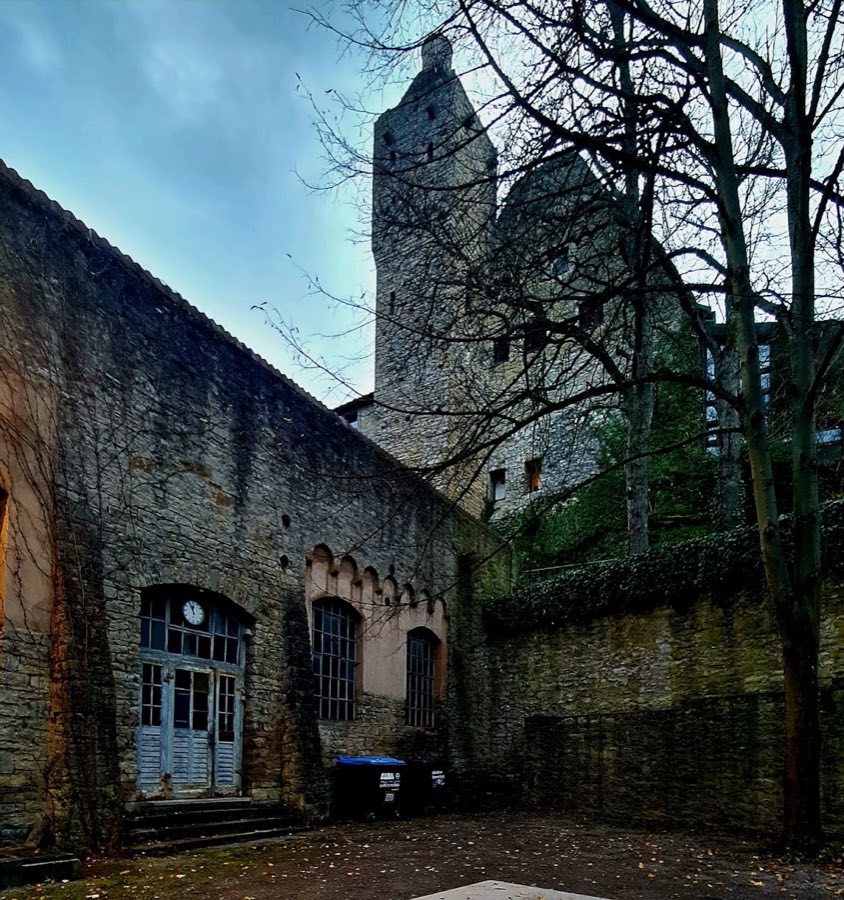
The site preserves a fortification complex organised around a tall central bergfried, defensive curtain walls and several towers that enclose the castle core. The bergfried is the principal element attributed to the earliest phase and survives in situ within the later court, while the surrounding walls and towers remain visible as part of the medieval defensive circuit.
After the destruction of 1525 the rebuilt domestic ranges were replaced by a multi-storey Renaissance residence set irregularly around the bergfried in a roughly seven-sided plan; this phase was once ornamented with small towers and projecting oriels later removed during the Baroque remodelling of 1720–1724, which nonetheless retained the bergfried. Traces of the post-reconstruction plan persist even where external decorative features were altered.
The 1730 portal on the town side survives as a notable historic feature, incorporating fifteenth- and early sixteenth-century grave monuments, some preserved as gypsum or plaster casts, and decorated with allegorical figures and the coat of arms of Franz Ludwig von der Pfalz flanked by lions. Internally, a portal with inscriptions and a sixteenth-century grave slab associated with the German Master are preserved in the library, while the former chapel houses the museum treasury and the festival hall on the second floor retains a Baroque stucco ceiling and painted decoration from the eighteenth-century remodelling.
In later centuries the complex was adapted for non-military uses and retains evidence of those reuses. The defensive circuit and towers survive in large part, the bergfried remains a vertical landmark, and interior historic fittings such as grave slabs, commemorative ornament and the decorated festival room are preserved in situ. The ensemble occupies a commanding position above the Neckar River, where the arrangement of walls, towers and the central bergfried continues to define the castle’s historic silhouette.
No. 56435
No. 32111
No. 72547
No. 73319
Comments
Comments for Horneck Castle will require a verified account before posting.
We'll send a verification link before your first comment is published.